Ad-Free Temp Mail: Is It Worth Paying For?
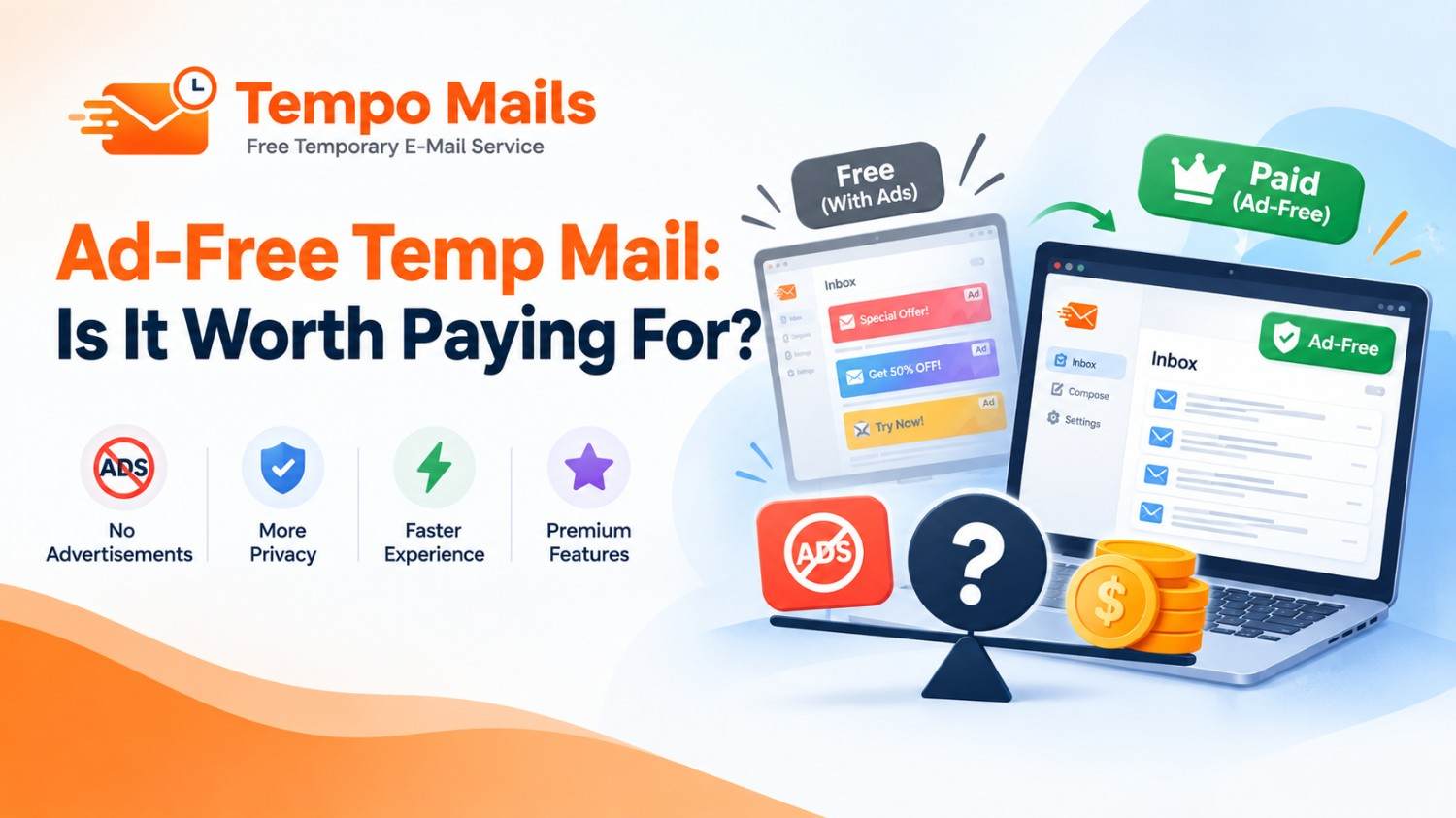
Quick Answer: Temp mail without ads exists in two forms. Free services keep advertising minimal by design. Premium tiers charge to remove ads entirely. Whether paying is worthwhile depends on usage frequency and how much ads affect the inbox experience. For most everyday use cases, a well-designed free option provides enough functionality without a premium investment. Users can generate a free temporary email address in seconds to see exactly how much, or how little, advertising affects the experience firsthand. Last Reviewed: September, 2026
Most disposable email services monetize their free tier through advertising. Some place ads around the inbox interface. Others require ad interaction before inbox content loads.
A small number of services, including Tempomails, keep the interface minimal. Ads therefore do not meaningfully disrupt the experience. For background on how these tools work in general, see the disposable email address overview on Wikipedia.
Understanding each model helps users evaluate their options. It also shows whether premium temp mail is justified or a clean free option is sufficient.
Mandatory ad interactions that appear before content loads are a well-documented source of user drop-off across web tools generally.
When this kind of interruption sits between a user and a time-sensitive task, such as retrieving a verification code, even a short delay can cause the task to fail outright.
Main Points
- Temp mail without ads is available both free and paid; the distinction is whether the free version's ad placement actually disrupts the inbox workflow.
- Ad-free temporary email through a paid premium tier typically bundles additional features like extended retention, mobile apps, and API access alongside the ad removal.
- Private disposable email through a zero-collection architecture provides stronger privacy than ad-supported services that may use advertising analytics to build session profiles.
- Tempomails provides a minimal, low-interruption experience without requiring payment, making it a practical temp mail without ads option for users who need clean inbox access without a premium subscription.
What Ads in Temp Mail Actually Look Like
The impact of advertising on disposable email services varies significantly by how and where ads appear. For context on what a clean inbox experience looks like without any of this friction, see how instant, ad-free inbox access works.
Non-intrusive placement
Banner ads may appear at the top or bottom of the page without obstructing the inbox. They do not require interaction. Users can still read messages and click verification links without interruption.
Sidebar advertising
Display ads alongside the inbox that reduce screen space but do not block content. Manageable on desktop but more disruptive on mobile where screen real estate is limited.
Interstitial ads
Full-page or overlay ads that appear before the inbox loads or when generating a new address. These require dismissal before the user can access inbox content, a meaningful interruption when waiting for an OTP that expires quickly. This is the exact failure point covered in avoiding OTP delays during time-sensitive sign-ups.
Ad networks tracking users
Some free ad-supported temp mail services embed advertising networks that collect session data, browser fingerprints, and behavioral signals. This partially contradicts the privacy purpose of using a disposable email in the first place.
Premium Temp Mail: What Paying Actually Gets You
Premium tiers on disposable email services rarely offer ad removal as a standalone purchase. It is typically bundled with a feature set that includes:
- Extended inbox retention beyond the standard session or 24-hour window
- Mobile app access with push notifications
- Custom domain support for branded disposable addresses
- API access for developer integrations
- Priority customer support
For users who need any of these capabilities, the premium tier may be worth evaluating on feature grounds regardless of the ad removal component. For users whose only complaint is the advertising, the value calculation is narrower.
When Free Temp Mail Without Ads Is Already Available
Not every free disposable email service relies on aggressive advertising to fund operations. Services with minimal infrastructure, using session-based deletion rather than database storage, no account management system, and no app maintenance overhead, can sustain a clean free experience without requiring advertising revenue at the same scale as feature-heavy platforms.
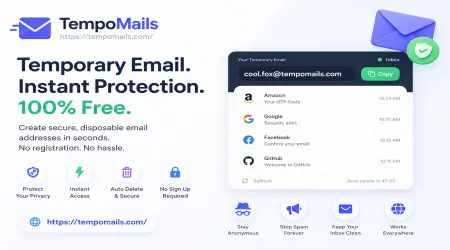
Tempomails operates on this model. The interface is minimal. No ad interaction is required before inbox access. No interstitial appears between address generation and message display. You can try the free temp mail generator to see this in practice, and for a closer side-by-side look, how Tempomails compares to other temp mail tools covers the speed, privacy, and interface differences in detail.
The private disposable email experience is available without payment because the architecture is deliberately lightweight.
For users whose primary concern is inbox clarity and speed rather than extended features, this approach delivers ad-free temporary email without the premium tier cost.
Privacy Consideration: Ad Networks in Free Services
One factor that makes ad-supported temp mail genuinely problematic for privacy-conscious users is not the visual disruption of the ads; it is the data collection that powers them.
Advertising networks embedded in free web tools typically collect:
- IP addresses and approximate location data
- Browser type and version fingerprint
- Session duration and interaction patterns
- Cross-site behavioral data for targeting purposes
For a service used specifically to avoid submitting real personal data to websites, having advertising infrastructure collect that same data through the temp mail interface itself is a meaningful contradiction. This is part of why people choose disposable email addresses in the first place -- avoiding exactly this kind of data exposure. Private disposable email that genuinely protects privacy should not introduce new data collection vectors through its own advertising systems.
Services that operate without advertising infrastructure and therefore without advertising network data collection provide a structurally cleaner privacy posture than ad-supported alternatives, regardless of whether those alternatives offer a paid tier to remove the ads.
Comparison: Free Ad-Supported vs Free Ad-Minimal vs Paid Premium
Factor | Ad-Supported Free | Ad-Minimal Free (Tempomails) | Paid Premium |
Cost | Free | Free | Monthly or annual fee |
Ad interruption | Present | Minimal | None |
Ad network tracking | Likely | None | None |
Extended retention | No | Session-based | Yes |
Mobile app | No | Yes -- Android app available | Yes |
Custom domain | No | No | Yes |
API access | No | No | Yes |
Privacy architecture | Varies | Session-memory | Varies by provider |
Is Paying for Premium Temp Mail Worth It?
The honest answer depends entirely on the use case.
- Pay for premium if: The workflow requires extended inbox retention across multiple days, mobile app push notifications are a functional need, API integration for development testing is required, or custom domain support is necessary for business use.
- Choose a free ad-minimal service if: The need is one-time or occasional verification, inbox access through a browser is sufficient, and session-based deletion provides adequate retention for the typical use case.
- Avoid ad-supported services with intrusive placement if: Time-sensitive OTP retrieval is a regular use case; interstitial ads that delay inbox access by even 10 to 15 seconds create timing failures when verification codes have short expiry windows.
Industry patterns around SaaS trial conversions consistently show that a large share of users who upgrade to a premium tier for a single feature end up reverting to the free version once that immediate need is met, since most everyday temp mail use cases don't require the extra functionality long-term.
Conclusion
Temp mail without ads is not exclusively a premium feature. The right free service delivers a clean, minimal experience without intrusive advertising by keeping the infrastructure simple enough to sustain without significant ad revenue. Ready to try it? Generate your free disposable email now and see the difference an ad-minimal inbox makes.
For users who need extended features beyond one-time inbox access, premium temp mail offers genuine value. For everyone else, an ad-minimal free service like Tempomails provides private disposable email without interruption or cost.
About the Author
Sarah Mitchell, Content Strategist at Tempomails, evaluates disposable email business models, ad placement impact on verification workflows, and privacy architecture across free and premium temporary email services. Content is reviewed and updated regularly.
(FAQs)
Is there a truly free temp mail without ads?
Yes. Services with lightweight infrastructure, like Tempomails, can provide minimal or no ad interruption without charging a premium. Their operational costs may be lower than those of feature-heavy platforms. Those platforms may rely on advertising revenue for app development and database infrastructure.
Do ad networks in free temp mail services track users?
Many do. Advertising networks embedded in free tools typically collect session data, browser fingerprints, and interaction patterns. This creates a privacy contradiction for services used specifically to avoid data collection.
What does a premium temp mail subscription typically include?
Extended inbox retention, mobile app access, custom domain support, API access, and ad removal are the most common premium tier components. Ad removal alone is rarely offered as a standalone purchase.
Does Tempomails show ads?
Tempomails keeps its interface minimal. No interstitial ads appear before inbox access, and no ad interaction is required to generate an address or read incoming messages.
Is premium temp mail worth it for one-time verifications?
Generally, no. One-time verifications are the core use case for free temp mail services. Premium features such as extended retention and mobile apps may add value for recurring or professional use. They are less useful for occasional, single-session verification tasks.
Can ad-supported temp mail affect OTP timing?
Yes. Interstitial ads that must be dismissed before the inbox appears can take 10 or 30 seconds to appear, which can lead to OTP failure on apps that have a small window for OTPs to appear.
What is private disposable email and how does it differ from regular temp mail?
Private disposable email refers to services that combine disposable inbox functionality with zero advertising network data collection. The privacy guarantee covers both the email address submitted to external platforms and the session data generated while using the temp mail service itself.
How do I know if a free temp mail service uses ad network tracking?
Look for advertising partners, third-party analytics, and data collection of a behavioral nature in the privacy policy. However, you may prefer to use a browser extension to identify and list active third-party scripts. Any advertising network scripts loading on the temp mail page indicate tracking is in use.
Related Resources
For more on getting the most out of a clean, ad-minimal inbox, explore Tempomails' free temp mail generator, read about using temp mail for forums and free trials, or get a free disposable email address whenever you need one.