
Temp Mail for Marketers: Testing Email Campaigns Safely
Quick Answer: Temp mail for marketers provides a clean, isolated inbox for testing email campaigns before they reach real subscribers. Marketers use disposable email addresses to verify subject lines, rendering, link functionality, and deliverability. This prevents test messages from polluting real contact lists or distorting production campaign analytics.
Every email campaign contains elements that require verification before sending. These include subject line display, HTML rendering, link functionality, personalization tokens, and unsubscribe mechanisms.
Testing these with a real inbox creates noise in open-rate analytics, adds unwanted test contacts to live lists, and clutters the marketer's primary email with campaign test messages.
Temp mail for marketers solves all three problems simultaneously by providing a clean, isolated inbox for every test send that disappears automatically when testing is complete.
Industry research on email deliverability consistently shows that campaigns which go through multiple pre-send test cycles perform better on click-through and inbox placement than campaigns sent without structured testing, reinforcing why systematic email campaign testing matters before a send goes live.
Main Points
- Temp mail for marketers creates isolated test inboxes. These inboxes prevent campaign test messages from distorting real subscriber analytics.
- Marketing email verification through disposable addresses catches common campaign errors. These include rendering issues, broken links, and personalisation failures. Problems can be identified before emails reach paying subscribers.
- Temporary email testing eliminates fake contact accumulation in CRM systems from repeated internal test sends.
- Tempomails provides instant disposable inbox generation with no registration, making it practical for fast-moving campaign testing workflows.
Why Marketers Need Disposable Inboxes for Campaign Testing
The Problem With Real Inboxes for Testing
Using a personal or shared team inbox for email campaign testing creates three compounding problems. Test sends inflate open and click metrics in marketing platforms. When a marketer opens a test email in their monitored inbox, that open registers as a data point.
Across dozens of test cycles, these false positives distort deliverability reporting and segment performance data. Real inboxes accumulate test messages.
A campaign that goes through ten revision cycles generates ten test emails in the same inbox, creating clutter that makes locating the latest version unnecessarily difficult.
Test contacts enter the CRM. Every test send to a real address creates a contact record in most marketing automation platforms.
These accumulate over time into a dataset of internal test addresses that skews list hygiene metrics and requires periodic manual removal.
What Temporary Email Testing Solves
Each test cycle uses a fresh temporary email address. The address has zero prior history, receives only the messages from the current test send, and deletes automatically when the session ends. The workflow avoids false metrics and CRM accumulation. It also keeps the inbox free from unnecessary clutter.
Specific Marketing Testing Use Cases
Subject Line and Preview Text Verification
Marketers test how subject lines and preview text appear across different email clients before finalising campaign copy. A temp mail address receives the test send and displays it in the Tempomails inbox exactly as an external recipient would see it, without the test message entering any monitored inbox that would record a false open.
HTML Rendering Checks
Campaign templates must render correctly across multiple email clients, including Gmail, Outlook, Apple Mail, and mobile clients. Sending test versions to Tempomails addresses verifies rendering outcomes in each client without accumulating test sends in a shared team inbox.
Link and UTM Parameter Verification
Every link in a campaign must route to the correct destination with accurate UTM parameters. A Tempomails inbox receives the campaign, the marketer clicks each link to verify routing, and the session expires without any of those test clicks registering in the campaign's conversion analytics.
Personalization Token Testing
Campaigns using first name, company name, or dynamic content tokens must be tested with addresses that trigger the personalization logic correctly. A Tempomails address used as a test contact in the CRM verifies that tokens populate correctly without creating a permanent fake contact record.
Unsubscribe Mechanism Testing
Unsubscribe links must function correctly before any campaign sends to a live list. Testing with a Tempomails address allows the marketer to click the unsubscribe link, verify the opt-out page, and confirm the mechanism works without removing any real subscriber from the list.
Marketing Email Verification Workflow
A practical temporary email testing workflow for marketing teams follows a consistent pattern regardless of the platform or campaign type. Generate a fresh Tempomails address at the start of each test cycle.
Add it as a test contact in the marketing automation platform. Trigger the test send. Check the Tempomails inbox to verify subject line display, HTML rendering, link functionality, and personalization output.
Make any required changes. Repeat with a new Tempomails address for the next test cycle. Close the Tempomails tab when testing is complete. The address and all messages are deleted automatically.
This pattern works across Mailchimp, HubSpot, Klaviyo, ActiveCampaign, and any other platform that allows manual test sends to specified addresses. Teams scaling this into continuous integration pipelines can find complementary guidance in our breakdown of temp mail for QA and automated testing teams and our overview of the best temp mail API for developers.
How Tempomails Fits Into the Marketing Workflow
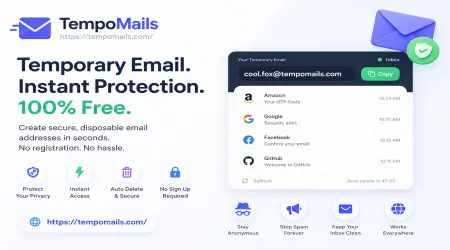
Tempomails generates a working inbox the moment the site loads at tempomails.com. No registration, no configuration, no personal data required. The marketer copies the generated address, pastes it into the marketing platform's test send field, triggers the send, and returns to Tempomails to view the result. Marketers who need a dedicated branded address for recurring test cycles can review Temp Mail with Custom Domain: Why It Matters for domain-level options, and the inbox is also available as an Android app on Google Play for checking test sends on the go.
The inbox displays full HTML email content including images, formatted layouts, and clickable links, exactly as they appear to external recipients. When the test cycle is complete and the tab closes, every test message is gone automatically.
Marketing teams that adopt isolated test inboxes for pre-send verification generally report fewer campaign errors than teams relying on shared internal addresses for testing, largely because isolated testing eliminates the metric distortion that false internal opens introduce into deliverability assessments.
What Temp Mail for Marketers Does Not Replace
Disposable email for campaign testing handles the individual inbox verification step. It does not replace dedicated email testing platforms like Litmus or Email on Acid. Those platforms can render previews across dozens of clients simultaneously. It does not provide spam score analysis or deliverability auditing.
Temp mail for marketers works best as a lightweight, zero-configuration tool for fast send verification between revision cycles, complementing rather than replacing more comprehensive testing tools for final pre-send quality checks.
Conclusion
Temp mail for marketers converts campaign testing from a metric-distorting, CRM-polluting process into a clean, isolated workflow that leaves no trace. Each Tempomails session provides a fresh inbox for one test cycle, automatic cleanup when done, and zero impact on live campaign analytics.
For marketing teams running frequent campaign revisions, temporary email testing is the simplest improvement to the pre-send quality process available.
Ready to run your next campaign test without touching a single real subscriber record? Generate a free disposable email address at Tempomails and send your next test cycle in seconds.
About the Author
Elena Vasquez is a martech consultant who has spent the past several years helping marketing operations teams build pre-send QA processes for email campaigns. Her work focuses on campaign testing workflows, deliverability hygiene, and inbox verification practices for marketing automation platforms. Editorial disclosure: this article was independently researched and reviewed by the Tempomails editorial team against current platform behavior, and is updated as testing workflows and marketing platforms evolve.
FAQs
Why not just use a personal inbox for email campaign testing?
Personal inboxes register false opens and clicks in campaign analytics, distort deliverability metrics, and accumulate test messages that make finding the latest version unnecessarily difficult.
Can I use the same Tempomails address for multiple test sends?
Within the same active session, yes. Once the tab closes, the address expires permanently. Open a new session with a fresh address for each separate test cycle.
Does clicking links in a Tempomails inbox affect campaign analytics?
No. Link clicks in Tempomails do not register in the marketing platform's conversion tracking because the test address is not a tracked subscriber in the active campaign.
How quickly does a test email arrive in Tempomails?
Test messages typically arrive within 10 to 20 seconds of the send being triggered. The inbox refreshes automatically. No manual reload is needed to see the incoming message.
Can Tempomails verify personalization tokens in campaign emails?
Yes. Add the Tempomails address as a test contact with the required field values in the CRM. The campaign sends to it with populated tokens exactly as it would to a real subscriber.
Does using Tempomails for testing create CRM records?
Only if the marketer manually adds the Tempomails address as a contact in the CRM for token testing. Since the address expires, the record becomes an inactive contact that can be deleted after testing is complete.
Is Tempomails suitable for testing transactional emails as well as campaigns?
Yes. You can test welcome emails, order confirmations, password resets, and other triggered transactional messages using a Tempomails address through the same workflow as campaign testing.
Does Tempomails display images in HTML emails correctly?
Yes. Tempomails renders full HTML email content, including embedded images, formatted layouts, and styled text, so you see how the campaign appears to external recipients.