Temp Mail vs Real Email: When to Use Which (Business Use Cases)
Quick Answer: Temp mail vs real email is not a competition. Each serves a different online purpose. Disposable email addresses support verification, testing, and private signups. Real email handles billing, recovery, compliance, and ongoing business communication. Matching the right tool to each situation protects both the inbox and the account simultaneously. Businesses that want to see this in practice can get a free disposable email address and try it on their next one-time signup.
Every business professional submits an email address dozens of times per week: platform trials, research tools, webinars, vendor signups, and newsletter access. Each submission using a real email adds one more data point to systems that collect, share, and sometimes breach it.
Temp mail vs real email is a decision that shapes the cumulative inbox exposure of every business user over time. Choosing the right option reduces spam and protects business email security. It also keeps the primary inbox free for important communication.
Industry email-volume research consistently shows that business professionals now receive well over 100 emails per day, with a substantial share classified as promotional or unsolicited, much of it traceable to voluntary email submissions made during platform and service registrations.
Key Points
- Temp mail vs real email decisions made consistently across business interactions reduce total email exposure and protect business email security from phishing and breach risks.
- Disposable email addresses are appropriate wherever the interaction is one-time, evaluation-based, or does not require ongoing communication to deliver business value.
- Real email is non-negotiable for financial platforms, compliance communications, client relationships, and any account requiring recovery access or billing management.
- Tempomails provides instant disposable address generation for business users with no registration, no cost, and no impact on the primary email identity. The service is also available as a free Android app for generating addresses on the go.
The Business Case for Disposable Email
Why Business Email Security Depends on Limiting Exposure
Every platform holding a real business email address is a potential breach source. A breached business email creates risks beyond inbox spam; it enables phishing attacks that impersonate known brands, credential stuffing against other business accounts using similar passwords, and social engineering attempts that reference the breached platform to appear credible.
A disposable email address submitted instead carries none of these risks. When the platform is breached, the Tempomails address in the database links to nothing: no name, no company, no other account, no active inbox. The breach produces no usable attack surface against the business user. Businesses can generate a disposable email address in seconds whenever a new platform asks for a signup.
Temporary Email Use Cases for Business Professionals
Vendor and Tool Evaluation
SaaS platforms, analytics tools, project management software, and productivity applications all require email registration before the product can be evaluated. Most trigger marketing sequences from the first session.
A disposable email address used during the evaluation phase protects the business inbox from follow-up campaigns for tools that do not pass the evaluation. Teams comparing providers can also check this roundup of the best temp mail services in the US for a broader evaluation checklist.
Webinar and Event Registration
Industry webinars, virtual conferences, and educational events require email registration that immediately adds the user to the organiser's marketing list. For events attended out of professional obligation rather than genuine interest in the organiser's ongoing content, a Tempomails address completes the registration without creating a permanent marketing relationship.
Research and Content Access
Industry reports, market research, and gated content require email submission to access. The content itself may be valuable; the newsletter subscription triggered by accessing it is not. A disposable email address retrieves the download link and expires before any follow-up sequence begins.
Competitor Research
Business professionals monitoring competitor platforms, reviewing competitor pricing pages, or evaluating competitor products for strategic intelligence purposes benefit from disposable email that keeps their real identity out of the competitor's user database and CRM.
Automated Testing and Development
Development teams testing registration flows, email delivery systems, and notification logic in business applications use disposable email addresses to generate clean test accounts without populating production databases with fake contact records. A closer look at temp mail for QA and automated testing teams covers how teams isolate inboxes across parallel test environments.
Real Email Use Cases Where Disposable Is Wrong
Financial Services and Billing
Any account linked to payments, subscription billing, or financial transactions requires a permanent business email. Billing confirmations and receipts need a monitored inbox. The same applies to renewal alerts and payment failure notifications. This helps prevent unexpected service interruptions.
Client-Facing Communication
Client relationships depend on consistent, recoverable contact points. Business email used in client communication must be permanent, professional, and linked to an account the client can reliably reach.
Compliance and Legal Communication
Regulatory notifications, data breach disclosures, and legal correspondence require permanent email access. Compliance-related communications also need reliable access for documentation and response timelines. A disposable address may expire before a compliance notification arrives. This can create a liability gap.
Account Recovery Dependencies
Any business platform where account recovery or password reset depends on the registered email must use a permanent address. Key business tools where losing access would disrupt operations, CRMs, project management platforms, cloud storage, and communication tools require recoverable email registration.
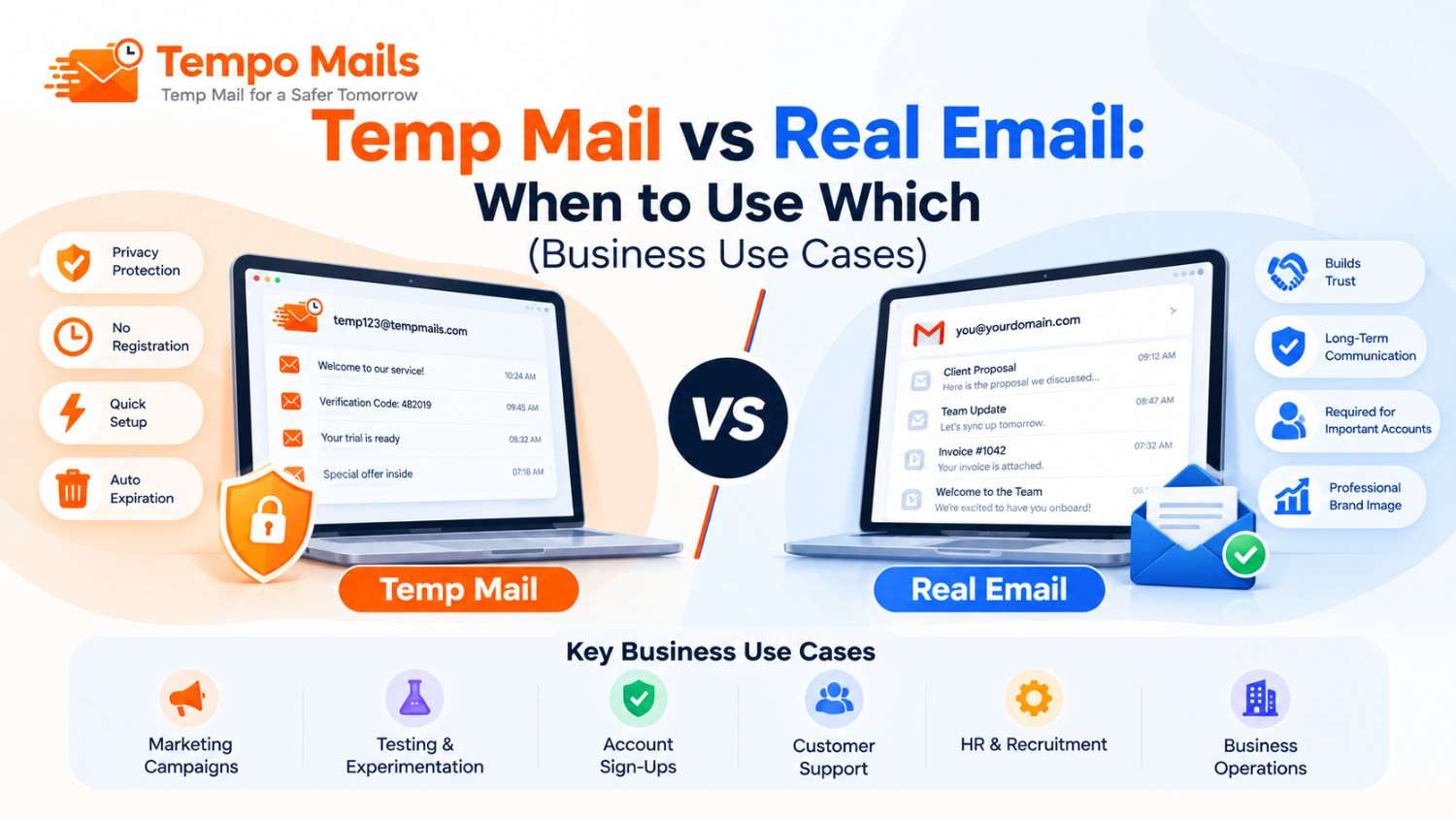
Decision Framework: Temp Mail vs Real Email for Business
Interaction Type | Use Temp Mail? | Use Real Email? |
SaaS tool free trial | Yes | No |
Vendor evaluation | Yes | No |
Webinar registration | Yes | No |
Gated content download | Yes | No |
Competitor research | Yes | No |
QA and testing accounts | Yes | No |
Subscription billing | No | Yes |
Client communication | No | Yes |
Compliance notifications | No | Yes |
Account recovery-dependent platforms | No | Yes |
Key business tools | No | Yes |
The Hybrid Approach for Business Users
The most effective business email security strategy uses three tiers rather than two.
- Primary business email for client relationships, billing, compliance, and any platform where account access is business-critical.
- Secondary permanent email for subscriptions and ongoing professional communications where marketing contact is acceptable but the primary inbox should remain clean.
- Tempomails for all one-time evaluations, research access, event registrations, testing, and any platform interaction where ongoing email contact offers no business value. Teams can start a free temporary email session the moment this tier applies.
This three-tier structure reduces the primary email's breach exposure surface, keeps the secondary email organised around intentional subscriptions, and handles everything else through disposable addresses that leave no permanent data trail.
Broader cybersecurity research consistently identifies compromised or exposed email addresses as a significant contributor to business breach exposure, with addresses submitted during vendor and platform evaluations flagged as a commonly underestimated source of corporate risk.
Conclusion
Temp mail vs real email for business reduces to one question: does this interaction require ongoing email access to deliver value? If yes, use real email. If no, use Tempomails. Applied consistently across business interactions, this distinction reduces inbox exposure, protects business email security, and keeps the primary email address reserved for communication where availability, continuity, and recovery access genuinely matter. Ready to put the framework into practice? Generate a free temporary email address now and keep the next one-time signup out of the primary inbox.
About the Author
Sarah Whitfield is a business technology analyst with over 8 years of experience covering business email security, SaaS procurement practices, and data privacy for small and mid-sized business teams. Her work focuses on practical decision frameworks that operations and IT teams can apply directly, including disposable email address applications in professional contexts and temp mail vs real email decision frameworks for business users and enterprise teams.
Editorial Disclosure: This article was reviewed against Tempomails' editorial standards for accuracy and practical relevance before publication.
(FAQs)
Can business professionals use temp mail without violating platform terms?
Most platforms require a valid working email. A Tempomails address satisfies this at registration. Specific terms vary by platform and should be reviewed for high-stakes business tool signups. Reviewing the domain is simple — open the temporary email generator and check the address format before submitting it to a new platform.
Does using Tempomails for vendor evaluation affect the evaluation experience?
No. The trial account functions identically regardless of email type. Marketing follow-up is eliminated, which improves rather than impairs the evaluation process.
What is the business email security benefit of using temp mail for competitor research?
The competitor's CRM contains a Tempomails address rather than the researcher's real business email, preventing targeted competitor marketing and removing the research activity from any potential data breach exposure.
Can a business use Tempomails for QA testing across multiple environments?
Yes. Each browser tab generates an independent address. Multiple environments can run simultaneously using separate addresses with fully isolated inboxes and no session cross-contamination.
Is there a risk that a webinar platform blocks Tempomails addresses?
Some platforms maintain domain blocklists. Tempomails' domain rotation provides fresh addresses in new sessions, resolving most blocking scenarios without requiring a real email submission. For platforms that need extra reliability, a custom domain temp mail setup offers more control over inbox exclusivity and platform compatibility.
How does the three-tier email strategy improve business email security?
It limits how many platforms hold the primary business email address, reducing the breach exposure surface. Fewer platforms with the real email means fewer independent breach risks that could expose the primary account.
Does Tempomails work for international business platform registrations?
Yes. Tempomails generates standard-format addresses accepted by platforms globally. No geographic restriction affects address generation or inbox delivery performance.
What happens to business data submitted alongside a Tempomails address during platform registration?
The email expires, but other data submitted name, company, role may remain in the platform's database. Only the email data point loses its contact value when the Tempomails address expires.