Tempomails vs Temp-Mail.org: Which Is Better?
Quick Answer: Choosing the right temp mail alternative depends on what matters most: privacy architecture, delivery speed, domain compatibility, or ease of use. Tempomails and Temp-Mail.org both provide disposable inboxes with no registration required, but they differ in session data handling, domain rotation, and platform compatibility. This comparison breaks down every category that affects real-world performance, so you can pick the service that actually fits your use case.
Temp-Mail.org is one of the most widely recognized temporary email providers globally, while Tempomails is a fast-growing temp mail alternative focused on instant inbox generation and session-based privacy.
Both services protect your real inbox during online registrations. However, they use different architectures and features that affect daily usability. This temp mail comparison covers both platforms honestly across every category that matters.
Disposable email adoption has grown steadily as more people look for quick, no-signup ways to avoid spam and protect their primary inbox during one-time registrations, with delivery speed and domain compatibility consistently ranking among the top factors users weigh when choosing a service.
Main Points
Both Tempomails and Temp-Mail.org provide instant, free temporary email addresses with no registration required.
Temp-Mail.org offers additional access options, such as a mobile app and browser extension. Tempomails focuses on a streamlined, no-configuration web experience and also offers its own free Android app for on-the-go access.
Domain compatibility varies between services; domain rotation strategies directly determine how often addresses are blocked by websites during registration.
Privacy architecture differs: understanding what each service retains after the session ends is the most important factor for users prioritizing anonymity.
Overview: Tempomails vs Temp-Mail.org
Tempomails
Tempomails is a browser-based disposable email service. It generates an address instantly on page load with zero registration. The service runs on session memory: the inbox is available only while the browser tab stays open, and once the session ends, all content is cleared.
No personal data is collected or stored by Tempomails at any point. The interface is simple and fast, and it works on any device through a browser. For users who prefer app-based access, Tempomails also offers a free Android app on Google Play, alongside its core browser tool — you can generate an address instantly with this free disposable email generator directly from any device.
For a closer look at what sets it apart from other providers, see this comparison of Tempomails against other temp mail services.
Temp-Mail.org
One of the most popular temporary email providers is Temp-Mail.org. It has a web interface, iOS and Android mobile apps, and a browser extension.
It provides a longer inbox lifespan than pure session-based services and supports address regeneration within the same session.
The platform serves a high volume of daily users globally and maintains a recognizable multi-domain pool.
Temp Mail Comparison: Feature by Feature
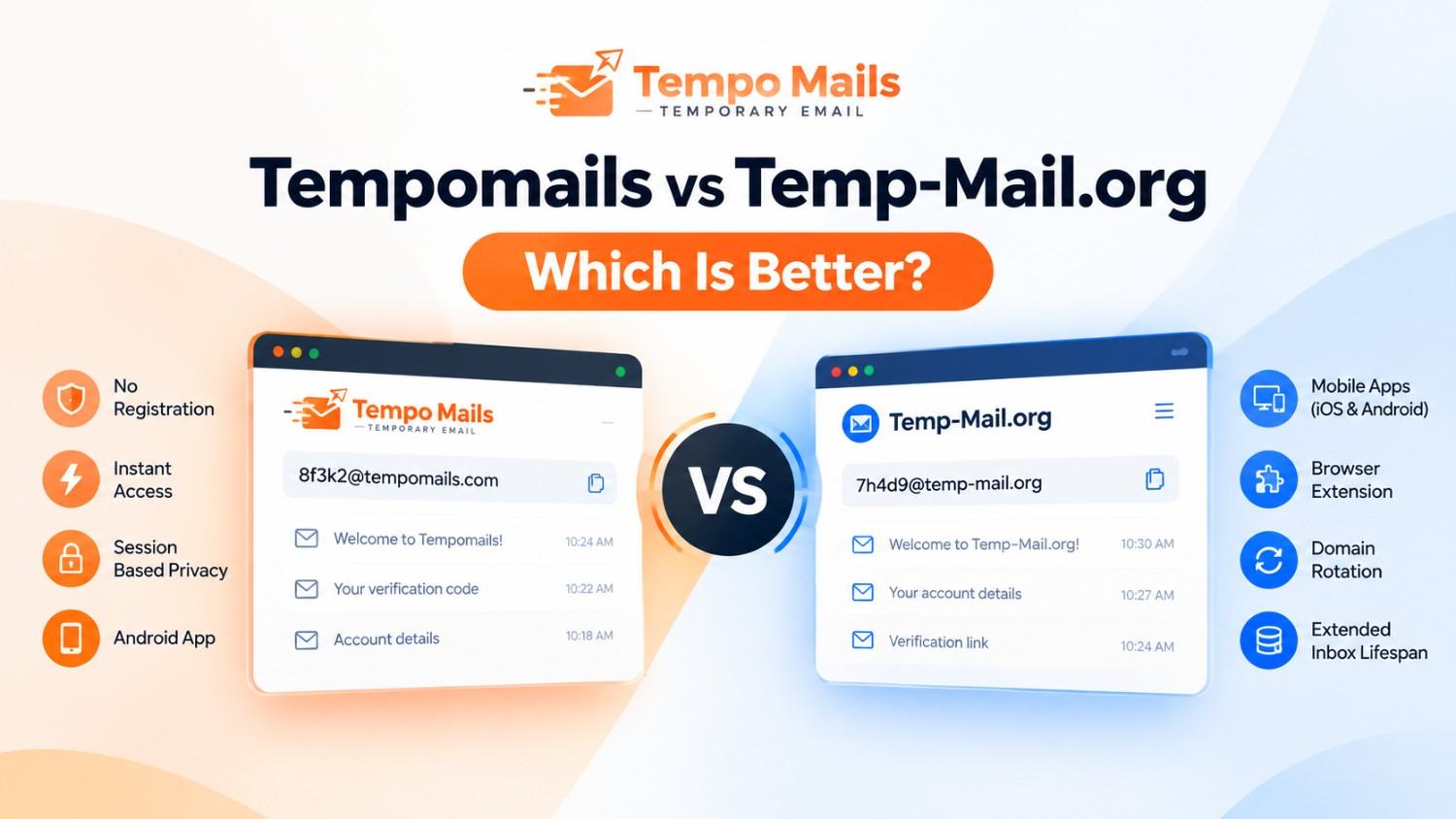
Feature | Tempomails | Temp-Mail.org |
Registration required | None | None |
Inbox generation speed | Instant on page load | Instant on page load |
Session duration | Browser tab open | Extended beyond session |
Mobile app | Yes, free Android app on Google Play | Yes, iOS and Android |
Browser extension | No | Yes |
Domain rotation | Yes | Yes |
Privacy architecture | Session memory; no persistent storage | Database storage with deletion policy |
Data retained after session | None | Varies by session type |
Cost | Free | Free with optional premium |
Ads in interface | Minimal | Present in free version |
Privacy Architecture: The Most Important Difference
For users where privacy is the primary reason for using a temp mail alternative, the storage model is the most significant differentiator. Tempomails holds messages in session memory.
When the browser tab closes, all data clears architecturally — no persistent database record exists that could be breached, subpoenaed, or retained after deletion. The privacy guarantee is structural.
Temp-Mail.org writes messages to database storage and applies a deletion policy after a defined period. The privacy guarantee is policy-based: data exists in persistent storage until the scheduled deletion runs, meaning a breach during that window could expose message content.
For users receiving low-sensitivity verification emails, this distinction may be acceptable. For users prioritizing strict anonymity, Tempomails' session-memory model — available as a free session-based temporary email service — provides the stronger guarantee.
Domain Compatibility
Both services maintain rotating domain pools to reduce blocklist exposure. Temp-Mail.org has a larger established domain network due to its longer market presence, which can provide broader initial compatibility across platforms.
Tempomails' rotation strategy keeps fresh domains available in each session, addressing the core problem that older, well-known domains face on aggressive blocklisting platforms.
In practice, both services encounter occasional blocking on platforms with comprehensive validation systems, and both resolve it the same way: by generating a new address in a fresh session. Users who need more control over their sending domain can also check whether Tempomails supports custom domain options for disposable addresses.
Ease of Use
Tempomails offers a simpler experience for users who want instant inbox access in a browser, with no downloads, no extensions, and no optional accounts to consider.
Temp-Mail.org offers more access options — app, extension, and web — which adds convenience for users who want inbox access across multiple environments without opening a browser.
Users who prefer a single-window, distraction-free experience may find the added options unnecessary. Tempomails keeps that experience simple, while still offering its Android app for anyone who wants app-based access alongside the browser tool.
Which Is the Best Disposable Email Service for Your Needs?
Pick Tempomails for the cleanest setup and the most privacy-focused architecture. It also provides a browser-based experience without extra apps or extensions required for core use.
Choose Temp-Mail.org if extended inbox lifespan, mobile app access, or browser extension integration are functional requirements that justify the added interface complexity and database-based storage model.
For pure one-time verification use cases — the majority of everyday disposable email needs — Tempomails' session-based model is the more privacy-protective and operationally simpler best disposable email service option. If speed is your main concern, this breakdown of which temp mail service feels fastest in real use is worth checking before you decide.
Independent reviews of temporary email tools consistently point to the same pattern: architecture-based deletion — where data is never written to a persistent database in the first place — offers a stronger, more verifiable privacy guarantee than policy-based deletion, which depends on a scheduled process running correctly after the fact.
Conclusion
Tempomails and Temp-Mail.org are both legitimate temporary email providers that serve the core disposable inbox use case well. The difference comes down to depth: Temp-Mail.org offers more access methods and a longer inbox lifespan, while Tempomails delivers stronger privacy architecture and a simpler experience.
For anyone looking for a temp mail alternative without the extra features layered on top of the privacy fundamentals, Tempomails is the cleaner, more private choice for everyday use.
Ready for a Faster, More Private Temp Mail Alternative?
Every extra step between you and a working inbox is friction you don't need for a one-time signup. Tempomails skips the registration, skips forced app installs, and skips long-term data retention — you get a working address the moment the page loads, and nothing is left behind when the session ends.
Generate a free temporary email address now, or grab the Tempomails Android app on Google Play if you'd rather work from your phone.
About the Author
Written by Sarah Whitfield, Senior Content Strategist, Tempomail Editorial Team. Sarah specializes in disposable email tools and online privacy, researching platform-specific verification behavior and testing inbox compatibility across major services. This comparison is based on Tempomails' direct testing of both platforms and publicly available information about Temp-Mail.org; features and pricing can change, so readers should confirm current details on each provider's site before choosing.
Editorial Disclosure: Tempomails operates this website. This comparison aims to be accurate and evidence-based, but readers should be aware of Tempomails' business interest in the outcome.
(FAQs)
Is Tempomails or Temp-Mail.org better for privacy?
Tempomails provides stronger privacy through session-memory architecture; no data persists after the tab closes. Temp-Mail.org uses database storage with a deletion policy, meaning data exists in persistent storage until scheduled removal runs.
Does Temp-Mail.org have a mobile app?
Yes. Temp-Mail.org offers iOS and Android apps. Tempomails also has a free Android app, in addition to working fully through any mobile browser without installation.
Which service has better domain compatibility?
Both rotate domains to reduce blocklisting. Temp-Mail.org has a larger established domain network. Tempomails' rotation keeps fresh domains available in each session. Both face occasional blocking on aggressive validation platforms.
Is Tempomails completely free?
Yes. Tempomails is free with no premium tier, no ads blocking inbox access, and no payment required for any core functionality.
Can I use both services for different situations?
Yes. Tempomails works best for single-session, privacy-sensitive verifications. Temp-Mail.org works better when extended inbox access or mobile app use is needed.
Does Temp-Mail.org collect personal data?
Temp-Mail.org's free tier requires no registration. However, its database storage model retains message content until the scheduled deletion period ends. Tempomails retains nothing after the session ends.
Which is faster for receiving verification codes?
Both deliver messages quickly under normal conditions. Tempomails' lightweight interface reduces the load time between message arrival and display. Performance varies by network conditions on both services.
Is using a temp mail alternative legal?
Yes. Using any disposable email service for online registrations is legal in all major jurisdictions, including the US, EU, UK, Canada, and Australia.