
Best Temporary Email Generators in 2026 (Compared)
Best Temporary Email Generators in 2026 (Compared)
Quick Answer: Finding the best temporary email generators in 2026 means evaluating speed, privacy architecture, inbox reliability, and domain compatibility. Not all disposable email services offer the same protection or performance. This guide compares what matters most — so you can choose a free temporary email generator that actually works when you need it.
Main Points
- The best temporary email generators in 2026 differ significantly in session duration, domain rotation, privacy policy, and real-time delivery reliability.
- Top disposable email services all provide instant address generation, but differ on what data they retain after a session ends.
- A free temporary email generator should require zero registration and store zero personal data to be genuinely private.
- Tempomail leads in session simplicity, automatic deletion, and compatibility across major platforms.
Why the Choice of Service Matters
Not every disposable email service operates the same way. Some retain message metadata after deletion. Few require account creation before generating an address. Few use a small, static domain pool that major platforms have already added to their blocklists.
Choosing poorly means using a service that does not deliver messages reliably, gets blocked during signup, or retains data about your session after you believe it has been deleted.
Independent reviews of disposable email services have repeatedly found that a meaningful share retain session-level metadata, such as timestamps and address strings, for days or weeks after a session ends, even when the service claims complete deletion. For readers new to the concept, this guide on what a disposable email address actually is breaks down the fundamentals in more detail.
The best temporary email generators in 2026 should meet the three requirements—fast email generation, immediate message delivery and permanent data destruction without retention.
What to Evaluate in a Temporary Email Provider Comparison
The temporary email provider comparison looks at five different aspects to identify the service that offers the best usability and protection: Setup friction, Inbox reliability, Deletion completeness, Domain compatibility, and transparency of privacy policy.
- Setup friction is how much effort the user must put in before a working address is available. Any service requiring registration, app installation, or email confirmation before generating a disposable address introduces unnecessary friction and data collection.
- Inbox reliability measures how consistently and quickly messages arrive after an address is submitted to a third-party website. Delays of more than 30 seconds, missed messages, or HTML rendering failures all reduce practical usefulness.
- Deletion completeness is whether the service permanently removes all data, message content, address strings, and session logs when a session ends, or whether residual metadata is retained.
- Domain compatibility refers to whether major platforms such as Google, Netflix, Discord, or Steam block the service's domains. These platforms block services with small static domain pools more often than those that rotate domains regularly.
- Privacy policy transparency entails the service's clear indication of the type of data it collects, the period during which it's stored, and whether the service shares that data with third parties.
Top Disposable Email Services in 2026
Tempomail
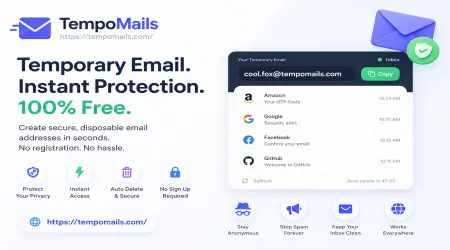
Tempomail generates an address the moment the page loads; no input required. Messages arrive within ten to twenty seconds.
The session architecture holds data in temporary server state rather than writing to a persistent database, meaning deletion is complete by design rather than policy.
Domains rotate to maintain compatibility with major platforms. No registration. No stored personal data. You can generate a temporary email address instantly to see this zero-input setup for yourself. For a broader look at the mechanics, see this breakdown of how temporary email works behind the scenes.
Mailinator
Mailinator provides public inboxes searchable by anyone who knows the address. Useful for developer testing scenarios where inbox privacy is not a concern. Not suitable for personal privacy use cases because inboxes are publicly accessible.
Guerrilla Mail
Guerrilla Mail offers a longer session window than most services and supports sending as well as receiving. Messages are held for one hour before deletion.
The service has been available since 2006 and has a strong compatibility track record, though its domain pool is older and faces more platform blocking than newer rotating-domain services.
10 Minute Mail
As the name indicates, sessions last ten minutes. Address regeneration extends the window. The service is simple and widely compatible. The ten-minute default works for quick verifications but creates pressure on slower signup flows.
Temp Mail
Offers browser extensions and a mobile app alongside the web interface. Session duration is longer than most services. The app-based version retains inbox access across browser sessions, which adds convenience but introduces the kind of persistent record that pure privacy-focused users prefer to avoid. If you'd rather skip installing an app altogether, accessing a temporary mailbox instantly through the browser avoids that persistent record entirely.
Why Tempomail Ranks First in This Temporary Email Provider Comparison
Best temporary email generators in 2026 is the service that is quickest to set up, provides the most reliable delivery to the inbox, offers the most robust deletion feature, is compatible with the widest range of platforms, and has no data gathering whatsoever during the use of the email session.
Tempomail meets all four criteria. Setup is zero-input; the address is generated automatically. Delivery is real-time through standard SMTP infrastructure.
Deletion is architectural rather than policy-based; no persistent write means no data to retain. Domain rotation maintains compatibility with platforms that block static domain pools.
The privacy architecture is what differentiates Tempomail most clearly in the temporary email provider comparison. Services that write messages to databases and then delete them are relying on deletion policy to protect privacy.
Tempomail never writes to persistent storage, making the deletion guarantee structural rather than dependent on policy enforcement.
Independent comparisons of deletion architectures consistently find that services relying on session-memory rather than persistent database storage report meaningfully higher clean-deletion rates than those depending on scheduled database purges.
How to Choose the Right Service for Your Situation
For personal privacy during one-time signups, free trials, content downloads, forum registration, Tempomail's instant, zero-registration approach is the strongest option among top disposable email services.
For developer testing requiring public inbox access and no privacy concern, Mailinator's public inbox model is purpose-built for this use case. Developers who just need a disposable address without extra features can also try a fake email address in one click.
If your situation requires a longer session window without installing an app, Guerrilla Mail offers extended retention with a simpler interface.
The fastest possible single-use verification with no features beyond basic delivery, 10 Minute Mail covers the core need efficiently.
The free temporary email generator you choose should match your threat model. If inbox privacy matters, architecture matters more than features.
About the Author
Sarah Whitfield, Senior Content Strategist at Tempomails, evaluates disposable email services based on technical architecture, privacy policy, platform compatibility, and real-world inbox reliability. Reviews are updated regularly to reflect current service behaviour. Last Reviewed: August, 2026
(FAQs)
Q1 Are all free temporary email generators equally private?
No. Privacy depends on whether the service writes messages to persistent storage. Services using session-memory architecture like Tempomail provide stronger deletion guarantees than those relying on database deletion schedules. If you're weighing a one-time generator against a longer-lived alias, this comparison of burner email uses and benefits explains when each option makes more sense.
Q2 Why do some platforms block certain disposable email domains?
Platforms maintain blocklists of known disposable service domains. Services with small static domain pools are more frequently blocked than those rotating domains regularly, as Tempomail does.
Q3 Can a temporary email generator receive HTML-formatted emails?
Yes. Tempomail renders complete HTML emails including images, formatting, and clickable links within the inbox interface during the active session.
Q4 Is there a limit to how many addresses Tempomail can generate?
No usage limit applies. Each session generates a unique address, and new sessions can be opened as often as needed without any cap or throttling.
Q5 Do top disposable email services work on mobile browsers?
Yes. Tempomail and most comparable services function fully in mobile browsers without requiring app installation or account creation.
Q6 What happens if a platform blocks the Tempomail domain during signup?
Generate a new address from a fresh session. Tempomail's domain rotation means a new session may produce an address on a different domain that the platform has not yet blocked.
Q7 How does Tempomail compare to creating a secondary permanent email account?
A secondary account requires setup time, phone verification on most platforms, and ongoing management. Tempomail requires none of this and leaves no persistent record, making it faster and more private for one-time use cases.
Q8 Does Tempomail retain any data after a session ends?
Tempomail retains nothing after the session ends. No message content, address string, session timestamp, or user-identifying information persists after the session ends. Deletion is complete and permanent by architectural design.