Email History in Temp Mail: How to Recover and Reuse Old Temporary Addresses
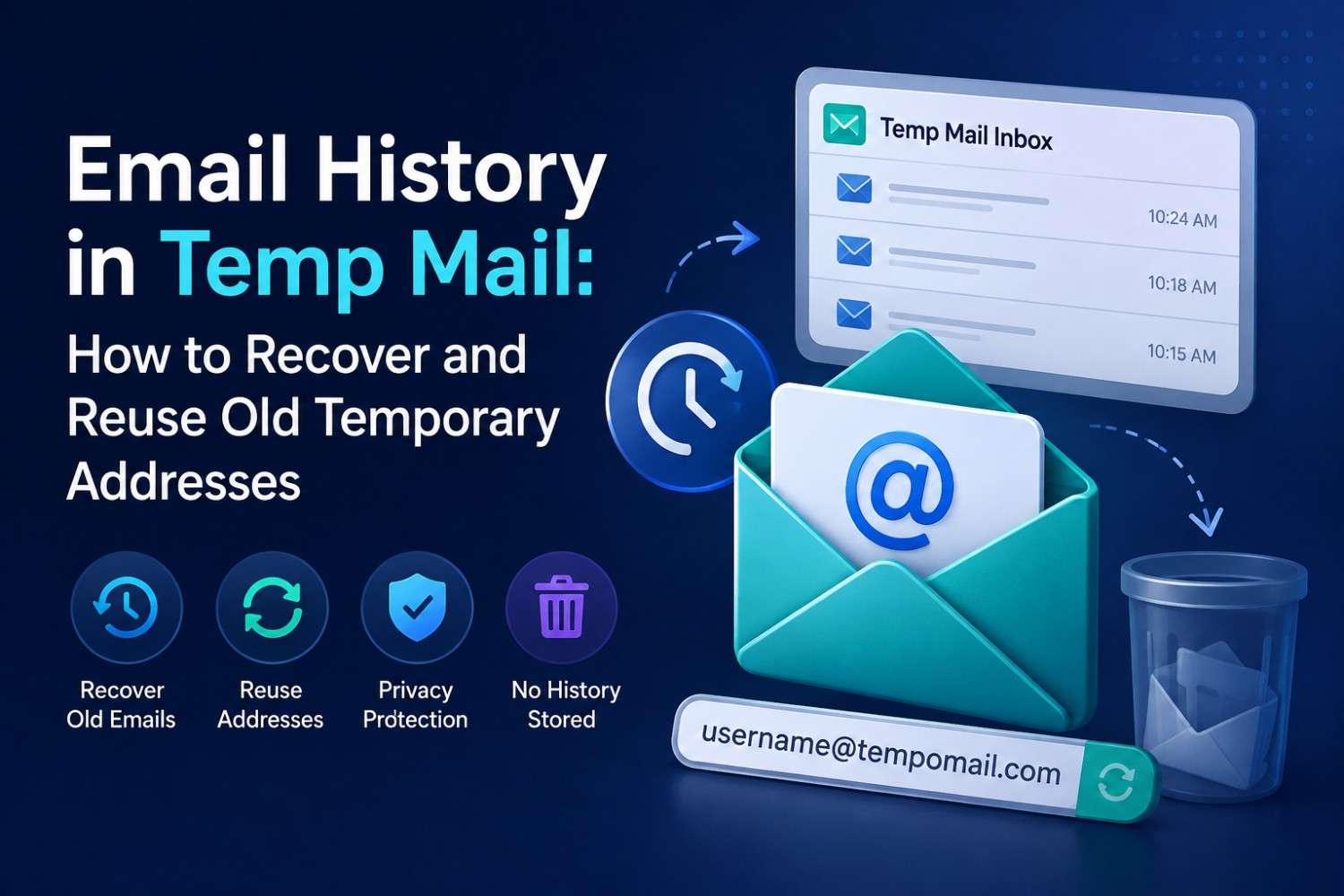
Email History in Temp Mail: How to Recover and Reuse Old Temporary Addresses
Quick Answer: Temp mail does not store email history by design. Once a session ends, the address and all messages are permanently deleted with no recovery option. Understanding this architecture helps users plan around it, saving important content before sessions close, rather than searching for a recovery function that does not exist.
Most users expect email history to work as it does in permanent accounts. Disposable inboxes work differently. The architecture is fundamentally different. Anyone signing up for a free temporary email service should understand this trade-off before assuming inbox data can be retrieved later.
Privacy researchers who study session-based architectures point to the same underlying principle: once a session ends and its memory is cleared, the data tied to that session has no persistent copy to recover, because none was ever written to disk in the first place.
Important Points
- Temporary email history does not exist in the traditional sense. The session-memory architecture does not write data to persistent storage.
- You cannot recover temp mail from an expired session. The address and all messages disappear when the browser tab closes.
- Entering the same username in a new session creates a new expired email address inbox. It does not restore previous messages.
- The only way to preserve content from a Tempomail session is to save it locally during the active session before closing the tab.
What Is Email History in Temp Mail?
Email history in a permanent account is a searchable archive stored on a provider's server indefinitely. In temp mail, no equivalent exists.
Tempomail holds incoming messages in temporary session memory rather than writing to a persistent database. No history accumulates, and no archive remains after the session closes. The inbox does not simply empty. It ceases to exist entirely. This mirrors how a computing session works more broadly across web applications: data tied to an active session is discarded once that session ends.
This architecture is the privacy feature, not a limitation. An inbox with no history leaves nothing to breach, subpoena, or retain beyond the user's session.
Can You Recover Old Temp Mail After a Session Ends?
No. This is the most important clarification for users searching for a recovery method.
When a Tempomail session ends, three things happen simultaneously. The address is removed from the active address registry. All messages in the session inbox are cleared from server memory. No backup, log, or archive is created at any point in this process.
There is no admin panel, recovery link, or support request that can restore expired session data. The deletion is not a scheduled policy action that runs after the fact; it is an architectural consequence of session memory clearing.
The data does not exist on any server after session end, which means it cannot be retrieved by anyone. This is what genuine privacy-by-design means in practice. Not deletion after a period, but no persistent record from the start. Choosing a reliable disposable email address provider from the outset avoids running into this limitation during an active sign-up flow.
Can You Reuse an Expired Email Address?
Technically, yes. However, this approach has important limitations.
Suppose a previous Tempomail address used username@domain.com. Entering the same username in a new session opens a new empty inbox.
Any messages sent to that address after the new session opens will be received. The previous session has no messages because Tempomail deleted them when the session ended.
This means reusing an expired email address creates a fresh session inbox at a familiar address, not a restoration of a temporary email archive.
When is this useful? A platform may send a follow-up message to an address from a previous session. If the delivery time is predictable, opening a new session with the same username may receive the message. The window remains narrow. You must also know the original username and domain.
What this does not achieve: recovering previously received messages, restoring account verification links from past sessions, or accessing content from any interaction that occurred before the current session opened. For a closer look at what account recovery actually involves in these situations, see this guide on resetting a lost temp mail account.
How to Preserve Important Content During a Temp Mail Session
Since recovering old Temp Mail is not possible after the session ends, the practical solution is preserving what matters during the active session.
- Save verification codes immediately. Copy any code or confirmation number as soon as it appears. Save it in a note, password manager, or document before completing verification.
- Download attachments before closing the tab. Files attached to messages in the Tempomail inbox are downloadable during the active session. Any attachment not downloaded before the tab closes is permanently unavailable afterward.
- Screenshot important message content. For messages containing reference numbers, order confirmations, or instructions that may be needed later, a screenshot during the session is the most reliable preservation method.
- Copy confirmation links to a separate document. If a verification link may need to be accessed again during a longer setup process, copying it to a secure note before completing the step ensures it is available if the process requires re-clicking.
- Keep the Tempomail tab open until the process is complete. The browser tab determines how long the session remains active. Closing the tab ends the session immediately. For any multi-step verification process, keep Tempomail open as the final tab to close.
These steps work with any free temp mail inbox, provided the browser tab stays open long enough to act. This matters most for one-time codes; see how to use temp mail for OTP verification on platforms like Amazon.
Why Temp Mail Has No Email History: The Privacy Reason
Understanding why temporary message history does not exist clarifies why the absence is intentional and valuable.
A permanent email provider stores every message in a database tied to a user identity. This database is subject to subpoenas, data breaches, advertising data mining, and provider policy changes.
The message history of a permanent account represents years of personal communications, verification records, and marketing contact, all accessible to anyone who gains access to the provider's systems. This is precisely the trade-off users accept when they create a temporary email address instead of a permanent one.
Tempomail's session-memory model means there is no database to access. A breach of Tempomail's servers would find no message content, no address history, and no user records.
This is not because Tempomail has strong security protecting stored data. Rather, it is because Tempomail stores no data that requires protection in the first place.
For users who tried to recover old temp mail and discovered this was impossible, the discovery reflects how comprehensively the privacy architecture works. This zero-retention approach also has clear implications under EU law; see how temp mail aligns with GDPR data minimisation principles.
This stands in sharp contrast to permanent email providers, which typically retain message history for as long as an account stays open, creating a much larger pool of stored data that could potentially be exposed in a breach.
When Permanent Email Is the Right Choice Instead
Temp mail works for one-time verifications, short-term access, and any interaction where ongoing email contact is not needed. It is the wrong tool for situations where email archive matters.
Account recovery requires a permanent inbox. If a platform sends a password reset or security verification email weeks after the original account was created, a Tempomail address used at signup will no longer exist. The recovery email cannot be delivered.
Subscription confirmations, billing records, and recurring platform notifications all require an active inbox. A permanent email address is the correct choice for any account where financial transactions or ongoing service communication will occur.
Long-term project collaboration, professional communication, and any relationship requiring sustained email exchange all need a real inbox with searchable inbox history. If checking an active disposable inbox feels unfamiliar, this walkthrough on accessing your temporary mailbox securely covers the basics.
The disposable inbox serves its purpose and disappears; it is not a replacement for the permanent email ecosystem that long-term relationships depend on.
Conclusion
Email history does not exist in Tempomail by design. Recovering old temp mail from expired sessions is structurally impossible. Reusing an expired email address opens a fresh empty inbox, not a restored archive.
The only reliable way to preserve content from a Tempomail session is to save it locally before the tab closes. For anything requiring a searchable history, ongoing access, or account recovery, a permanent email account is the appropriate tool.
Ready to put this into practice? Generate a new temporary email address in seconds and start protecting your real inbox today.
Author Expertise
The Tempomail Editorial Team tests disposable inbox architecture, session behaviour, and email privacy infrastructure across major temporary email platforms. Findings are reviewed and updated regularly to reflect current service behaviour. Last Updated: August 2026
FAQs
Is there any way to retrieve messages from a closed Tempomail session?
No. Session memory clears completely when the tab closes. No server-side backup, recovery link, or support process can restore messages from an expired session; the data no longer exists on any server.
What happens if I enter the same Tempomail address in a new session?
A fresh empty inbox opens at that address. New messages sent after the session opens are received normally. No messages from previous sessions are present because they were deleted when those sessions ended.
Does Tempomail keep any logs of addresses that were used?
No. Tempomail retains no address records, session logs, or usage history after a session ends. The zero-collection architecture means nothing about past sessions exists on any server.
Can I extend a Tempomail session to avoid losing messages?
Keep the browser tab open and active. The session remains active while the browser tab stays open. Closing or allowing the tab to go inactive ends the session and triggers permanent deletion.
Will a platform resend a verification email to my Tempomail address if I request it?
This works only while the session remains active. Once the session ends, the address no longer exists. Any resent message will go undelivered. Open a new session and update the platform account email before requesting a resend.
Is it possible to search within a Tempomail inbox for specific messages?
Tempomail inboxes display all messages received during the active session. There is no search function because the inbox contains only the current session's messages, typically a small number that do not require searching to navigate.
How is temporary email history different from the deleted folder in a permanent inbox?
Permanent inboxes usually keep deleted messages in a trash folder for a set period. Tempomail has no trash folder. Messages cease to exist when the session ends, leaving no recovery step.
Does Tempomail save drafts or outgoing messages?
No. Tempomail is a receive-only service. Tempomail inboxes don't send outgoing messages, and they don't support drafts. There is no sending history because no messages are sent.