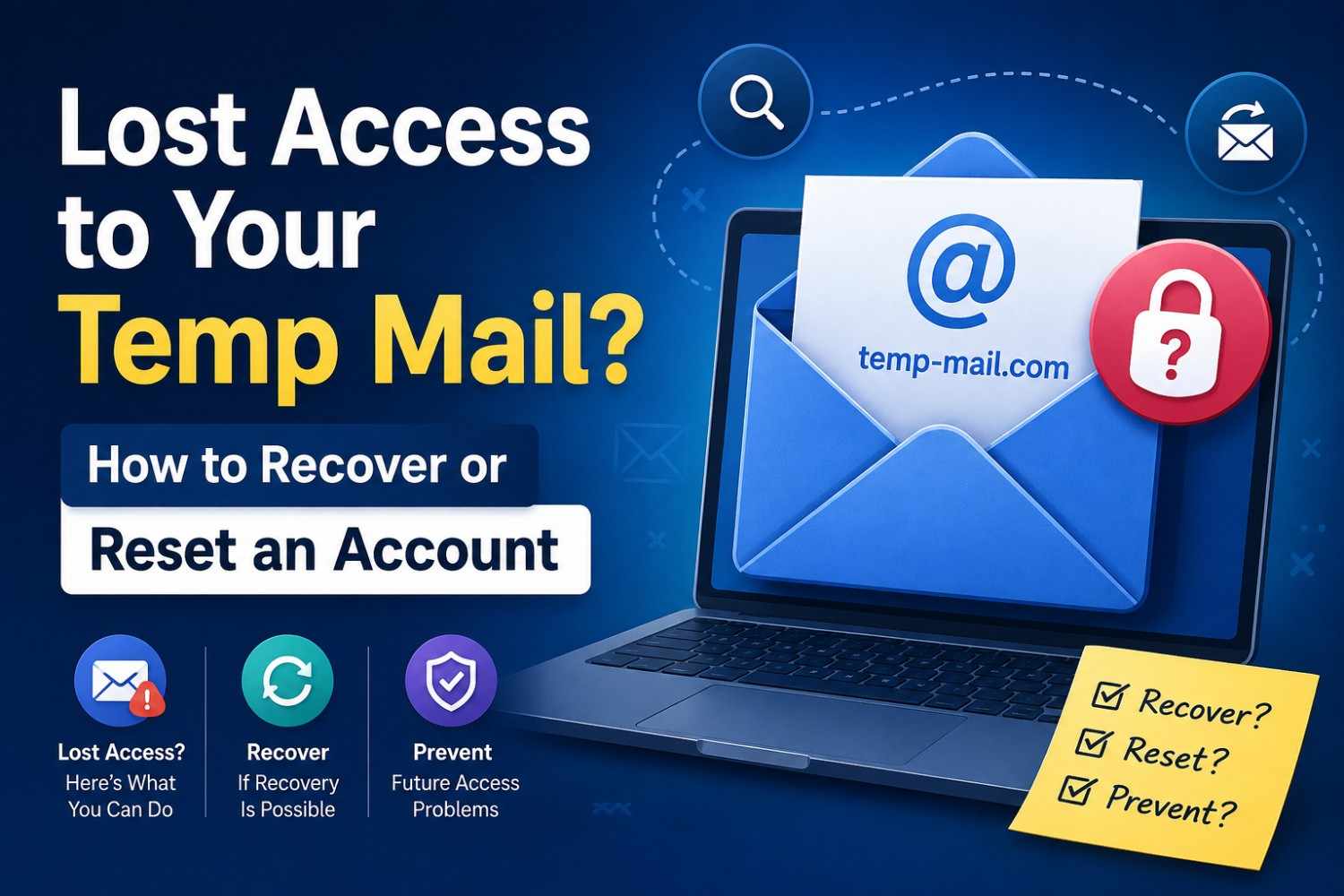
Lost Access to Your Temp Mail? How to Recover or Reset an Account
Quick Answer: Unlike regular email account recovery, temp mail account recovery does not have a password, a username, or a traditional login system. Only if there is some session data left and you used the right service will it be possible to recover access. This is a guide for options when recovering. It also covers what you can do if the recovery doesn't work and how you can prevent it from happening in the first place. Choosing a reliable temporary email service from the start can prevent most of these recovery headaches entirely.
Access to a temporary email inbox is a dire situation, particularly when a verification link, download, or account confirmation is awaiting inside. Knowing the exact cause of access loss is the key between recovery and restart. If you are new to the concept, our guide on what temp mail is and how it works covers the basics before you dive into recovery steps.
Main Points
- Temp mail account recovery is only possible if the session is still active in your browser or the service uses a persistent address system.
- Most disposable inboxes delete all messages permanently when the browser tab closes; this is by design, not a bug.
- Temporary email access issues caused by tab closure or session expiry have no recovery path on session-based services like Tempomail.
- The best protection against losing temp mail access is updating any linked accounts to a permanent email before closing the disposable session.
Why Temp Mail Access Works Differently From Regular Email
Standard email accounts use usernames and passwords stored on mail servers. Gmail and Outlook allow password resets and identity-based recovery.
Temp mail works on a completely different model. Most disposable email services create a session-based inbox which is only available during the email session. For the full technical picture, see how temp mail sessions work behind the scenes.
No account or saved credentials exist. The server keeps no record of inbox activity. When the session ends, the service removes all messages from its infrastructure.
This architecture is what makes temp mail private. It is also what makes temp mail account recovery impossible in most standard use cases. This privacy-by-design approach is part of the broader disposable email address model used across the industry, and it is also why choosing a trusted temp mail provider upfront matters more than trying to recover access later.
The Most Common Reasons Access Is Lost
1. The Browser Tab Was Closed
The most frequent cause of temporary email access issues. Session-based services like Tempomail end the session the moment the tab closes. The inbox no longer exists after this point.
2. The Browser Was Refreshed Without Copying the Address
Sometimes, a new temp mail page is generated when refreshing, and the previous temp mail address is replaced. The old address will not be recovered if you did not make a copy or save the address.
3. The Session Expired Due to Inactivity
Others terminate inactive sessions after a certain time, typically 10-60 minutes. An unused open tab may therefore lose its session automatically.
4. Cookies or Cache Were Cleared
Clearing browser cookies removes any session data that kept the inbox accessible. Services use cookies to maintain session continuity. Clearing those cookies breaks the session link.
5. A Different Device or Browser Was Used
Session-based inboxes remain linked to the browser instance that created them. Opening a new browser or switching devices starts a completely fresh session with a different address.
Can You Recover a Tempomail Inbox?
The honest answer depends on the session state:
If the Tempomail tab is still open
The inbox is still active. Return to the tab and retrieve any messages or links waiting inside. Do not close the tab until the verification or download step is fully complete.
If the tab was closed but the browser session was not ended
Some browsers restore tabs after a crash or unexpected closure. Try using the browser's session restore feature Ctrl+Shift+T on most desktop browsers to reopen the Tempomail tab. If the session restores, the inbox may still be accessible briefly.
If the session has fully ended
Recovery is not possible. The inbox no longer exists on Tempomail's servers. No recovery tool, support request, or workaround can restore a deleted session-based inbox.
This is not a service failure. It is the fundamental privacy design of session-based disposable email: the inbox is deleted precisely so that no record of it can be retained or accessed after the session ends.
Recovery Options by Scenario
Situation | Recovery Possible? | Best Action |
Tab still open | Yes | Retrieve content immediately |
Tab closed, browser not restarted | Sometimes | Try Ctrl+Shift+T to restore tab |
Session expired, tab still open | Unlikely | Check if inbox still loads |
Cookies cleared | No | Start fresh session |
Different device or browser | No | Start fresh session |
Service uses persistent address system | Yes | Re-enter address to restore |
Services That Use Persistent Addresses
Not all disposable email services are fully session-based. Some use a persistent address model; the inbox is accessible to anyone who knows the address, regardless of which session or device is used. On these services, recover disposable inbox access simply by re-entering the same email address.
The most popular examples of this are Guerrilla Mail and Mailinator. The inbox is accessible to anyone familiar with the address. If you are weighing the trade-offs, our comparison of temp mail versus email alias services breaks down when each option makes sense, and how it stacks up against other temp mail tools like 10 Minute Mail.
This means that it's easier to recover, but offers less privacy, as any third party that knows or guesses the address can read its contents as well.
If recovery of a specific inbox is more important than privacy, a persistent-address service is a better fit than Tempomail for that use case.
What to Do When Recovery Is Impossible
If the Tempomail session has ended and recovery fails, the next step depends on what you lost:
If a platform verification link was in the inbox
Return to the platform and request a new verification email. Most platforms allow resending the confirmation link. Use a new Tempomail address for the resend, and this time, complete the verification before closing the tab. This is especially common when using a temp address to sign up for software free trials, where confirmation emails are often required within a limited window.
If a download link was in the inbox
Return to the gated resource page and resubmit the form with a new Tempomail address. Save the downloaded file to your device immediately after the delivery email arrives. This scenario comes up often when downloading gated PDFs and ebooks with temp mail, where the delivery link only works once.
If an account was registered with the expired temp address
Most platforms will allow you to change the email address you have registered with without needing to have access to the original email address. Use the registration password to log in and change the email address to a permanent address. If the platform needs to confirm the email change, reach out to the support team of the platform directly.
How Temporary Email Access Issues Affect Linked Accounts
Losing a temp mail inbox can affect every account registered with that address. This is one reason it helps to pick a dependable disposable email tool from the start, one built for consistent delivery rather than just quick throwaway use.
- Password recovery: Any platform that sends password reset links to the registered email becomes inaccessible if that inbox is gone.
- Two-factor authentication: Sites using 2FA via email become inaccessible if the inbox isn't there.
- Account alerts: Security alerts, billing confirmations, and the like are never delivered.
The single most effective way to prevent these downstream problems is updating linked accounts to a permanent email before the Tempomail session ends. This takes under two minutes and eliminates every recovery problem associated with a closed temporary inbox.
Benefits of Understanding How Temp Mail Recovery Works
Faster response to access loss
Knowing immediately whether recovery is possible saves time. Rather than searching for a recovery option that does not exist, users can move directly to the most practical next step.
Better session management
Understanding that the tab closure ends the session permanently encourages better habits: completing all necessary steps before closing, saving files immediately, and updating linked accounts proactively.
Correct service selection
Users who need recoverable inboxes can choose persistent-address services rather than session-based ones, matching the tool to the actual use case. It is also worth understanding whether using a temporary email is legal for your specific use case, since rules can vary by platform and region.
Reduced frustration with platform signups
If you miss a verification link, request a new one quickly. This keeps the signup process moving without trying to recover an inaccessible inbox.
How to Prevent Temp Mail Login Problems in the Future
When using a disposable inbox for the first time, use the following checklist:
- Before you go to the platform, copy the Tempomail address; if you lose the tab, you will have the address handy to use.
- Do not close Tempomail until you have done all verification steps, got the confirmation link and clicked it, and the account is fully active.
- Save any files or download links to your device immediately; do not leave downloads inside the Tempomail inbox.
- If you need to access the account, recover your password, or communicate with them, update the account to a permanent email before closing it.
- Do you receive multiple e-mails from the platform you are using? Some platforms will email you a confirmation receipt and then a welcome email with further links.
Long-Term Alternatives That Avoid This Problem Entirely
A Dedicated Secondary Email Address
A separate Gmail or Outlook address used only for platform signups provides full recovery access alongside inbox separation. The practical alternative for any use case where losing access would cause problems.
Email Alias Services
Services like SimpleLogin create forwarding aliases that mask the real address while remaining permanently accessible. Unlike session-based temp mail, aliases never expire and support account recovery, the better choice when inbox privacy and access continuity both matter. For everyday signups where quick access still matters, many users simply stick with a free temp mail generator and update the address later if the account becomes long-term.
Final Verdict
Temp mail account recovery follows a simple rule: if the session is still active, recovery may be possible. If the session has ended, recovery is not. The session-end deletion that makes disposable email private is the same feature that makes recovery impossible.
The practical response to a closed temp mail inbox is not recovery; it is moving forward efficiently. Request a new verification link, resubmit the download form, or contact the platform's support team to update the registered address without requiring access to the original inbox.
For future sessions, update linked accounts to a permanent email before closing the Tempomail tab. This provides the strongest protection. That one step eliminates every downstream problem caused by a closed disposable inbox. Bookmarking a go-to temporary email service now makes this a five-second habit instead of a recovery emergency later.
FAQs
1. Can Tempomail support recover a deleted inbox?
No. Tempomail's session-based architecture deletes all inbox data when the session ends. There is nothing for support to retrieve; The system deletes the data by design.
2. What if I remember the temp email address but the session is closed?
Remembering the address does not restore the inbox on session-based services. The address no longer points to an existing inbox. On persistent-address services like Guerrilla Mail, re-entering the address does restore access.
3. Can I use the same Tempomail address again in a new session?
No. Each new Tempomail session generates a new random address. You cannot re-select or restore the previous address.
4. The platform is asking me to verify the temp email I no longer have access to. What do I do?
Contact platform support if you lose access to the registered email. Support teams may update the address after identity confirmation. Some platforms also let users change it through account settings.
5. Why did my Tempomail inbox disappear while the tab was still open?
Session inactivity timeouts can end a session even when the tab remains open. If the inbox becomes inaccessible without the tab being closed, the session likely expired. Open a new session to generate a fresh address.
6. Is there a way to extend a Tempomail session?
Keep the tab active and complete the required steps during the session. Using the inbox can help maintain activity longer than leaving it idle.
7. What happens to messages sent to an expired Tempomail address?
Sending servers receive a non-delivery response. The service does not store the messages elsewhere. The sender may receive an undeliverable notification.
8. Should I always switch to a permanent email after using a temp address for signup?
For any account where ongoing access, password recovery, or communication matters, yes. Update to a permanent email before closing the Tempomail session while the update confirmation can still be received.
Related Resources
- Why some websites block temp mail domains
- Using temp mail for online surveys
- Can a temporary email receive attachments
Author Expertise
Written and reviewed by Sarah Whitfield, Email Privacy Researcher at Tempomail, who studies disposable email behaviour, session management, and inbox recovery scenarios across major temporary email services. Content is updated regularly to reflect current service architecture and platform verification practices. Visit tempomail.com for tools and guides. Last Reviewed: August 2026
Related Source:
Using Temp Mail to Download Gated PDFs and eBooks Without Spam
Temp Mail for Software Free Trials: Try Before You Buy, Risk-Free