How Does Temp Mail Work? SMTP, Domains, and Inbox Explained (Simple Guide)
Quick Answer: How does temp mail work? It utilises the standard email system, SMTP servers, and dedicated domains to establish a session-based inbox that receives real messages in real time. If a site sends a confirmation e-mail to a temp mail address, it is processed in the same way as any other mail. The difference is where the message appears – it appears only for a short period of time, then permanently when the session ends. Last Reviewed: August 2026
Most people use temp mail without thinking about how it works. Open the site, copy the address, and receive the email. Simple. But the simplicity on the surface conceals a functioning email infrastructure that mirrors the architecture behind every email system globally.
Understanding how does temp mail work helps users make better privacy decisions — and explains why Tempomail delivers messages as reliably as any standard inbox.
Temporary email services run on the exact same global SMTP infrastructure that powers Gmail, Outlook, and every other commercial mail provider — there is no separate or lesser system involved. For a broader look at how the whole disposable-inbox model fits together, see this complete guide to what temp mail is.
Key Points
- Temp mail works through three elements: a generated address, a server that receives incoming emails, and temporary storage that automatically deletes all data after the session ends.
- All emails sent from the temporary email system are sent via the regular SMTP protocol—just like all emails sent in the world.
- Disposable inbox technology holds messages in temporary server memory rather than writing to a permanent database, making deletion complete by design rather than policy.
- An email forwarding process is not involved; standard temp mail messages are routed directly to the session inbox without redirection through any personal account.
Step One: The Address Is Generated
A temporary email system generates a unique address string the moment a session begins, creating a username and domain combination that no active inbox has used before, and that will never be reused after the session ends.
When you open Tempomail, the platform generates a random address automatically. The address follows standard email format: username at domain dot com. Tempomail randomises the username. The domain belongs to Tempomail's mail receiving infrastructure. You can watch how temp mail works in real time by generating an address yourself.
Tempomail stores no information about who requested the address. It does not log IP addresses to user profiles or record device identifiers. The address exists as an active inbox entry in the session, not as a registered account in any database.
Step Two: The Domain Accepts Incoming Mail
Every email address has two parts. The username identifies the specific inbox. The domain identifies which mail server receives messages sent to that address.
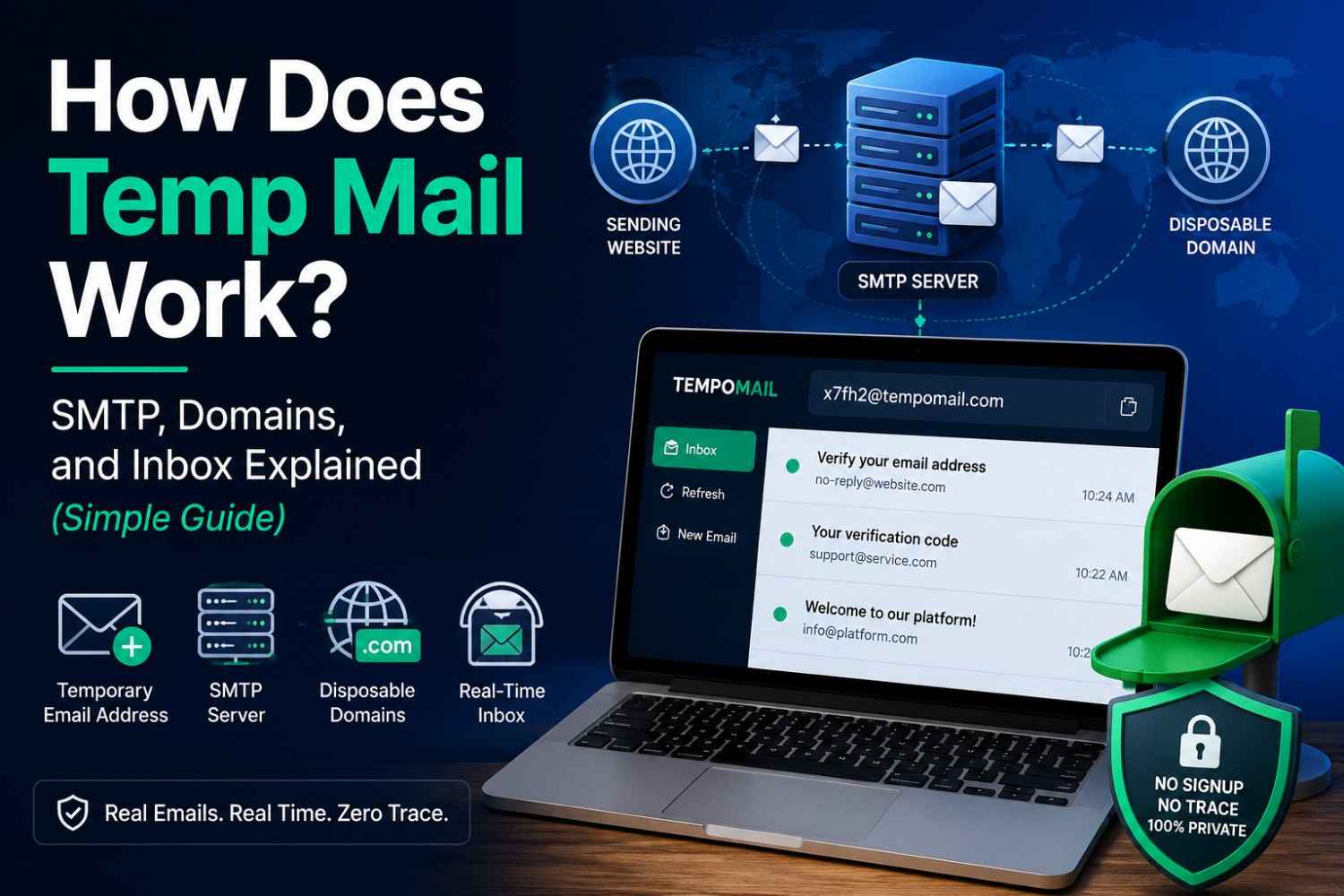
Tempomail operates dedicated mail servers configured to accept all incoming messages for its active domains. When a website sends a verification email to a Tempomail address, its sending server looks up the domain in DNS records, the same process used for any email delivery globally. This domain-and-DNS mechanism is part of the broader system covered in this temp mail explained in detail.
The DNS lookup returns the Tempomail mail server address. The sending server delivers the message through the SMTP protocol. The whole process is the same as sending an email to a Gmail or Outlook account. The destination server is simply a temporary one rather than a permanent provider.
What SMTP Does in This Process
SMTP (Simple Mail Transfer Protocol) is the standard communication protocol that all mail servers use to transmit email messages between sending and receiving systems. Temp mail uses SMTP identically to any permanent email infrastructure.
SMTP does not distinguish between temporary and permanent receiving servers. It connects, authenticates, and delivers. The receiving server accepts or rejects the message based on its configuration. Tempomail configures its servers to accept all incoming messages for active session addresses.
This is why any website can send to a Tempomail address. The website's email system sees a standard domain with a functioning SMTP receiving server. It delivers the message. The temp mail infrastructure handles the rest.
Step Three: The Message Appears in the Session Inbox
Disposable inbox technology holds incoming messages in temporary server-side session storage, making them visible to the active browser session without writing to any permanent database that could be searched, subpoenaed, or retained after deletion.
Once the Tempomail server accepts the message through SMTP, it stores the message in the active session inbox. The browser displays this inbox in real time. Messages appear within seconds of the sending server completing delivery.
The inbox renders full message content HTML formatting, images, plain text, clickable links, and downloadable attachments. Everything a standard inbox displays is available in the session window. You can see exactly how a temporary email works by opening an inbox and watching a message land in it live.
The technical distinction from a permanent inbox is where the message lives. Gmail stores each message in a database that persists indefinitely. A Tempomail message exists in session state, not in a permanent database. This architectural choice is what makes complete deletion possible.
Step Four: The Session Ends and Everything Deletes
When the browser tab closes or the session expires, Tempomail clears the session state. Tempomail removes the address from the active registry and erases every message in the inbox.
No deletion policy is needed as no data is written to permanent storage. There is no need to remove the message from a database. It existed in session memory, and session memory clears when the session ends.
This is the core difference between disposable inbox technology and a standard email provider that deletes messages on a schedule. Scheduled deletion depends on policy enforcement. Session memory clearance is architectural; it happens by definition when the session terminates.
This is exactly why architecture matters more than a privacy policy: a system that never writes data to permanent storage has nothing left to delete, while a database-based system depends on a company actually following through on its retention promises. For a closer look at how this compares with other privacy tools, see this temp mail vs email alias comparison.
What the Email Forwarding Process Is Not Involved In
Standard temp mail does not use an email forwarding process. Messages go directly to the Tempomail session inbox. There is no intermediary account, no redirection through a personal email address, and no connection to any real inbox at any stage.
This distinguishes temp mail from email aliases and masked addresses, which do use a forwarding mechanism to redirect messages to a real account. Temp mail receives messages independently, which is why no real email address is needed to use it, and why no personal inbox is exposed during the process. Because no data is retained anywhere, this architecture also explains is using temp mail legal in every major jurisdiction — the service simply has nothing on record to hand over.
Author Note
Written by Sarah Whitfield, Digital Privacy & Email Security Analyst — 6+ years covering inbox privacy, disposable email tools, and anonymous communication services, specialists in disposable inbox technology, email infrastructure, and temporary email system architecture. Content is based on direct technical knowledge of how temp mail services operate. Reviewed regularly to reflect current standards.
Conclusion
Understanding how Temp Mail works makes it easier to choose the right privacy tool for online signups and verifications. Temporary inbox infrastructure provides real-time email delivery with automatic deletion after the session ends. Tempomail combines standard email infrastructure with a privacy-focused design to deliver a fast, secure, and temporary inbox experience. Ready to see how does temp mail work firsthand? Generate a session inbox now and watch a message arrive. For the full picture of the tool itself, read this complete 2026 guide to temp mail.
(FAQs)
Why do temp mail messages sometimes arrive slowly?
Delays originate from the sending server, not Tempomail's receiving infrastructure. Some websites batch verification emails or apply rate limiting. Most messages from major platforms arrive within 10 to 30 seconds.
Can Tempomail receive emails from any website globally?
Yes. Any website using standard SMTP delivery can send to a Tempomail address. The only exception is websites that actively blocklist Tempomail's domains, which Tempomail addresses through regular domain rotation.
How does temp mail work on mobile devices?
Yes, exactly the same way. The underlying SMTP delivery and session inbox technology function identically regardless of the device. The Tempomail browser interface is fully functional on mobile without any app installation. Open a temp mail session on your phone to try it directly in the browser.
Why can some websites detect and block temp mail addresses?
Detection works at the domain level, not the address level. Some platforms maintain blocklists of known disposable email domains. Tempomail rotates domains to maintain compatibility, but detection is always possible when a domain becomes widely recognised.
Is the temporary email system secure enough for receiving verification codes?
Yes, for low-stakes verifications. SMTP delivery to Tempomail's servers is as secure as standard email delivery. For sensitive accounts, banking, healthcare, or financial services, use a permanent email address instead.
Can Tempomail receive password reset emails?
Yes, during the active session. If the session has ended before the reset email arrives, the message is undeliverable. Keep the tab open when expecting time-sensitive messages.
Does Tempomail use an email forwarding process to deliver messages?
No. Messages route directly to the Tempomail session inbox via SMTP. No forwarding mechanism is involved, and no personal email address is connected to the process at any stage.
What happens to messages that arrive after the Tempomail session ends?
The address is removed from the active registry. The sending server receives a non-delivery response. No message is stored anywhere; the inbox no longer exists to accept it.
Related Source:
Is Using a Temporary Email Illegal? What the Law Actually Says
Why Some Websites Block Temp Mail Domains (and What to Do About It)
Can a Temporary Email Receive Attachments, Images and Files?
Temp Mail and GDPR: What EU Privacy Law Says About Disposable Email