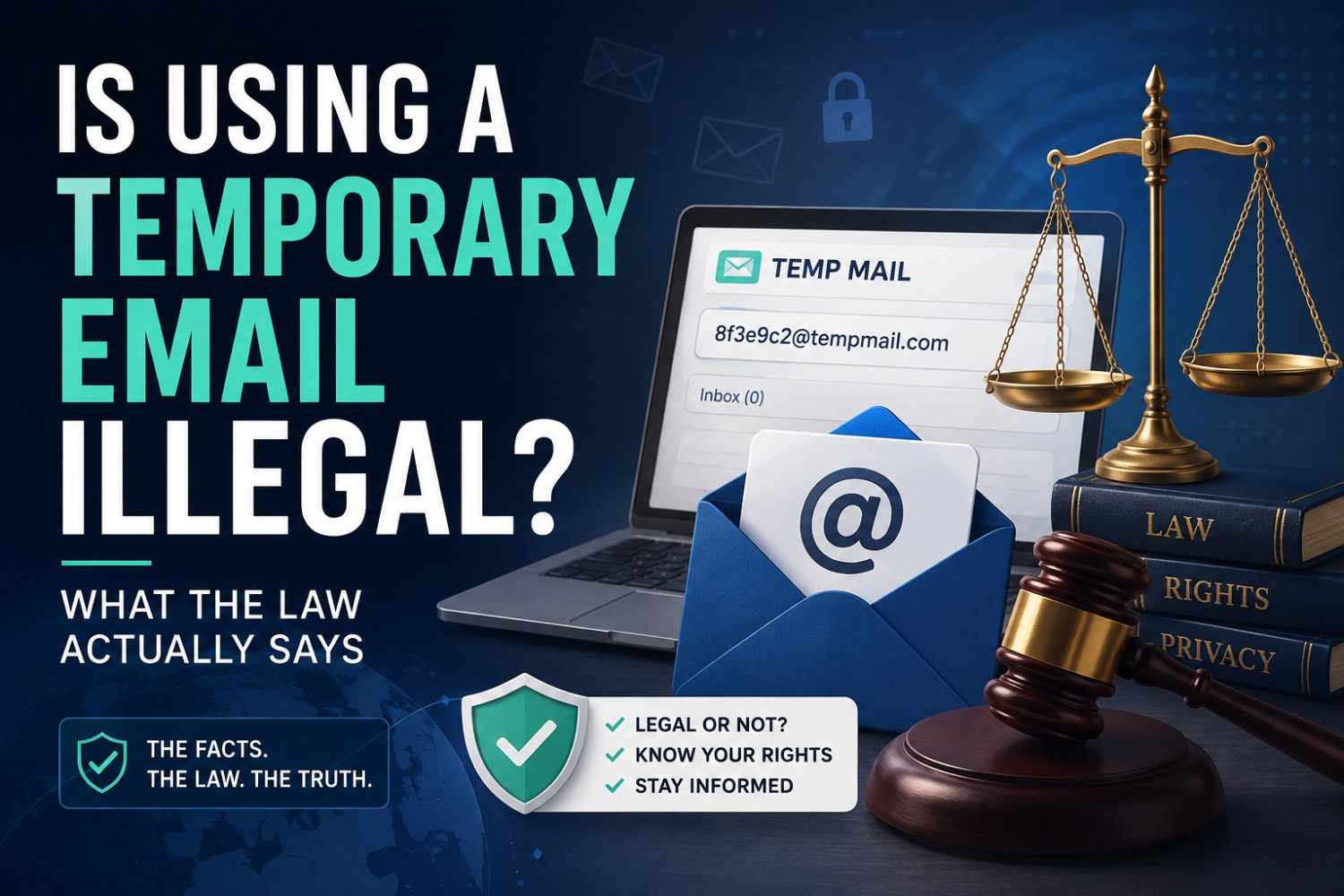
Is Using a Temporary Email Illegal? What the Law Actually Says
By Sara Whitfield, Data Privacy & Compliance Writer — 7+ years covering digital privacy law and data protection regulation · Updated August 2026
Quick Answer: Is temp mail illegal? No. Using a temporary email address is completely legal in all major jurisdictions worldwide. Disposable email tools protect personal privacy and are recommended by cybersecurity professionals. The law regulates how businesses handle your data — not whether you choose to protect it using an anonymous email address instead of your real one. You can generate a temporary email address in seconds if you want to try it yourself.
Many people ask whether temp mail is illegal because online anonymity is often associated with wrongdoing. That association is unfounded in this context. Using a disposable email address is the digital equivalent of giving someone a PO Box instead of your home address, a standard privacy practice with no legal consequences for the person using it. For a broader look at how these addresses work, see this disposable email address guide.
Tempomail generates a working temporary inbox instantly, with no registration and no personal data collected at any stage. The tool exists to protect user privacy, and privacy protection is a legal right in most jurisdictions globally. If you want to set one up yourself, this guide on how to create a temporary email address walks through the steps.
The IAPP's Global Privacy Law and DPA Directory tracks data protection and privacy laws now in force across 144 countries, with the majority explicitly affirming individual users' rights to minimise the personal information they share with online services.
Key Takeaways
- Using a temporary email address is legal everywhere — no country bans it, though individual websites can still block it under their own terms of service.
- The activity, not the tool, determines legality — fraud, impersonation, harassment, or scams remain crimes regardless of which email address is used.
- Avoid temp mail for banking, government, healthcare, work, or school accounts, and any account that needs long-term recovery access.
- Data minimisation laws like GDPR, UK GDPR, CCPA, PIPEDA, and Australia's Privacy Act all support the right to limit how much personal data you share.
What Is a Temporary Email?
A temporary email service generates a random, session-based email address. It works as a fully operational receiving inbox. Messages arrive in real time. The service permanently deletes all content when the session ends. Users need no registration, password, or personal data to use it. For a deeper look at the technology behind it, see this complete guide to what temp mail is.
The address works like any standard email. Websites send verification codes and confirmation links to it. The inbox receives them. When the session closes, everything is gone. No archive remains after the session. Users cannot recover the inbox. The service keeps no connection to a personal identity. To understand exactly how long that window lasts, see how long a temporary email address stays active.
Is Temp Mail Illegal?
The Short Legal Answer
No. Is temp mail illegal is one of the most commonly searched privacy questions, and the answer is clear in every major jurisdiction. If you’d like to see how it works firsthand, you can try a temporary email generator with no signup required.
There is no specific law in the United States, European Union, United Kingdom, Canada, Australia, or any other major economy that expressly bans the use of a temporary email address. There is no legal grey zone with anonymous email usage; it's a recognized privacy practice.
Why Using a Privacy Tool Is Not Automatically Illegal
Privacy tools exist specifically to protect users from excessive data collection. Regulatory frameworks globally support the right to minimise personal data disclosure.
Using a disposable email address is the practical application of this right, giving a website what it needs for verification without exposing personal contact details to long-term data collection systems.
The tool itself carries no legal risk. Legal risk arises from what someone does with any tool — not from the tool's existence or use in legitimate contexts.
Is Temp Mail Against a Website's Terms of Service?
This is where the question becomes more nuanced. Temporary email legality at the law level is clear. At the platform-contract level, individual websites may prohibit disposable email addresses in their own terms of service.
Violating a website's terms of service is generally a contractual matter, not a criminal one. The usual consequence is account termination. Using a temporary address against those terms does not itself create criminal liability or a legal sanction.
Check platform-specific terms before using a temporary email for high-stakes access. The reason is practical. Different services may have different contractual requirements.
Legal Ways to Use Temporary Email
Avoiding Spam
Submitting a real email address to any website creates the risk of that address entering marketing lists, being sold to data brokers, and generating ongoing promotional contact.
Using a temporary email for any interaction where ongoing communication is not needed or wanted is a fully legal privacy decision. You can generate a fresh temporary email address whenever you need one for this exact purpose.
Unknown Website Signups
Data risk is associated with registering on a website, service, or tool that you don't know, or on a platform with an unknown privacy policy. A temporary email address limits that risk without violating any law. The website receives a working verification address. The user receives no lasting marketing exposure.
Website and App Testing
Developers and QA teams use temporary email addresses to test registration flows, email delivery systems, and transactional email content. Each test generates a clean address with no prior history and no residual data after the test completes. This is standard professional practice. This guide on using disposable emails for app testing covers the practice in more detail.
One-Time Downloads
Content platforms that gate resources behind email submission forms require a working address to deliver the download. Providing a temporary address to access a single PDF, report, or guide is entirely legal and protects the user from ongoing marketing contact initiated by the download submission.
Protecting Your Primary Email
Disposing of a primary email address and using a temporary email address to keep it clean and free of spam is a privacy hygiene choice. It is not illegal, is widely used, and is in line with the internationally recognised principles of data minimisation as enshrined in privacy legislation. This burner email explainer covers other uses and benefits of the same approach.
When Can Temp Mail Use Become Illegal or Risky?
Temporary email itself is neutral. The legal risk arises from the activity, not the tool. These are the contexts where using any email address, temporary or permanent, creates legal exposure.
Fraud
Using any email address to make false representations for financial gain is fraud. The temporary nature of the address does not create the legal problem that the fraudulent intent does. Financial fraud remains criminal regardless of which email type someone uses.
Identity Theft
Creating accounts that impersonate another real person, using a temporary address to conceal the impersonation, is identity theft. This is a criminal offence in all major jurisdictions. The temporary email is not the crime; the impersonation is.
Phishing and Scams
Using a temporary email to send or coordinate phishing campaigns, collect credentials through deceptive communications, or operate scam infrastructure is criminal. Temporary email services support the receipt of verification emails. Using them as part of a criminal communication scheme creates clear legal liability.
Harassment and Threats
Using a temporary email to send threatening, harassing, or abusive messages is illegal. A temporary email does not provide immunity for criminal conduct.
Free Trial Abuse
Creating multiple accounts to bypass a free trial limit by using different temporary email addresses for each registration may violate a platform's terms of service.
In some jurisdictions and under specific circumstances, systematic circumvention of a paid service through repeated free account creation could constitute a civil breach.
This is a terms-of-service issue primarily, not a criminal one in most cases, but it carries contractual risk.
Fake Reviews
Submitting fake reviews under accounts created using temporary email addresses to deceive consumers or manipulate ratings constitutes deceptive trade practices in most jurisdictions. The temporary email facilitates the account creation, but the deceptive review is the legal problem.
Is a Temporary Email Actually Anonymous?
Tempomail does not collect names, phone numbers, IP addresses, or device identifiers. The service generates an address, receives messages in session memory, and deletes everything when the session ends. The inbox has no personal data linked to it at any stage.
From a data collection standpoint, the session leaves no persistent record on Tempomail's servers. The inbox cannot be attributed to any individual after the session closes because no identifying information was ever associated with it.
Submitting a real email address to an unfamiliar website commonly results in that address being added to marketing lists or shared with third-party advertising partners, often without the user realising it until the promotional messages start arriving.
Can a Temporary Email Be Traced?
Technically, email metadata travels through standard SMTP infrastructure and can be examined at the network level by parties with access to that infrastructure. This applies only to a device actively sending a message, not to Tempomail users who are simply receiving one; the sending device’s IP address could be visible to the receiving mail server, but Tempomail’s own infrastructure does not expose it.
For Tempomail users who are only receiving messages, the traceability exposure is minimal. No outbound message is sent from the inbox. No IP address is logged to a user record. The session ends with no persistent record connecting a device to the inbox that was used.
Users with stronger anonymity requirements may need additional privacy tools. Combining them with a temporary email can provide broader protection.
When Should You Avoid a Temporary Email?
Banking
It is essential to have a permanent email account for confirming transactions, alerting for fraud, notifying for security, and account recovery in financial accounts. A temporary address that expires eliminates a recoverable contact point and poses both practical and security concerns.
Government
Government service accounts, tax portals, benefit systems, and licensing platforms require verified, permanent contact information for regulatory and legal communication. Using a temporary email for government service registration creates access and compliance problems.
Healthcare
Healthcare platforms store sensitive records and require reliable email access for appointment confirmations, test results, prescription notifications, and account security. A temporary address creates gaps in critical communication that may have health consequences.
Work and School
Professional and academic platforms typically require institutional email addresses and maintain records linked to that address over time. Using a temporary email for work or school systems creates access problems and may violate institutional policies.
Long-Term Accounts
Any account that needs ongoing access, recovery, or communication requires a permanent address. Subscriptions, e-commerce accounts with purchase history, and community platforms where relationships develop over time all require a real email that remains accessible.
Disposable Email Laws and Privacy Regulations
GDPR
The General Data Protection Regulation, applicable in the European Union, establishes data minimisation as a core legal principle under Article 5. Users have a legal basis for providing only the personal information necessary for a specific interaction. Using a temporary email to limit data disclosure is consistent with this principle. See the General Data Protection Regulation entry on Wikipedia for the full legal text of this principle.
UK GDPR
Following departure from the EU, the United Kingdom adopted the UK GDPR, which mirrors the EU framework's data minimisation provisions. Temporary email use in the UK aligns with the same principle that users should be able to control the personal data they share with online services.
CCPA
The California Consumer Privacy Act establishes rights for California residents to limit personal data collection. While the CCPA places obligations on businesses rather than restricting individual choices, its framework supports the use of tools that minimise unnecessary personal data disclosure.
Other Privacy Frameworks
Brazil's LGPD, Canada's PIPEDA, and Australia's Privacy Act all establish data minimisation or data limitation principles that are consistent with temporary email use as a privacy protection measure. No major privacy framework in any jurisdiction treats temporary email use as a legal violation.
Is Temp Mail Legal in Different Countries?
United States
Legal. No federal law prohibits using a disposable email address. The CAN-SPAM Act regulates business email marketing; it places no restrictions on individual email address choices. State laws do not address temporary email use.
United Kingdom
Legal. The UK GDPR supports data minimisation. No UK law prohibits using a temporary email address for personal privacy protection. Using temp mail in the UK carries no legal consequences.
European Union
Legal. GDPR Article 5 explicitly supports data minimisation as a legal principle. Using a temporary email address to limit personal data disclosure is consistent with EU privacy law. No EU member state has enacted legislation specifically restricting temporary email use.
Canada
Legal. PIPEDA and provincial privacy legislation support individuals' rights to limit personal information disclosure. No Canadian law prohibits temporary email addresses. Using disposable email in Canada is standard privacy practice.
Australia
Legal. The Australian Privacy Act establishes privacy principles supporting data minimisation. Australian law does not prohibit temporary or disposable email use for personal privacy protection.
Pakistan
Legal. Pakistan does not yet have a comprehensive, enacted data protection law. The Personal Data Protection Bill, drafted in 2023 and approved by the Federal Cabinet, is still pending before Parliament, while the Prevention of Electronic Crimes Act (PECA) 2016 addresses some data-related offences in the interim. No provision in current or pending legislation prohibits using a temporary email address.
No specific provision prohibits the use of temporary email addresses. The current legal framework permits temp mail use in Pakistan for personal privacy.
How Tempomail Protects User Privacy
Tempomail uses a privacy-by-design architecture. The service collects no personal data during a user session. The service retains no name, IP address, device identifier, or usage history after the session ends. You can see this privacy-first approach yourself by generating a temp mail address and checking what information it asks for — none.
This approach means Tempomail has no personal data to produce if a legal or regulatory request occurs. The service never collects that data. Deletion also happens at the architectural level. Session data never enters a permanent database, so nothing remains after the session closes.
Users engage with Tempomail in full compliance with applicable temporary email legality standards in every jurisdiction where this question has been legally assessed.
Final Verdict
Is temp mail illegal? No. Temporary email legality is well-established across every major jurisdiction globally. Using a disposable email address to protect personal privacy is consistent with international data protection principles, supported by privacy legislation worldwide, and carries no legal consequence for users with legitimate privacy purposes.
The legal boundary is behaviour, not tools. Anonymous email usage becomes a legal issue only when the underlying activity, fraud, impersonation, or harassment, would be illegal through any channel. The temporary email address is not the problem. The act is.
Tempomail provides a privacy-by-design service that aligns with both the legal right to data minimisation and the practical need to protect real inboxes from unnecessary exposure during routine online interactions. Ready to protect your inbox? Generate a free temporary email address now, or compare more options in this roundup of the best temporary email generators in 2026.
(FAQs)
Is it against the law to use temp mail for website signups?
No. Using a disposable email address for website signups is legal in all major jurisdictions. No law requires individuals to provide permanent email addresses to private online services.
Can I be prosecuted for using a temporary email address?
No. Prosecution requires a criminal act. Using a temporary email address to protect your privacy is not a criminal act in any jurisdiction where temporary email legality has been examined.
Do GDPR or CCPA restrict anonymous email usage?
No. GDPR and CCPA have requirements for businesses that gather personal information. These two do not prevent persons from using a temporary email address to reduce the personal information given.
Are there any countries where temp mail is illegal?
No country has enacted specific legislation prohibiting the use of temporary or disposable email addresses. The concept of disposable email laws as a restrictive legal category does not exist in any known jurisdiction.
Can a website ban me for using a temporary email?
Yes, if their terms of service prohibit it. This is a contractual consequence, account termination, not a legal one. No criminal or civil liability attaches to violating a website's email address policy.
Does using temp mail violate email verification requirements?
No. Email verification requirements ask for a working inbox that can receive a message. Tempomail provides a fully functional inbox that satisfies this requirement at the technical level.
Is Tempomail compliant with privacy regulations?
Yes. Tempomail collects no personal data at any stage of a session. Its privacy-by-design architecture is consistent with GDPR, CCPA, and all major data protection frameworks currently in force.
Could businesses legally require real email addresses during signup?
Yes, businesses can set their own terms. However, requiring a real email address in terms of service creates no legal obligation on users beyond the risk of account termination if the terms are violated.
Related Source:
How Does Temp Mail Work? SMTP, Domains and Inbox Explained (Simple Guide)
Why Some Websites Block Temp Mail Domains (and What to Do About It)
Can a Temporary Email Receive Attachments, Images and Files?
Temp Mail and GDPR: What EU Privacy Law Says About Disposable Email