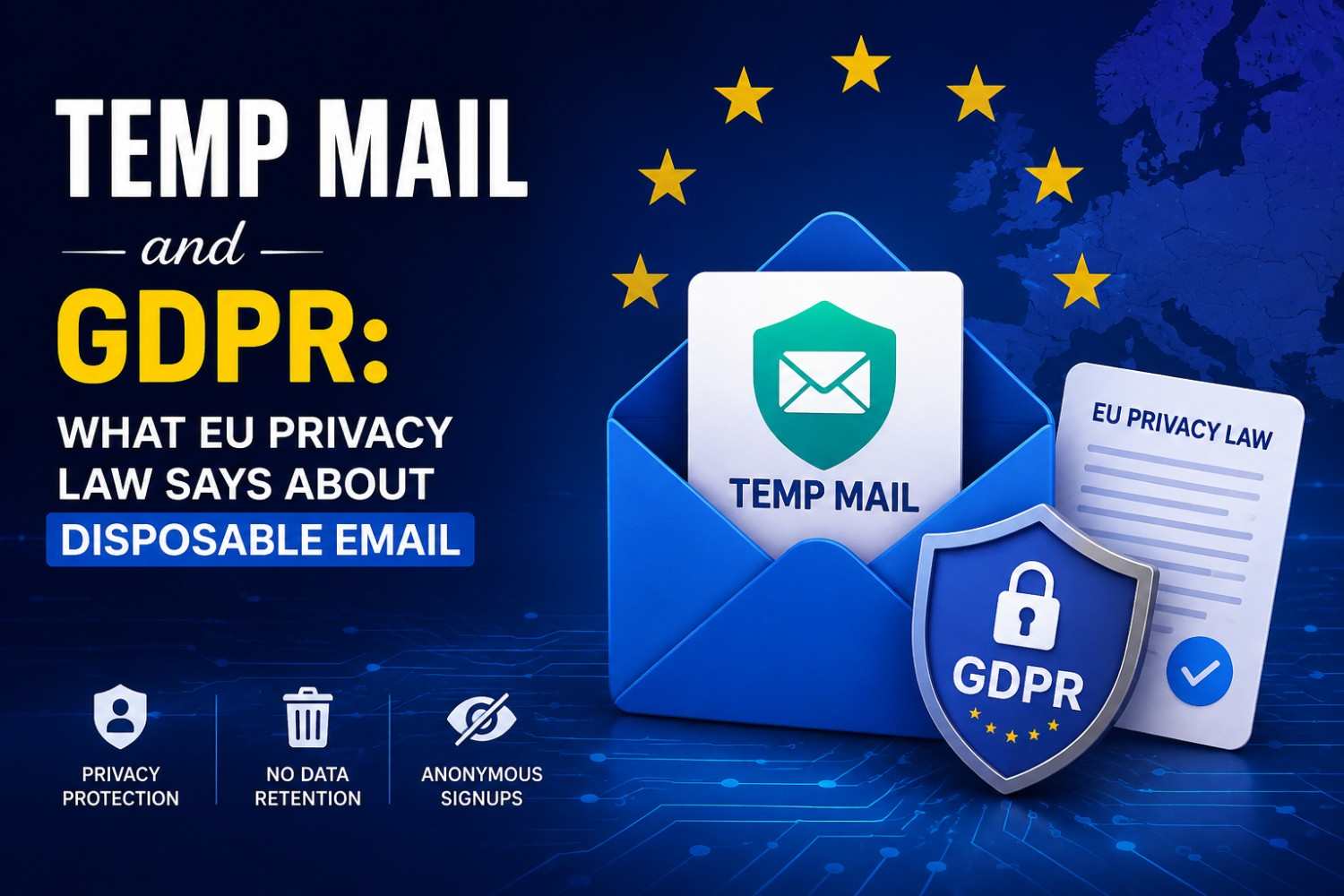
Temp Mail and GDPR: What EU Privacy Law Says About Disposable Email
Quick Answer: EU privacy law does not prohibit individuals from using disposable email addresses. GDPR governs how organisations collect and process personal data — it actively supports the right to minimise what you share. Using temp mail and GDPR principles together is not just compatible; a disposable inbox is one of the most practical expressions of data minimisation rights that ordinary users have available to them. Anyone can try a free temporary email service in seconds to see how this works in practice.
Many users assume that GDPR restricts what email address they can use online. It does not. GDPR places obligations on data controllers, the organisations collecting information, not on the individuals submitting it. Before going further, it helps to understand what temp mail is and how it works at a basic level.
Main Points
- Temp mail and GDPR are fully compatible. EU law regulates organisations collecting data, not individuals choosing to protect their own.
- GDPR Article 5 establishes data minimisation as a legal principle, which disposable email directly supports.
- Disposable email compliance from a user perspective means providing a working address for verification without permanently exposing personal contact data.
- EU data protection rules do not require individuals to provide permanent email addresses to private platforms or services.
What GDPR Actually Regulates
The General Data Protection Regulation (GDPR) is the new privacy law that applies to data collected from users across Europe. For a general overview of its scope and history, see the General Data Protection Regulation entry on Wikipedia before looking at how it applies to disposable email specifically. It has been implemented in the entire European Union since May 2018. The regulation has specific rights for people and obligations for organisations that collect or process their personal data.
Personal data under GDPR covers a broad scope. An email address is considered personal data according to GDPR if it identifies a person. This leads to an important question. Does using a disposable address create a legal issue for the user? This is a common concern, and the short answer to whether using a temporary email is illegal is no, but it's worth understanding the reasoning.
The answer depends on who GDPR regulates. The regulation places obligations on data controllers and data processors. These include organisations that operate websites, platforms, and services.
It creates no obligation on the individual providing personal data during a registration process. A user choosing which email address to submit is making a personal privacy decision, not a regulatory one.
Where GDPR Supports Disposable Email Use
Article 5: Data Minimisation
GDPR Article 5(1)(c) establishes the data minimisation principle as a core legal requirement for organisations collecting personal data. Data collected must be adequate, relevant, and limited to what is necessary for the purpose for which it is processed.
This principle exists because the regulation recognises that unnecessary data collection creates unnecessary risk for individuals. GDPR email privacy is therefore built on the premise that less personal data in circulation is better, both for individuals and for the legal compliance of the organisations holding that data.
A user who provides a disposable email address for a one-time platform verification is applying data minimisation from the individual's side of the interaction.
The platform receives what it needs for its stated purpose: a working email for verification, without receiving a permanent personal contact point that it may retain and use indefinitely.
Article 7: Conditions for Consent
GDPR Article 7 requires that consent for data processing be freely given, specific, informed, and unambiguous. Many platforms obtain email addresses during registration and then use them for marketing purposes on the basis of that initial interaction.
Users who are not aware that registration consent extends to ongoing marketing have not given informed consent as GDPR requires.
A disposable address limits the practical effect of any consent ambiguity; marketing emails sent to an expired inbox are simply undeliverable.
This is not a legal technique. It is a practical outcome of using a tool that aligns with the spirit of what GDPR attempted to achieve.
Article 25: Privacy by Design
GDPR Article 25 requires organisations to implement technical and organisational measures that apply data protection principles by design. Tempomail's architecture no personal data collected, no session data retained after session end, and no persistent record connecting a user to an inbox reflects the same privacy-by-design approach that GDPR requires of data controllers. This is the same thinking behind Tempomail's disposable inbox generator, built to collect nothing beyond what a single session needs.
What Disposable Email Compliance Means in Practice
Disposable email compliance, from a user's perspective, means using a tool that satisfies a platform's technical email requirement without creating an unnecessarily long-term personal data relationship with that platform. Trying a temporary inbox tool directly shows how quickly a working address can be generated and discarded.
The platform receives a valid email address that functions for its stated purposes, sending a verification email. The user receives the verification, completes the registration, and the email address expires.
No permanent personal data point remains in the platform's database that can be used for ongoing marketing, sold to third parties, or exposed in a future data breach. From an organisational perspective, disposable email compliance presents a different question.
Organisations operating under GDPR must decide whether they have a legitimate interest in requiring permanent email addresses for their services.
For most consumer platforms, the honest answer is that a verification function can be satisfied by any working email address. The desire for a permanent address is a marketing and data collection preference, not a technical necessity.
What EU Data Protection Rules Say About Organisations Blocking Temp Mail
Some organisations block disposable email domains as a matter of policy. The broader pattern of why some websites block temp mail domains extends well beyond GDPR compliance alone. This is legally permissible under GDPR provided the organisation has a documented legitimate interest or contractual necessity for requiring a permanent email address.
EU data protection rules do not require organisations to accept disposable email addresses. A financial services platform regulated under MiFID II or PSD2, for example, has clear regulatory grounds for requiring verified permanent contact information. A news website offering free article access does not have the same basis. Users in specific EU member states, such as those looking for temporary email for Germany, generally face the same baseline GDPR protections regardless of location within the bloc.
The European Data Protection Board has not as yet provided specific guidance on disposable email addresses as of July 2026. Also, the general GDPR principles remain, such as proportionality, necessity and limitation of purpose.
An organisation requiring permanent email addresses for purposes beyond technical verification should be able to demonstrate that the requirement is proportionate to a legitimate stated purpose.
Practical Scenarios: Temp Mail and GDPR Together
Scenario 1: Newsletter or content access gate
A user provides a Tempomail address to access a free ebook or article. The platform collects an email address for its stated purpose: delivering the content. This is one of the most common use cases for downloading gated ebooks and PDFs without handing over a permanent inbox.
GDPR email privacy is maintained because the user has not provided a permanent personal contact point for ongoing marketing. The same approach works well for stopping newsletter spam once the content has been downloaded.
The platform's consent for future communications is effectively moot because the inbox no longer exists.
Scenario 2: Free trial signup on a SaaS platform
A user signs up for a software free trial using a disposable address. The platform can verify the email and provide trial access. This pattern is especially common for software free trial signups where a long-term commitment isn't wanted upfront.
GDPR data minimisation supports this approach. The user provides only what the trial requires, without creating a permanent contact for post-trial sales.
If the user decides to subscribe, updating to a permanent email in account settings is the appropriate next step.
Scenario 3: EU financial services platform
A user attempts to register on a regulated financial platform using a disposable address. The platform's AML and KYC obligations under EU financial regulation require verified, permanent contact information.
The platform is legally justified in blocking disposable email domains. This is one of the clear categories where EU data protection rules are not the relevant framework; sector-specific financial regulation applies instead.
Benefits of Aligning Disposable Email With GDPR Principles
Reduced personal data in circulation
Every platform that holds a real email address is a potential data breach vector. A disposable address that expires before any breach occurs contributes nothing to a leaked database. Users weighing their options can compare temp mail vs email alias vs masked email to decide which privacy tool best fits a given situation.
Practical enforcement of consent rights
GDPR gives individuals the right to withdraw consent for marketing. A disposable inbox achieves the same practical outcome at the point of signup without relying on platforms to honour consent withdrawal requests correctly.
Lower regulatory risk for compliant organisations
Organisations that cannot reach users through expired disposable addresses may inadvertently reduce their exposure to claims of unlawful marketing contact, because no contact is possible after the session ends.
Support for data minimisation at the user level
Data minimisation is a regulatory principle imposed on organisations, but individuals can apply the same principle to their own behaviour. Using a disposable address is the user-side equivalent of what GDPR asks organisations to do by design.
When a Permanent Email Is Required Under EU Law
Certain interactions within the EU require permanent, verifiable contact information regardless of individual privacy preferences:
The categories where permanent email is legally required rather than merely preferred include regulated financial services under MiFID II and PSD2, healthcare platforms handling patient data under national implementations of EU health law, government service portals under eIDAS regulations, and any service where identity verification is a legal compliance obligation rather than a platform preference.
Outside these regulated categories, European privacy regulations do not require individuals to provide permanent email addresses to private services.
Conclusion
Temp mail and GDPR operate in the same direction; both support reducing unnecessary personal data collection. GDPR places that obligation on organisations. Disposable email gives individuals the practical tool to enforce the same principle from their own side of the interaction.
EU data protection rules do not prevent the use of a disposable email address for platform registration, access to content or service trials. The regulation was intended to provide personal information better control over personal information. Readers can generate a disposable email address right now to put these data minimisation principles into practice immediately.
A disposable inbox is one of the most direct expressions of that control available without legal or technical complexity.
Author Expertise
Written by Elena Marsh, a Certified Information Privacy Professional (CIPP/E), and reviewed by the Tempomail editorial team, based on prevailing guidance for GDPR enforcement, publications of the European Data Protection Board, and the analysis of the interaction between disposable email and the GDPR principles. Content is updated regularly to reflect regulatory developments. Last Updated: August 2026.
(FAQs)
1. Does using a disposable email violate GDPR?
No. GDPR imposes a duty on organisations to gather personal data. It doesn't control the email address that people may wish to enter. None of the GDPR provisions limit that choice.
2. Can organisations legally block disposable email domains under GDPR?
Yes, provided they can demonstrate a proportionate legitimate interest or contractual necessity for requiring a permanent address. Most consumer platforms cannot demonstrate this beyond marketing preferences.
3. Is a disposable email address classified as personal data under GDPR?
A disposable address uses a valid email format and functioning mail server. Its status as personal data depends on whether it identifies a person. A session-based Tempomail address expires after use. The service then deletes it, preventing later identification through that address.
4. What does GDPR data minimisation mean for everyday email signups?
It means individuals have a reasonable basis for limiting the personal data they provide to what a platform actually needs. For most signups, a working email for verification is all that is technically necessary.
5. Does the European Data Protection Board have guidance on disposable email?
As of July 2026, the EDPB has not issued specific guidance on disposable email addresses. General GDPR principles therefore provide the applicable framework.
6. Can a platform force me to provide a permanent email under GDPR?
A platform can require a permanent email as a condition of service, but it must be able to justify this as proportionate to a legitimate purpose. Accepting that condition is a choice; refusing the service is the alternative if the requirement is not acceptable.
7. How does Tempomail's own architecture align with GDPR?
Tempomail collects no personal data during a session. It also retains no data after the session ends. This privacy-by-design approach aligns with the principles in GDPR Article 25. You can explore this temporary email platform directly to see the privacy-by-design approach in action.
8. Is using temp mail for EU platform signups the same as anonymous browsing?
No. A disposable email removes the email address from the data chain. However, platforms may still collect IP addresses, device data, or browsing behaviour. For broader privacy, users can combine disposable email with a VPN and private browsing. This combination is particularly useful when using temp mail while travelling across different networks and jurisdictions.