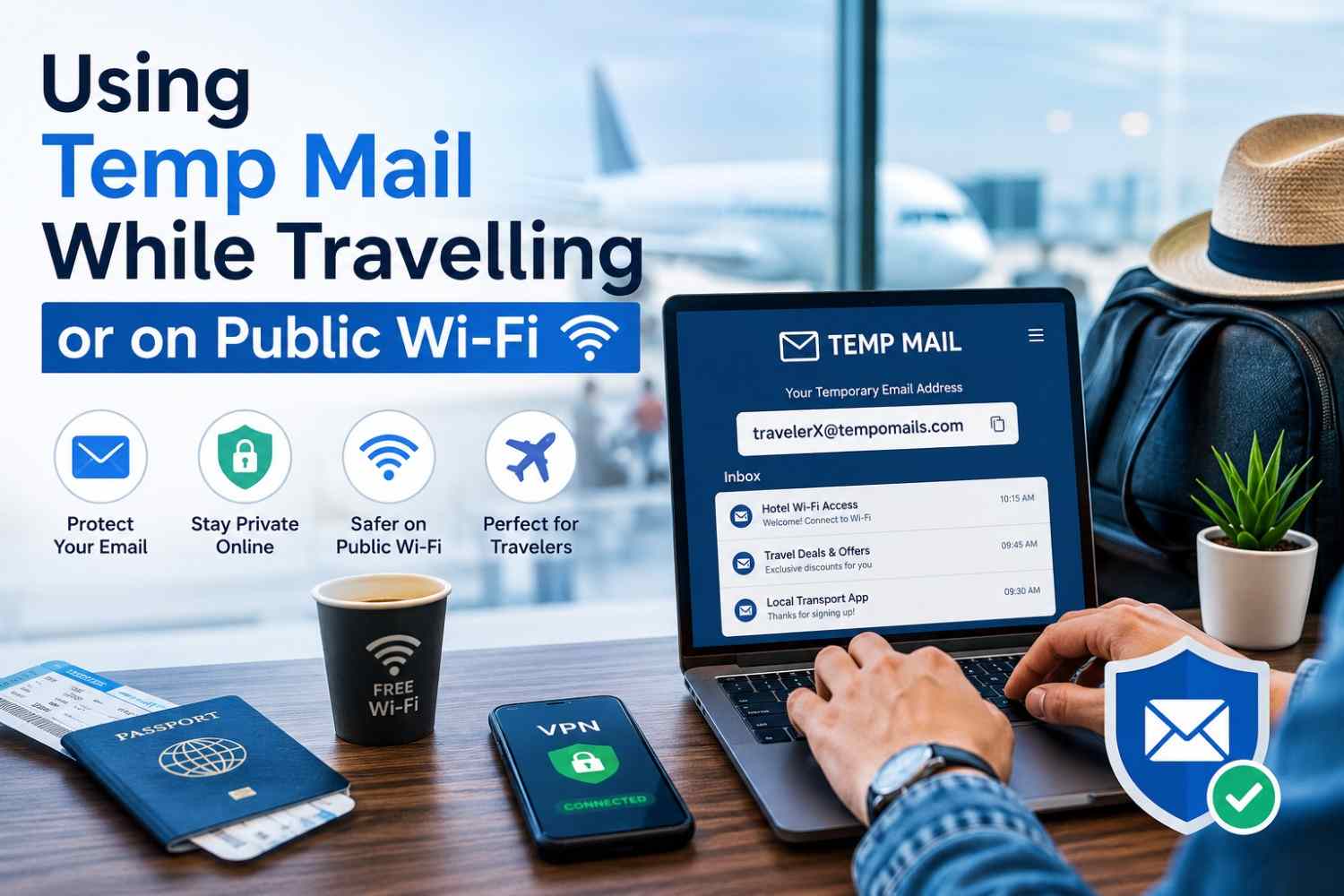
Using Temp Mail While Travelling or on Public Wi-Fi
Using Temp Mail While Travelling or on Public Wi-Fi
Quick Answer: Using temp mail while travelling or using public Wi-Fi helps keep your personal email private. It has the ability to guard your primary inbox against spam, junk mail and certain threats on the internet. A temporary email will allow you to use it when registering for hotel Wi-Fi, travel apps, and other temporary services. But it is not the best option when it comes to major accounts and sensitive data.
Public Wi-Fi is commonly used by people on the move. You can find it in airports, hotels, cafes, and other public places. Although the convenience of using public Wi-Fi is present, it may pose privacy and security threats as well. Hackers may occasionally attack unsecured networks to gather user data or carry out a phishing attack.
These risks can be minimized with a temporary email address. You can use a temporary email address in instances of one-time sign-ups and when you are travelling, so that you do not need to use your own email everywhere. This maintains a cleaner inbox and assists in guarding your personal details. If you're new to the concept, our guide on what temp mail is and how it works covers the basics in more detail.
Nowadays, an increasing number of travellers seek convenient methods to remain anonymous online. A reliable temporary email generator makes it easy to create a disposable inbox in seconds.
Key Takeaways
Temp mail can assist you in keeping spam and marketing emails out of your primary inbox.
- It provides an additional level of privacy concerning shared Wi-Fi networks.
- It is useful for hotel Wi-Fi signups, travel apps, and temporary registrations.
To be safer on the Internet, consider temp mail, a VPN and safe browsing.
What Does Using Temp Mail While Travelling or on Public Wi-Fi Mean?
Temp mail when on the move or on open Wi-Fi refers to the use of a temporary email address in place of your personal email to conduct short-term online transactions. This is useful in safeguarding your primary inbox when connecting to other networks in airports, hotels, cafes, or co-working environments. For a deeper technical breakdown, see how temp mail works.
A lot of travel services require that a user enter an email address. To illustrate this, one might be required to connect to hotel Wi-Fi, subscribe to local transportation apps, get travel discounts, or get access to public internet services. Using your primary email to complete all these signups can result in spam, advertising, and privacy issues, which is why a temporary address is the safer choice.
A temporary email provides you with a separate inbox for these one-time registrations. When you do not require the email anymore, it is possible to just stop using it. This keeps your personal email clean and reduces the amount of unwanted mail later on.
This can be easily done through a temp mail service that offers temporary email addresses accessible instantly by travellers whenever they need temporary access to online services. This means that users will have greater privacy, yet remain connected when they are on their trips.
Why Public Wi-Fi Can Be Risky for Your Personal Email
Public Wi-Fi Networks are not always secure.
Public Wi-Fi is a common internet connection which is used by a large number of individuals simultaneously. Free Wi-Fi can be offered at airports, hotels, cafes, and shopping centres, which might not have a high level of security measures.
Cybercriminals Can Target Public Networks
Hackers tend to seek openings on communal Wi-Fi networks. They can provide false hotspots, phishing sites or tricks to gather personal data from unsuspecting users.
Your Personal Email Contains Valuable Information
The majority of email accounts contain valuable information such as passwords, account recovery links, banking alerts, and personal discussions. When a person accesses your email account, they can be able to access other online accounts.
Public Wi-Fi Can Increase Privacy Risks
When you use your main email on social networks, your personal data can be put at risk. Hence, tourists are advised not to do so when using sensitive accounts on unsecured connections.
Benefits of Using Temp Mail While Travelling
Helps Keep Spam Out of Your Main Inbox
Numerous travel sites, promotions, and free Wi-Fi providers also market following registration with marketing emails. A disposable email will stop these emails from showing up in your personal mail.
Protects Your Personal Email Address
You will not need to provide your main email to various services on a trip and can rely on a temporary one, as well as keep your personal contact data confidential. Curious how this compares to other privacy options? Check out temp mail vs email alias vs masked email.
Reduces Your Digital Footprint
Temp email also reduces the number of sites and services holding your actual email address. This can help to minimise undesired communication and privacy issues in the future. For another angle on protecting your identity while travelling, see our comparison of disposable email vs virtual phone number.
Makes Quick Signups Easier
Travellers might have to subscribe to local applications, Wi-Fi data, or travel offers. Temp mail gives the option of quickly registering without any long-term commitment. This same approach works well for social apps too - see our guide on using temp mail for Snapchat sign-up.
Adds an Extra Layer of Privacy
A disposable email service and similar tools provide users with a dedicated, temporary inbox that offers a higher level of privacy when on the road.
How to Use Temp Mail Safely on Public Wi-Fi
Use a VPN Whenever Possible
VPN secures your internet connection and offers extra security when connecting to hotel, airport, or cafe Wi-Fi networks.
Use Temp Mail for Low-Risk Registrations
Wi-Fi registrations, newsletters, travel deals, and short-term web registrations are best done with temporary email addresses.
Verify Websites Before Entering Information
Always ensure that a site is authentic before giving such information. Find secure web communications and registered domain names. Keep in mind that not every site accepts disposable addresses - read why some websites block temp mail domains to avoid signup issues.
Avoid Sharing Sensitive Information
Do not use temp mail for banking details, personal documents, or confidential communications.
Follow Basic Cybersecurity Practices
Always keep your device up to date, make sure you use strong passwords, and use multi-factor authentication in significant accounts where possible.
Situations Where You Should NOT Use Temp Mail
Temp mail is not suitable for every online activity. Although it is very useful with temporary registrations, certain services may need a permanent email address to ensure security, account recovery and further communication. If you're concerned about the legal side of things, our article on whether using a temporary email is illegal explains what the law actually says.
Banking, digital wallet, and investment accounts.
- Visa, passport, and government services.
- Flight, hotel, insurance, and car rental bookings.
- Work emails, business accounts, and client communications.
Social media, cloud storage, subscriptions, and education portals.
A simple rule to remember: Use temp mail for short-term and low-risk registrations. You should always use your main email address when dealing with important accounts and services which you may require in future. Wondering about the technical limits? Find out whether a temporary email can receive attachments.
FAQs
Is it safe to use temp mail on public Wi-Fi?
Yes, temporary email can be more secure than temporary registration via personal mail with a public Wi-Fi. Your primary inbox is safe even if the registration information is disclosed. Nevertheless, you are not supposed to expose confidential information on unsecured networks.
Can temp mail protect me from spam while travelling?
Yes. One of the biggest benefits of temp mail is spam prevention. Temporary email addresses are widely used by travellers to access hotel Wi-Fi, travel promotions, and to create a temporary email address to sign up for public internet services to avoid unwanted email items in their inbox.
Can I use temp mail for hotel or airport Wi-Fi registration?
Yes. Most travellers have been using temporary email addresses where Wi-Fi providers demand an email to use public Wi-Fi. This will save the marketing emails in the future and also protect your main inbox.
Can I use temp mail for Airbnb, Uber, or other travel apps?
Temp mail can be used for testing or one-time registrations. Nonetheless, switching to a permanent email address is recommended if you intend to use the service often to get updates and access your account in case of necessity. Not sure which type of disposable inbox suits you best? Compare 10 minute mail vs temp mail.
Does temp mail make me completely anonymous online?
No. Temp mail covers your email address, yet websites have access to information, including your IP address and device data. Use temp mail with a VPN and safe browsing to enjoy greater privacy.
Conclusion
When travelling or using public Wi-Fi, it is an easy method to enhance your online privacy by using temp mail. It helps protect your personal inbox from spam, unwanted marketing emails, and unnecessary exposure when signing up for temporary services. Be it hotel Wi-Fi, airport Wi-Fi, or travel apps, a disposable email can provide an extra layer of security.
Nevertheless, temp mail is not used in place of your main email. Banking, travel bookings, government services and other valuable accounts are still to be done using personal email. In short-term registrations, a reliable temp mail service can assist travellers to keep their messages in order, avoid spam, and guard their personal data whilst travelling.
Author Expertise
Sarah Bennett, a digital privacy and cybersecurity writer with over 6 years of experience covering online safety, email protection, and temporary email tools, leads our research into internet privacy and public Wi-Fi threats. She regularly tests and reviews services such as a temp mail generator to help travellers understand how disposable inboxes keep their real data secure.