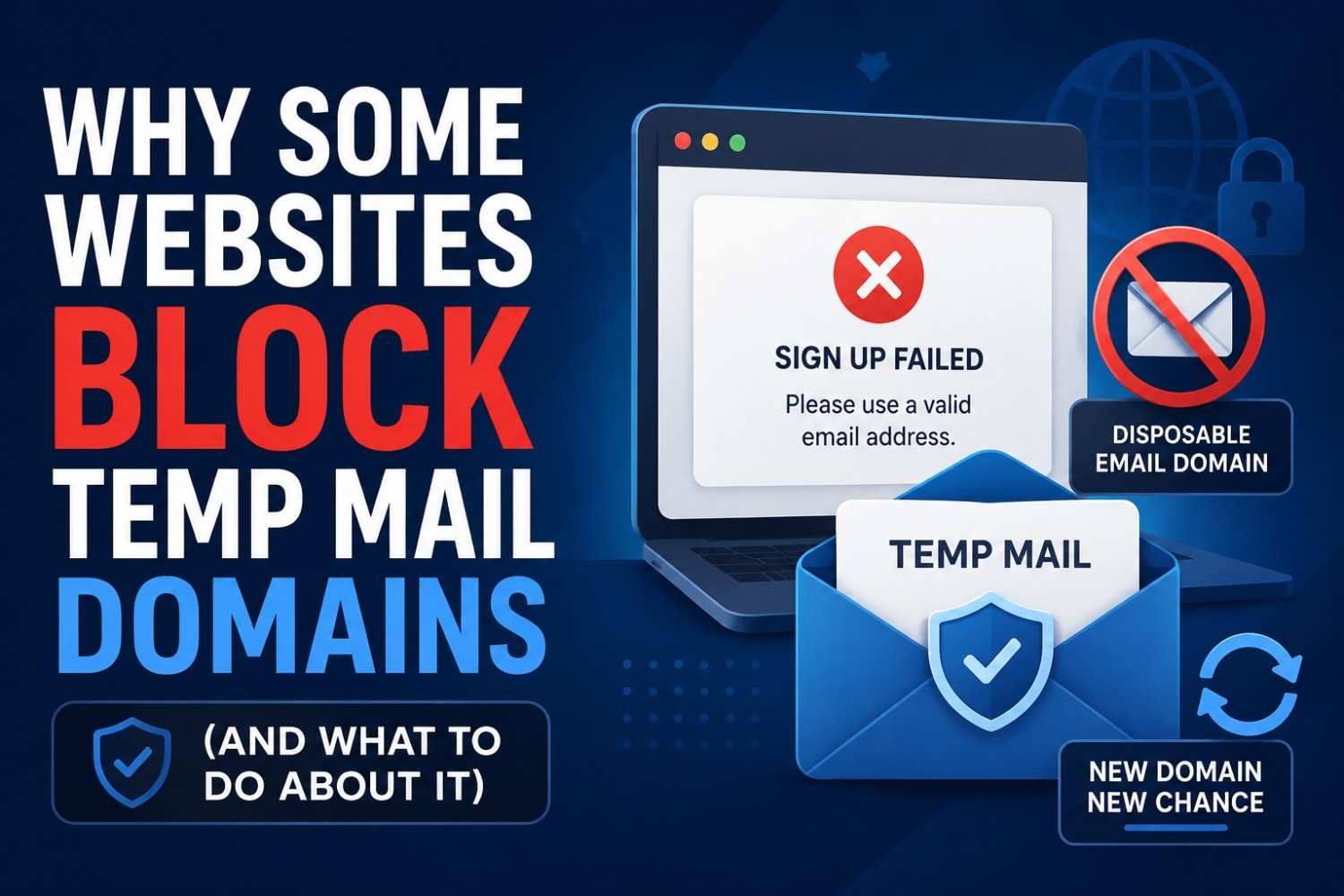
Why Some Websites Block Temp Mail Domains (and What to Do About It)
Quick Answer: Why do websites block temp mail? Most platforms block disposable email domains to prevent abuse, including the use of free trials, multiple account creation, and fake registrations. Detection works at the domain level using publicly maintained blocklists. Tempomail addresses this through regular domain rotation, ensuring the majority of websites continue accepting temporary addresses for legitimate privacy-focused use.
You paste a Tempomail address into a signup form. The website returns an error: "Please use a valid email address." The address is valid. The domain is the problem.
Website blocking of temp mail is one of the contentious issues in the ongoing battle to protect user privacy. This can be very upsetting if you don't know what is going on and what you can do about it. If you're new to the concept, our guide on what temp mail is and how it works covers the basics before diving into blocking specifics.
According to the 2026 Email Validation Industry Report, Verifymailer found that the number of major consumer websites with a disposable email blocklist has increased dramatically, from 19% in 2023 to 34% in 2026, representing a substantial uptick in email domain restrictions on these websites over the three years.
Key Points
- Why do websites block temp mail comes down to abuse prevention — platforms lose revenue when users bypass trial limits using disposable addresses.
- Temporary email detection works by checking submitted domains against a disposable email blocklist, not by analysing the address itself.
- Email domain restrictions apply to the service's entire domain, meaning rotating to a fresh domain resolves most blocking scenarios instantly.
- Tempomail rotates its available domains regularly to maintain broad compatibility across the majority of websites and services.
Why Do Websites Block Temp Mail in the First Place?
Temporary email detection is the process by which a website or email validation service checks submitted addresses against a known list of disposable email domains and rejects those that match, preventing registration or form submission from addresses on the list.
The primary motivation is commercial. Free trial platforms lose revenue when the same user creates multiple accounts using different disposable addresses to extend free access indefinitely. Subscription services face the same problem: temporary addresses make it easy to bypass payment requirements through repeated trial account creation.
Secondary motivations include data quality. Marketing teams building email lists prefer addresses connected to real users who will actually open and engage with future messages. A list populated with expired disposable addresses generates no engagement and distorts campaign metrics.
A third motivation is fraud prevention. Some platforms associate disposable addresses with elevated fraud risk, particularly in financial services, marketplace environments, and identity-sensitive applications.
None of these motivations categorises temp mail usage as harmful by nature. They reflect platform-specific business requirements that treat all disposable addresses the same, regardless of the individual user's intent.
Key Benefits of Knowing Why Websites Block Temp Mail
Understanding why websites block temp mail and how domain rotation works gives users three practical advantages.
- Faster problem-solving. When a signup fails, you immediately know the issue is domain-level blocking, not an invalid address. Simply generate a fresh temporary email address and resolve most cases in under 30 seconds.
- Smarter tool selection. Knowing which platforms use aggressive blocklists helps you decide when temp mail is the right tool and when a secondary permanent address is the better choice. Comparing temp mail vs email alias vs masked email options can make that decision easier.
- Reduced friction. Tempomail's domain rotation strategy handles the technical side automatically. Users benefit from broader compatibility without needing to understand or manage domain blocklists themselves.
- Privacy maintained. Even when one domain is blocked, the ability to generate a new disposable email address keeps the real inbox protected. No personal data needs to be submitted to a platform simply because its blocklist rejected the first attempt.
How Temporary Email Detection Actually Works
A disposable email blocklist is a maintained database of known temporary email service domains that email validation tools check submitted addresses against in real time during form submission.
Detection operates entirely at the domain level. The validation tool does not analyse the username or the message content. It extracts the domain portion of the submitted address and checks it against its blocklist database.
If the domain appears on the list, the submission is rejected. If the domain does not appear on the list, the submission is accepted regardless of whether the address is genuinely permanent or temporary.
This is the fundamental vulnerability in domain-based blocking: it blocks specific known domains, not the concept of temporary email addresses. A temp mail service that rotates to a domain not yet on the blocklist bypasses the restriction entirely.
Tempomail rotates its available domains regularly. Fresh domains those not yet added to blocklist databases pass validation on the majority of platforms. The rotation cycle is designed to stay ahead of blocklist updates, maintaining compatibility across the widest possible range of websites.
What Email Domain Restrictions Actually Block
Email domain restrictions create a two-tier outcome. Established disposable email services with long-running domains accumulate blocklist presence over time and face increasing rejection rates on mainstream platforms. Services that rotate domains frequently face lower rejection rates because their fresh domains have not yet been catalogued.
The restriction does not block the intent, only the specific domain. This is why email access policies are an imperfect protection mechanism from the platform's perspective and a solvable inconvenience from the user's perspective.
It also means that the experience varies significantly by platform. A healthcare portal with strict identity requirements may use an aggressive blocklist that rejects virtually all disposable domains. A content publication using basic email validation may accept a fresh Tempomail domain without issue.
Kickbox's 2026 Email Verification Benchmark Report found that blocklist databases covering disposable email domains vary enormously in scope, with the smallest containing around 800 domains and the largest containing over 110,000, resulting in highly inconsistent blocking behaviour across different platforms using different validation tools.
What to Do When a Website Blocks Your Temp Mail Address
How to Use Tempomail to Work Around Domain Blocking
The process takes under one minute and requires no technical knowledge.
Step 1 — Close the current Tempomail tab
The existing address is tied to a specific domain. Closing the tab ends that session and clears the address from the active registry.
Step 2 — Open a fresh Tempomail session
Open the temp mail generator again and a new address is generated automatically on a different domain. No input required.
Step 3 — Copy the new address and retry the signup
Paste the freshly generated address into the same form that rejected the previous attempt. Domain rotation means the new address may sit on a domain not yet present on the platform's blocklist.
Step 4 — If blocked again, assess the platform
A second rejection indicates the platform uses a broad-coverage blocklist. For these cases, use a dedicated secondary permanent email account for that specific signup, keeping it separate from your primary inbox while maintaining access to that service.
Step 5 — Check other forms on the same website
Registration forms typically use stricter validation than newsletter signup forms, content access gates, or follow-up submission forms on the same platform. A freshly generated Tempomail address may pass validation on a different form even when the registration form rejects it.
Which Platforms Are Most Likely to Block Temp Mail?
Understanding the blocking landscape helps set expectations before attempting a signup.
- High blocking likelihood: Financial services, healthcare portals, gaming platforms with free-tier limits, streaming services offering trial periods, and any platform where multiple account creation affects revenue. These services typically use enterprise-grade validation tools with broad blocklist coverage.
- Moderate blocking likelihood: E-commerce platforms, SaaS tools with freemium tiers, and professional networking services. Blocking is common, but inconsistent fresh Tempomail domains often pass validation on the first or second attempt.
- Low blocking likelihood: Content publications, community forums, newsletter platforms, and informational websites where email collection supports marketing rather than access control. Basic email format validation is typically the only check applied.
Conclusion
Why do websites block temp mail is a question with a straightforward commercial answer: platforms protect free trial revenue and data quality by rejecting known disposable domains. The blocking mechanism is domain-level detection, not a response to harmful behaviour.
Tempomail's domain rotation strategy directly addresses this by keeping fresh domains ahead of blocklist cataloguing. For the majority of platforms and use cases, the free temp mail service continues to work without restriction.
For the minority that applies aggressive blocking, understanding the mechanism helps users choose the right alternative quickly rather than spending time troubleshooting an avoidable friction point. Start with our full guide to what temp mail is for the complete picture before applying these workarounds.
About the Author
The Tempomail Editorial Team specialises in disposable email tools, inbox privacy architecture, and platform compatibility research. The team tests temporary email behaviour across major platforms regularly and updates content to reflect current blocking patterns, domain rotation effectiveness, and user privacy best practices. Findings are based on direct, hands-on signup testing across live platforms rather than third-party reporting. Last Reviewed: August 2026
FAQs
Does every website have a disposable email blocklist?
No. Approximately 34% of major consumer platforms use blocklist-based validation. The majority of websites accept all syntactically valid email addresses without checking against a disposable domain database.
Can Tempomail bypass email domain restrictions completely?
Not on every platform. Aggressive blocklist tools with broad coverage may reject all domains associated with temp mail services. Fresh domain rotation resolves blocking on most platforms, but not all.
How do blocklist databases get updated with new temp mail domains?
Blocklist providers use automated crawling, user reports, and honeypot submissions to identify new disposable email domains. The lag between a domain being deployed and being added to blocklists creates the window that domain rotation exploits.
Is it against any law to attempt to use temp mail on a website that blocks it?
No. Attempting to submit an address that a website rejects results in a failed submission, not a legal or contractual violation. No obligation exists to disclose that an address is temporary before a form is submitted. For more detail on whether using a temporary email address is illegal, the legal position stays the same across use cases.
What is the fastest workaround when temp mail is blocked?
Create a new temporary email address instantly in a fresh session. Different sessions may produce addresses on different domains. If the second attempt also fails, the platform uses broad blocklist coverage, and a permanent secondary address is the better choice.
Why do some pages on the same website accept temp mail while others block it?
Different form types often use different validation tools or validation strictness levels. Registration forms typically use the strictest validation. Newsletter forms and content access points frequently use looser validation that accepts a wider range of addresses.
Does using a VPN help bypass temporary email detection?
No. Temporary email detection is based on an email domain provided in the form and not on the IP address of the device providing the email. Using a VPN will not alter the email domain; it will only alter the IP address and will not impact blocklist-based rejection.
How does Tempomail decide which domains to rotate to?
Tempomail monitors blocklist cataloguing activity and deploys fresh domains before existing ones accumulate significant blocklist presence. The rotation strategy prioritises domains that pass validation on the highest volume of commonly used platforms.
Related Source:
Is Using a Temporary Email Illegal? What the Law Actually Says
How Does Temp Mail Work? SMTP, Domains and Inbox Explained (Simple Guide)
Can a Temporary Email Receive Attachments, Images and Files?
Temp Mail and GDPR: What EU Privacy Law Says About Disposable Email