Temp Mail vs Real Email: Key Differences You Should Know
Temp Mail vs Real Email: Key Differences You Should Know
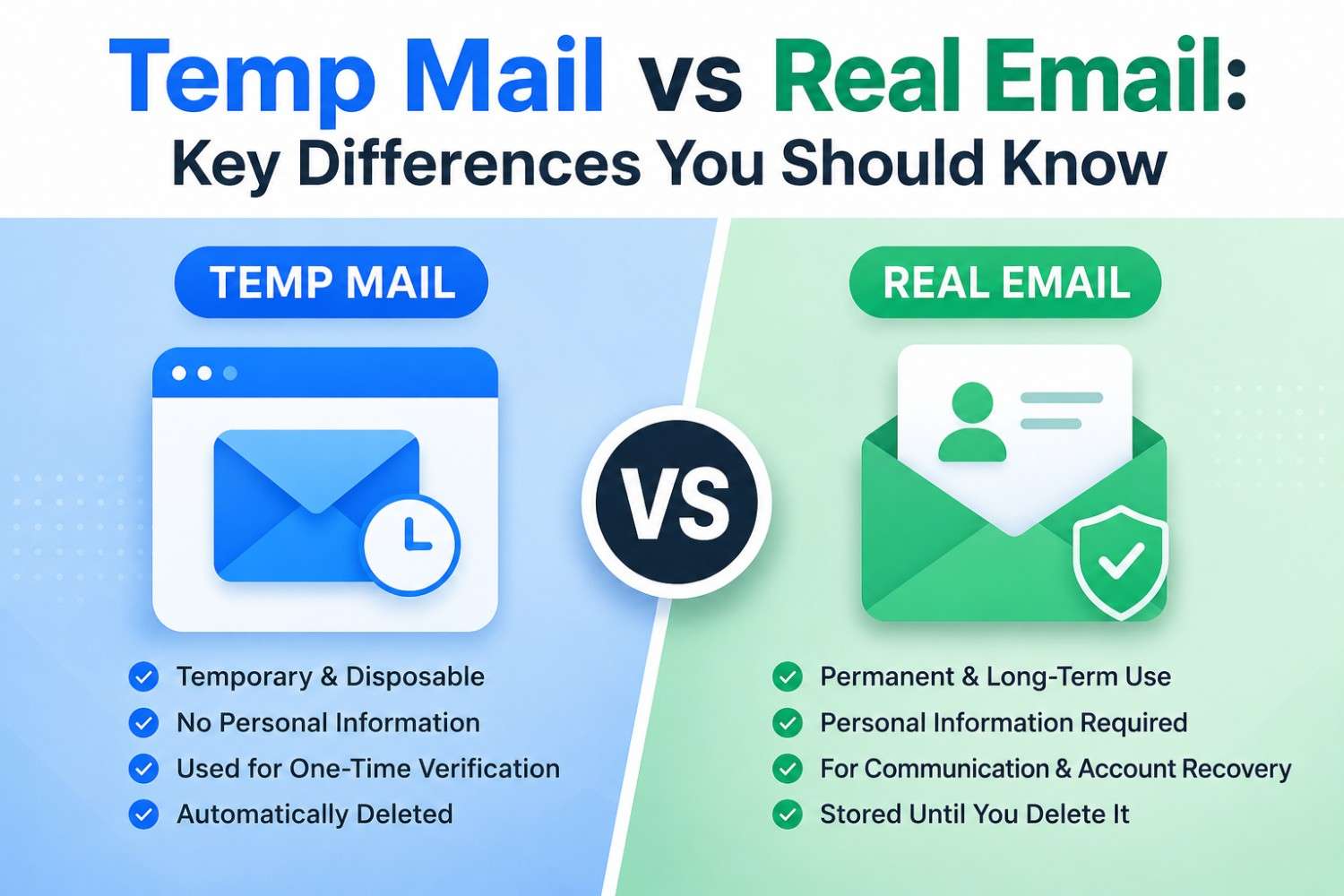
Quick Answer: The temp mail vs real email distinction comes down to purpose and permanence. A real email account is built for identity, communication, and long-term access. The idea behind temp mail is to use it for one purpose – to receive a confirmation or verification, and then it vanishes. They are all for different things, and knowing which one fits your situation keeps your primary inbox clean and lowers your exposure to spam and identity theft. Last Updated: July 2026
Important Points
- The idea behind temp mail vs real email is not a competition; each has a different purpose, and using both simultaneously is the best way to go about things.
- Temporary email benefits are immediate setup, no personal information leaks, and automatic deletion without maintenance.
- A permanent email account handles identity, relationships, and long-term account access where recovery matters.
- An anonymous email address through Tempomail is the right choice whenever a website demands an email but has no legitimate ongoing communication need.
Two Tools With Two Different Jobs
Comparing temp mail vs real email, then the two are not being compared appropriately, and the results will be incorrect. The question's not what's best, it's what's right. Using your regular email account for every signup is like sharing your home address with every store you visit.
Using temp mail for everything important is like trying to receive a bank statement at a phone booth. Both approaches create problems. The right approach is knowing when each one applies. This practice is part of a broader approach known as disposable email addressing, used for over two decades to limit spam and protect primary inboxes.
Radicati Group's 2026 Email Statistics Report found that the average professional receives 126 emails per day, with 49% classified as unsolicited or promotional, the majority traceable to signup forms where a regular email account was submitted instead of a disposable alternative.
What a Permanent Email Account Actually Provides
A permanent email account is an active inbox that's tied to a particular identity, maintained by the mail provider for an extended period, and utilized in subsequent communications, account recovery, and identity verification in services that require long-term access.
A regular email account is the correct tool for situations where losing access would have real consequences. Banking and financial services require it because account recovery depends on reaching a live inbox.
Work and professional communication require it because contacts need to reach you reliably over time. Any platform where you build history, purchase content, or maintain a subscription requires a real email because recovery access depends on it.
The regular email account is also what carries your reputation. Senders remember it. Services link their records to it. It is, in a meaningful sense, part of your digital identity.
What Temp Mail Actually Provides
A session-based disposable inbox, Temp Mail creates an email address without a name, which receives messages in real-time, and then automatically removes everything when the session expires. New to the concept? Our simple guide explains what a disposable email address is and how it works from the ground up.
Temp mail is the correct tool when the situation requires email verification but offers no benefit worth the long-term exposure of your real address. A free trial that markets to you afterwards.
A one-time download behind a registration wall. A forum signup where you want to comment once. A promotional discount that requires email entry. If you want a closer look at where those limits matter most, our breakdown of temp mail's safety and privacy limits covers it in detail.
In all of these situations, temporary email benefits include zero inbox pollution, zero identity link, zero ongoing commitment, and zero maintenance. This completes the task. The inbox disappears.
Side by Side: The Core Differences
The simplest way to understand the disposable email comparison is to look at what each option does across five practical areas.
- Setup time. A permanent email account takes several minutes and requires a name, phone number, and often a secondary email. A free temporary email generator takes zero seconds of active effort; the address appears when the page loads.
- Personal data required. A long-term email account is tied to your identity by design. An anonymous email address from Tempomail is connected to nothing and no one.
- What happens to incoming messages. A permanent account stores messages indefinitely and builds a searchable history. Tempomail's session inbox holds messages only for the active session and deletes everything permanently when it ends. Curious about the mechanics? We break down how temporary email actually works behind the scenes.
- Spam exposure. Every signup using a long-term email account is a potential spam source. Every signup using Tempomail sends future spam to an address that no longer exists.
- Recovery access. A regular email account enables password resets, security alerts, and account recovery for the services it is registered to. Temp mail enables none of this, which is exactly why it should not be used for accounts where recovery access matters.
NordVPN's 2026 Digital Privacy Index found that users who adopted a split email strategy using a permanent account for identity-linked services and a disposable alternative for low-stakes signups reported 71% fewer spam emails within 30 days compared to users relying on a single permanent address for all interactions.
When Temporary Email Benefits Outweigh Permanent Account Use
The disposable email comparison becomes practical when applied to real decisions. These situations consistently favor temp mail over a real address.
Accessing any service that requires email to give you something once a code, a download, a trial period- and has no legitimate reason to contact you afterwards. Registering on platforms where you are uncertain about their data-sharing practices.
Testing services from a developer or quality assurance perspective without accumulating real user records. Engaging with communities or marketplaces where providing your real contact details to other participants creates unnecessary risk. This applies just as well to everyday shopping, like handling a one-time verification code for an Amazon account.
In none of these situations does a long-term email account offer any advantage. You can complete the task with Tempomail. The real inbox stays clean.
When a Permanent Email Account Is Non-Negotiable
Financial accounts, healthcare platforms, government services, and any subscription with a billing cycle require a permanent email account because the consequences of losing email access missed payment alerts, locked account recovery, missed security warnings- carry real financial or safety implications. We cover this in more detail in our guide on whether a disposable address works for payment platforms like PayPal.
A real address is essential for professional communication and for building ongoing relationships, as reliability and continuity are important to the individuals on the receiving end of the communication
The rule is straightforward. If you would need to recover the account in a year, use a personal email address. If you would not recognize the sender in a year, use a disposable email address instead.
About Tempomail
Written by Alex Bennett, Senior Privacy Content Strategist at Tempo Mails, who researches email security and disposable inbox systems and reviews this guide regularly to reflect current platform behavior and email practices. Instant disposable inboxes, zero registration, zero stored data. Generate an anonymous email address, receive messages in real time, and protect your real inbox automatically, every time.
FAQs
Can I switch between temp mail and real email depending on the situation?
Absolutely. The most effective approach is using a disposable email service for low-stakes signups and a regular email account for identity-linked services, not choosing one over the other entirely.
Will websites treat my submission differently if I use temp mail?
Many websites do not actively distinguish between disposable and permanent email addresses during submission, although some platforms maintain blocklists for known temporary email domains. Tempomail rotates domains regularly to maintain broad compatibility.
Is there any risk to my real inbox from using temp mail alongside it?
No. Tempomail keeps every session completely separate from other email services. Using Tempomail alongside a permanent account creates no connection between the two.
What happens to messages sent to a Tempomail address after the session ends?
They go undelivered. The address no longer exists on Tempomail's server after the session ends, so sending mail servers receive a non-delivery response.
Does using an anonymous email address create any legal issues?
No. Most jurisdictions allow people to use a throwaway email address for verification. Many also recognize it as a standard privacy practice. Check the terms for the services they offer for any specific platform.
Can temp mail replace a real email account entirely?
No practical way to do this exists. Services requiring ongoing access, payment records, and account recovery all depend on a reachable permanent inbox. Temp mail complements a real account; it does not replace one.
How does Tempomail handle messages that arrive after the session closes?
After the session expires, Tempomail removes the generated address from the active server state. Subsequent delivery attempts fail at the server level with a standard non-delivery response.
Is Tempomail safe to use on a shared or public device?
Yes. Since Tempomail requires no account login and retains no data, there is no session information left on the device that could expose the inbox to another user after the tab is closed.