Temporary Email Safety Explained: Risks, Privacy and Smart Usage
Temporary Email Safety Explained: Risks, Privacy and Smart Usage
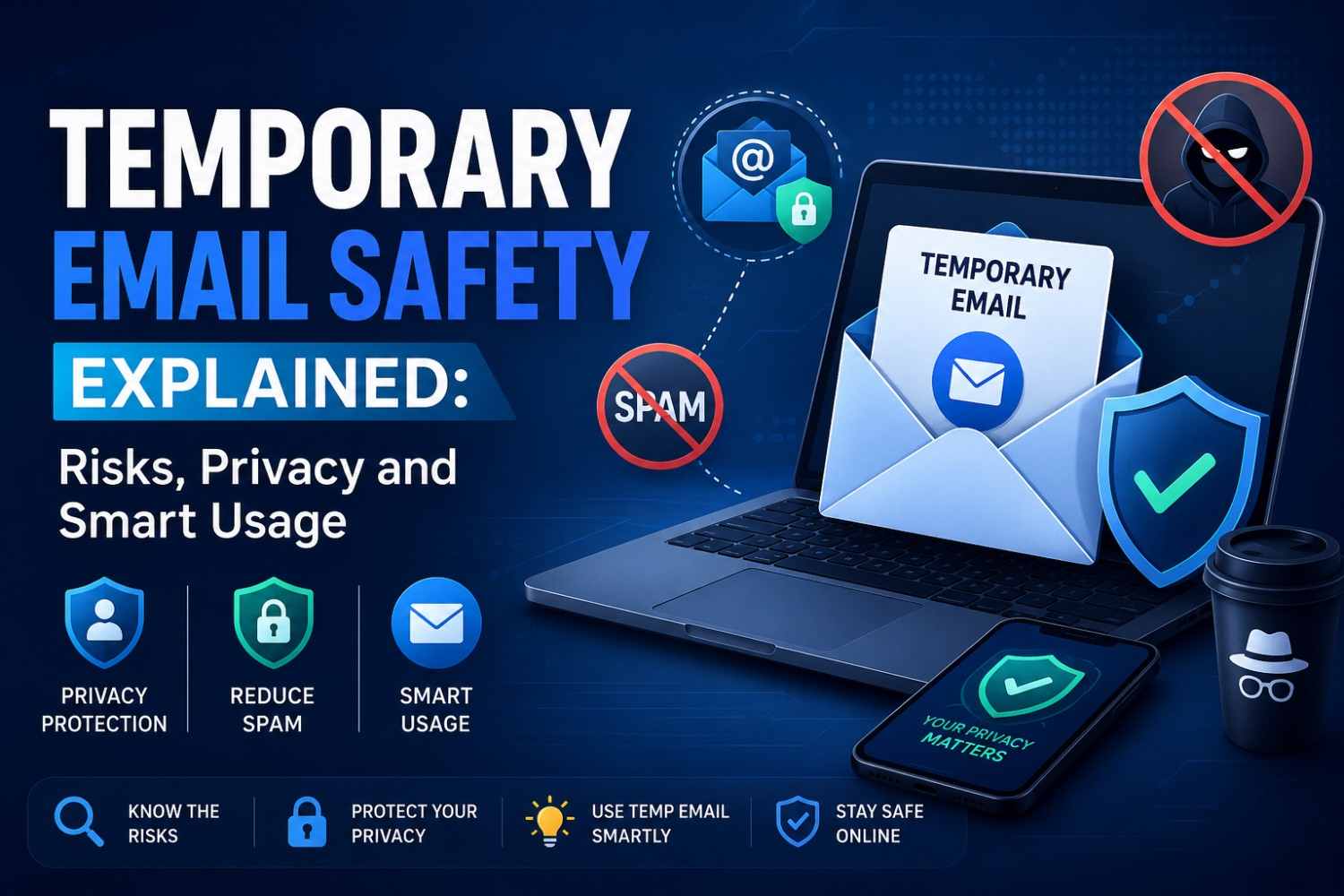
Quick Answer: Temporary email safety depends on how and where it is used. If you're using disposable email for a one-time verification, content download, or trial sign-up, it is actually safe. It is also more private than a real address. For financial accounts, recovery-dependent platforms, and identity-sensitive services, the temporary inbox risks outweigh the privacy benefit. Matching the tool to the situation is the entire strategy. You can also generate a free temporary email address in seconds if you want to try it yourself.
Disposable email is misunderstood in both directions. Some users assume it is inherently risky. Others use it everywhere without considering where it creates problems. The truth is situational. For background, see what a temp mail service actually is and how it works before deciding when to use one.
Phishing campaigns frequently target email addresses harvested from website registration forms, which is why deciding which email to submit — real or disposable — is one of the highest-impact daily privacy choices an internet user makes.
Main Points
- Temporary email safety is strongest for registration-only interactions where no ongoing email access is needed after the initial verification step.
- Disposable email security is architecturally superior to permanent email for breach exposure, because session-memory deletion leaves no persistent data for attackers to extract.
- Temporary inbox risks are real and specific: account recovery fails, 2FA codes cannot be delivered, and any platform that sends critical notifications after session end becomes unreachable.
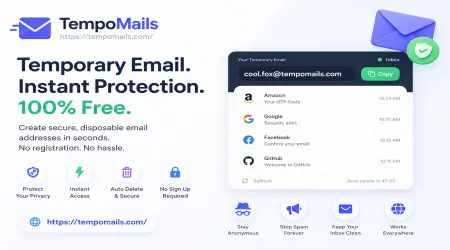
- Anonymous email privacy through Tempo Mails is zero-collection by design; The system retains no name, IP address, or session log after the tab closes.
What Makes a Temporary Email Safe?
Architecture Is the Foundation
Tempo Mails holds messages in session memory rather than writing them to a permanent database. When the session ends, the address is removed from the active registry, and all messages are cleared.
This is not a deletion policy; it is an architectural consequence. No data exists after the session ends, so breaches, subpoenas, or retention cannot affect it.
No Collection, No Risk
Standard email providers collect names, IP addresses, device identifiers, and usage patterns. Tempo Mails collects none of these at any stage. A disposable email session leaves no fingerprint on any server after it closes.
The Sender Cannot Reach Back
Every marketing email, phishing attempt, and data broker message directed at an expired Tempo Mails address goes permanently undelivered. The address does not exist in any reachable form after session end.
Where Disposable Email Security Holds
One-Time Verifications
Any platform that sends a single confirmation link or code then requires no further email contact is a safe use case for temporary email. The verification completes during the active session. Users do not need or expect any subsequent email contact.
Free Trials and Content Access
Streaming trials, SaaS evaluations, gated content, and promotional discount registrations all trigger email-based marketing sequences that serve no genuine user benefit. Disposable email absorbs the verification and eliminates the downstream marketing exposure.
Anonymous Account Creation
Forums, communities, and platforms where posting anonymously is the point benefit from temporary email. The user creates the account and completes verification. No email trail connects it to a real identity. This is also why some platforms block temp mail domains outright, since anonymity cuts both ways.
Developer and QA Testing
Test accounts for registration flow testing, email delivery verification, and API integration work are the cleanest use case for disposable email. Each test generates a fresh address, completes cleanly, and leaves no residual data in any system. Teams that need this at scale often look into automating disposable email testing with a temp mail API, or simply use a temporary email generator for one-off runs.
Where Temporary Inbox Risks Are Real
Account Recovery
Registered email is also used to receive recovery tokens and password reset links, which are typically sent after registration, e.g., days or weeks later. An expired Tempo Mails address cannot receive them. Accounts created with disposable email have no recovery path once the session ends. This is a direct consequence of how temp mail sessions actually work behind the scenes.
2FA Code Delivery
Platforms that deliver two-factor authentication codes by email depend on inbox access. An expired Tempo Mails address blocks 2FA delivery. This can happen during a new device login, suspicious activity trigger, or security review.
Financial Platform Notifications
Withdrawal confirmations, transaction alerts, and billing communications on financial platforms require a reliably accessible inbox. An expired address makes these communications undeliverable, creating operational gaps that can result in missed fraud alerts or blocked transactions. It also raises a related question: whether a temporary inbox can receive attachments at all during that window.
KYC Communication Interruption
Regulated platforms conducting identity verification send documentation requests, status updates, and approval notices during the KYC review period. A Tempo Mails address that expires mid-review interrupts this process at a sensitive stage. If you are unsure where the rules stand, using a temporary email is legal in most cases, but KYC platforms still expect a reachable inbox.
Are Temporary Emails Safe? A Quick Decision Table
Use Case | Safe to Use Temp Mail? | Reason |
Newsletter signup | Yes | No recovery needed, marketing absorption |
Free trial access | Yes | One-time verification, no funds involved |
Forum or community registration | Yes | Anonymous participation, no financial risk |
Developer test accounts | Yes | No real data, controlled environment |
Social media (non-critical) | Yes, with caveat | Update email after signup for recovery |
Crypto exchange with real funds | No | Recovery and 2FA delivery required |
Banking and financial services | No | Legal and security communication needed |
KYC-required platforms | No | Mid-process communication required |
Government and healthcare portals | No | Compliance and recovery requirements |
Long-term subscription services | Partial | Create with temp mail, update before close |
Anonymous Email Privacy: What Tempo Mails Does Not Collect
Anonymous email privacy through Tempo Mails is absolute in scope because the zero-collection model applies before, during, and after every session. Before the session: no account creation, no registration data, no personal information of any kind.
During the session, the system holds messages in temporary server memory. It does not write message content to a persistent database. The system does not log user behaviour. After the session, the system removes the address from the active registry.
The system clears all messages. No backup exists. No server-side record of the session remains. This means that even if someone compromised Tempo Mails' infrastructure, they would have nothing to extract. The private email anonymity guarantee is structural, not dependent on security promises.
Smart Usage: The Hybrid Approach
For accounts where both privacy at registration and ongoing access matter, the right approach is sequential. Create the account with a Tempo Mails address. Complete the initial verification during the active session. This works the same way whether you compare it against a 10 minute mail service or decide to use Tempo Mails' free generator directly.
Before closing the tab, navigate to account settings and update the registered email to a dedicated permanent address. Confirm the update using the permanent inbox. Then close Tempo Mails.
This delivers temporary email safety at the registration data level: the original submission contains the disposable address, not the real one, while preserving full recovery capability, 2FA delivery, and notification access through the permanent address going forward.
Security researchers generally agree that a dedicated separation strategy, using disposable email for registrations and a separate protected permanent address for recovery-dependent accounts, meaningfully reduces exposure to successful account takeover attempts compared to submitting the same real email address across every platform.
Conclusion
Temporary email safety is real where it is applied correctly and limited where it is not. Disposable email security at the architecture level is structurally stronger than any permanent inbox for breach and phishing exposure. Temporary inbox risks are equally real for any account requiring ongoing email access.
The smart usage strategy matching disposable email to one-time interactions and permanent email to recovery-dependent ones eliminates both the privacy risk of submitting real addresses everywhere and the security risk of using disposable addresses where permanence is required. The same logic applies whether you are weighing disposable email against a virtual phone number, or specifically using temp mail for a crypto exchange signup. Either way, you can start with a free disposable email address and upgrade to a permanent one only when the platform actually requires it.
About the Author
Written by Priya Nathan, a data privacy analyst with 8 years of experience in email security and identity protection, who evaluates disposable email security, temporary inbox architecture, and anonymous email privacy across platforms and use cases. She has previously contributed research on inbox security to independent privacy publications and reviews Tempo Mails content for technical accuracy before publication. Content reflects current security research and is updated regularly to stay aligned with evolving platform requirements. Last Updated: August 2026
FAQs
Is temporary email safety guaranteed for all signups?
It is guaranteed for one-time verifications with no ongoing email need. For accounts requiring recovery or 2FA delivery after session end, a permanent address is the safer choice.
Does disposable email security protect against all phishing attacks?
It prevents phishing sent to the registered address after session end. Phishing targeting other accounts or arriving through other channels is outside the scope of what temporary email protects.
What are the main temporary inbox risks for social media accounts?
Loss of recovery access when the session expires. This is resolved by updating the registered email to a permanent address in account settings before closing the Tempo Mails tab.
How does anonymous email privacy work if Tempo Mails itself were breached?
No personal data would be exposed because none is stored. Session-memory architecture means no message content, address history, or user records exist on Tempo Mails' servers after session end.
Can I improve temporary email safety by keeping the tab open longer?
Yes. Session duration is tied to the tab remaining open. Keeping it open during multi-step verification processes ensures the inbox remains accessible throughout the entire flow.
Is disposable email security affected by the platform being signed up for?
No. Tempo Mails' security properties are independent of the destination platform. The address generates, receives messages, and deletes the same way regardless of which website it is submitted to.
Does using temp mail affect anonymous email privacy on shared devices?
No. Tempo Mails requires no login and stores no session data on the device. Closing the tab removes all accessible session information; no browsing history of inbox content remains.
When does the hybrid approach work best for temporary email safety?
For any account where both registration privacy and long-term access matter. Create with Tempo Mails, update to permanent email before closing the tab, and the account retains full functionality with registration-stage privacy intact. You can try the free temporary email generator now to see how the workflow feels in practice.