How Companies Collect, Share, and Sell Your Email Data
Quick Answer: Companies collect email addresses during registration, then share and sell your email data to advertisers, data brokers, and third-party platforms — often without users realizing it has happened. Understanding how this chain works explains why submitting a real email address to any low-stakes platform creates lasting exposure that extends far beyond the original signup
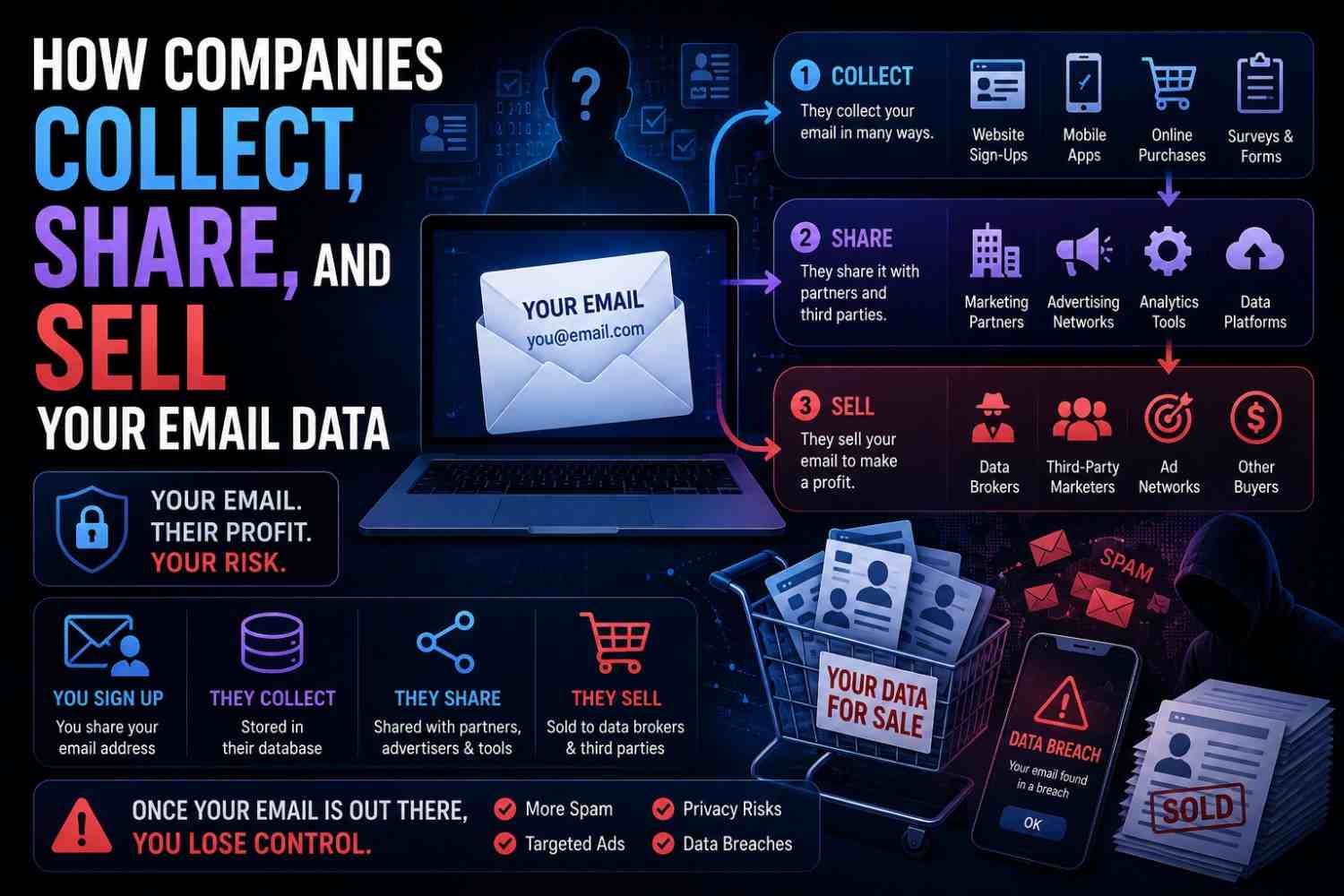
Submitting an email address to a website is rarely a one-party transaction. The moment it is entered, the data collection chain begins, and the original website is rarely the last stop.
Industry research on email data flows indicates that a single address can reach numerous third parties within weeks of being submitted, with the recipient list often expanding further through downstream transfers.
Main Points
- Companies sell your email data through broker networks, advertising platforms, and partner agreements that users implicitly accept through privacy policies.
- Email data collection begins at registration and continues through behavioural tracking and cross-platform identity linking.
- Consumer data privacy weakens every time a real email enters a new platform's database.
- Using a free temporary email generator like Tempomail prevents real email entry into the collection chain at the source.
How Email Data Collection Starts
Registration is the entry point. Platforms log email addresses entered into signup forms and link them to other submitted data. This may include names, locations, preferences, and browsing behaviour. Most platforms use email service providers such as Mailchimp, Klaviyo, or HubSpot to manage subscriber lists.
These providers operate across thousands of clients simultaneously, and their terms typically permit aggregated data use, meaning an email submitted to one client may inform targeting across the provider's broader network.
How Companies Share Email Data
Explicit third-party sharing
Most privacy policies include language permitting data sharing with named or categorised partners, including advertising networks, analytics platforms, and social media custom audience tools. Accepting the terms implies consent to this sharing.
Lookalike audience targeting
Platforms upload email lists to networks such as Meta or Google to create lookalike audiences. A real email in these lists enters the network's user-matching database.
Data broker transfers
Data brokers acquire email addresses through direct purchase, web scraping, and partnership agreements. Once compiled into a consumer profile, the address is sold to marketers, employers, insurers, and background check services.
How Companies Sell Your Email Data
The commercial market for email data remains large and largely invisible to individuals. Brokers sell email lists by demographics, purchase behaviour, location, and stated interests. A single address appearing in multiple segments commands a higher price than a single-segment one.
Consumer data privacy regulations in some jurisdictions require brokers to honour opt-out requests. In practice, enforcement is inconsistent, and re-acquisition from new sources is continuous.
Personal Information Tracking Through Email
Beyond the sale of addresses themselves, platforms use personal information tracking tied to the email address to build behavioural profiles. Email tracking pixels report when someone opens a message. They can also reveal the number of opens, device, and approximate location.
Companies tie this data to the email address. They use it to update engagement scores and trigger follow-up campaigns. Brokers may also use it to assess commercial value.
Every open of a marketing email generates a new data point. The address continues generating data indefinitely as long as the marketing sequence continues.
What Happens When a Platform Is Breached
Email data collection creates concentrated risk. When a platform stores millions of email addresses together, one breach can expose them all.
Stolen addresses allow credential stuffing on other platforms. These can also be used as a tool for targeted phishing. They can link leaked information with other data to create comprehensive records of identity.
A real email submitted to ten platforms creates ten independent breach exposure points. Using a disposable email address submitted to those same platforms creates zero; each address expires before any breach window opens — a clear example of how temporary email protects your identity during data breaches.
How Tempomail Breaks the Data Collection Chain
Stage | Real Email | Tempomail Address |
Registration | Enters platform database | Enters as already-expiring address |
Third-party sharing | Shared with partners | Shared but no longer reachable |
Data broker transfer | Compiled into profile | Not contactable, no value |
Marketing emails | Delivered and tracked | Undeliverable after session end |
Breach exposure | Active target | Expired, no attack surface |
Cross-platform linking | Enabled | Not possible |
Protecting Consumer Data Privacy Going Forward
For existing accounts where the real email is already registered, there are practical steps to take to protect your digital footprint, such as removing their details from data brokers, unsubscribing from existing senders, or enhancing the security of the accounts.
For new signups, using a temporary email generator prevents the real email from entering the collection chain entirely. The platform receives a working verification address.
The registration completes normally. When the session ends, the address expires; the collection chain has no active endpoint to exploit.
Survey research on digital privacy consistently shows that a large majority of Americans express concern over corporate data collection, while only a small fraction have ever filed a formal data removal request.
Conclusion
Companies collect, share, and sell your email data through systems most users never see and privacy policies most users never read. Tempomail breaks this chain at the point of entry: the address expires before any downstream sharing, personal information tracking, or breach exposure can use it as an active contact point.
Ready to stop your email data from entering that chain in the first place? Generate a free temporary email address right now, no signup required, or download the Tempo Mails Android app to keep your inbox protected on the go.
About the Author
Written by Elena Vasquez, a data privacy researcher with over eight years of experience studying how consumer information moves through advertising and data-broker networks. This article was reviewed by the Tempo Mails editorial team for accuracy and reflects current privacy research, breach data, and regulatory reporting. It is updated regularly as data-sharing practices and regulations evolve.
(FAQs)
Do all websites sell email data?
Not all, but a significant majority of marketing-active platforms share it with at least one third party. Privacy policies disclose this; most users accept without reading.
Can I stop a company from selling my email data?
Yes, in jurisdictions with data protection laws such as GDPR and CCPA, formal opt-out or deletion requests can compel removal. Enforcement varies, however, and re-acquisition from new sources is common.
Does unsubscribing remove my email from all sharing systems?
No. Unsubscribing removes the address from one sender's active list. It does not reverse transfers already made to data brokers or advertising partners.
How does Tempomail prevent email data collection?
The address expires at session end. Any marketing, phishing, or broker contact directed at it goes permanently undelivered. The collection chain has no active endpoint once a temporary email address takes the registration's place.
Does using temp mail affect the service received from the platform?
During the session, the account functions normally. After the session ends, email-based communications, including notifications and recovery messages, cannot be delivered to the expired address.
Are data broker removal requests effective?
Partially. Brokers are legally required to honour them in some jurisdictions, but re-acquisition from new sources means removal must be repeated regularly to remain effective.
Can a breached platform expose a Tempomail address?
Yes, but the expired address has no value to attackers. It cannot receive phishing emails, cannot be used for credential stuffing against a real person, and links to no real identity.
Is email data sharing disclosed in privacy policies?
Yes, typically, but in language most users do not read. Consent is implied through acceptance of terms at registration, which is why upstream prevention through disposable email is more effective than relying on disclosed opt-outs.