How Temporary Email Protects Your Identity During Data Breaches
How Temporary Email Protects Your Identity During Data Breaches
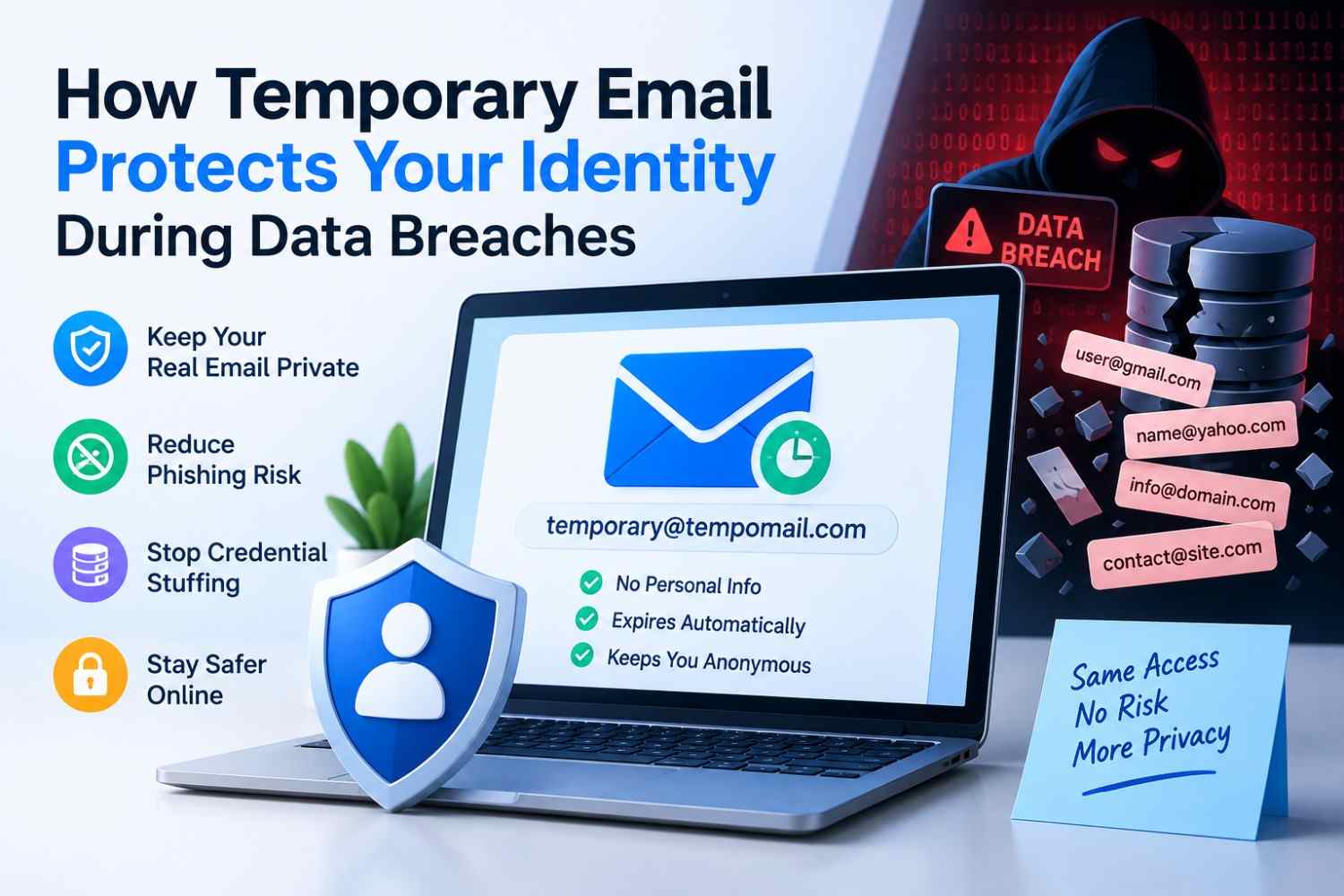
Quick Answer: Temporary email data breach protection works by keeping your real address out of vulnerable platform databases entirely. When a website is breached, attackers extract whatever was stored. A Tempomail address that expired before the breach contains no links to real identity, cannot be used for phishing, and connects to nothing else in your digital life. The protection is structural, not reactive.
Data breaches expose billions of email addresses annually. Every address in a breached database becomes a phishing target, a credential-stuffing input, and a social engineering starting point. The address that was never there cannot be extracted.
Industry breach research consistently shows that stolen or exposed email addresses rank among the most common starting points attackers use for phishing, credential stuffing, and follow-on identity theft, with website registration databases a frequent source of harvested contact data.
Key Points
Temporary email data breach protection operates upstream — the same session-based approach behind how temporary email works generally — so the address expires before it can be extracted from a compromised database as a usable contact point.
Identity theft protection through disposable email is most effective for low-stakes signups where the real email adds no value but creates measurable breach exposure.
Email breach prevention using Tempomail requires no ongoing management; the address deletes itself, removing breach risk automatically at session end.
Online privacy security is strengthened not just by protecting one account but by reducing the total number of places a real email address exists, each representing a potential breach source.
A real email address submitted to ten different platforms creates ten independent breach risks. A Tempomail address submitted to those same ten platforms creates zero persistent breach exposure across all of them.
How Data Breaches Use Email Addresses Against You
When a platform is breached, attackers do not typically use stolen addresses to access only that platform. The real damage happens across the broader digital identity.
A real email address extracted from a breached database immediately enables credential stuffing, where the same email is tested against other platforms using commonly reused passwords.
It enables targeted phishing because the attacker knows which platform was breached. The attacker can then craft convincing impersonation emails.
Account enumeration also becomes possible. Attackers can determine whether the email exists on high-value platforms like banking or investment services before attempting access.
A Tempomail address extracted from the same breach leads nowhere. Because the account was never tied to a permanent identity, using a temporary email address this way leaves no connection to any other account, and phishing emails cannot reach it.
Credential stuffing also cannot use it because no real person's password pattern is associated with the address. The breach data containing a Tempomail address is commercially worthless to the attacker.
Email Breach Prevention: Where Temporary Email Fits
Not all platforms carry equal breach risk. Directing the right email type to the right platform category is what makes online privacy security practical rather than theoretical.
Highest breach risk categories
E-commerce platforms, retail loyalty programs, gaming services, streaming trials, forum registrations, and marketing-heavy SaaS tools all have histories of significant data exposures.
These platforms hold real email addresses in large, attractive databases, and are also the biggest source of unwanted marketing mail — see blocking junk emails at the source for more on that side effect. Choosing to generate a disposable email address for all of these removes real contact data from the highest-risk storage environments.
Moderate breach risk categories
Professional networking platforms, productivity tools, and content subscription services carry moderate risk — this is the same category covered in using temp mail for job portal signups, where switching at the right moment matters. The hybrid approach applies here: create with Tempomail, verify during the session, update to a dedicated permanent email for recovery.
Lowest breach risk for real email use
Financial platforms, government services, healthcare systems, and institutional accounts require permanent email for legal and security communication. These should receive a dedicated real email address separate from the one used for general signups.
Temp Mail vs Other Email Strategies: When to Use Which
| Strategy | How It Works | Best For | Breach Protection |
| Real primary email | Permanent address used everywhere | Trusted long-term platforms | Low: one breach exposes all linked accounts |
| Secondary permanent email | Separate address for less trusted signups | Moderate-risk platforms | Moderate — limits primary exposure |
| Email alias | Forwards to real inbox, reversible per sender | Ongoing subscriptions with privacy preference | Moderate — real inbox still exists in forwarding chain |
| Masked email | Random address per service, permanent forwarding | Long-term privacy with recovery need | Good — breach exposes alias, not real address |
| Tempomail short-life inbox | Session-based, self-deleting, no data retained | One-time signups, trials, test accounts | Highest: no persistent data to breach |
For a deeper look at how forwarding-based alternatives work, see temporary email forwarding.
Identity Theft Protection Through Architectural Privacy
The strongest identity theft protection is not reactive. It does not monitor breaches after they happen or alert users when their data appears in a leaked database. Instead, it prevents real data from entering vulnerable systems in the first place.
Tempomail's session-memory architecture means incoming messages are never written to a persistent database. When the session ends, the address is removed from the active registry and all associated messages are cleared.
There is no backup, no archive, and no server-side record that a breach could expose. The address ceases to exist before it can be extracted by anyone. This is also why, as explained in recovering a temp mail session, messages generally cannot be restored once a session ends. This matters because breach timelines are long.
Breach discovery and public disclosure frequently take months rather than days, and during that extended window attackers actively trade and use the stolen data.
A real email address sits in the attacker's dataset throughout that window. A Tempomail address that expired hours after submission is not in any dataset.
Online Privacy Security: The Cumulative Effect
Individual temporary email use reduces exposure at each signup. The cumulative effect across all signups substantially reduces the total attack surface of a real digital identity. A typical internet user submits their real email address to 50 to 100 platforms over a few years.
Each submission is an independent breach risk. If 10% of those platforms experience a breach in five years, the real email address could appear in five to ten breached databases. Each database can enable independent phishing campaigns, credential stuffing attempts, and targeted attacks.
Replacing real email submissions with Tempomail for all low-stakes signups reduces this exposure systematically. Each disposable address creates zero persistent breach risk.
Ten Tempomail signups create zero independent breach exposure points. The cumulative online privacy security benefit scales directly with how consistently the practice is applied.
Security researchers who track breach exposure repeatedly find that the same email address surfaces across multiple unrelated breaches over time, compounding the risk with each additional exposure.
Cross-breach credential stuffing remains one of the fastest-growing categories of account takeover, and these patterns show that each additional platform holding a real email address increases overall breach risk.
Reducing that footprint is also a data-minimisation practice recognized under privacy regulation — see how temp mail aligns with GDPR — and it starts with a habit as simple as choosing to switch to a free temporary email service for every non-essential signup.
When Temporary Email Does Not Prevent Identity Exposure
Temporary email addresses the email address component of a breach. Using a disposable inbox does not protect other identifying data submitted alongside the email, such as names, addresses, payment information, and phone numbers.
For signups that require both an email address and personally identifiable information, the disposable email limits one data point while the rest remains in the breached database.
This is still meaningfully better than submitting a real email alongside that data, because the real email is what enables cross-platform attacks. Without it, the remaining data is less actionable for identity theft purposes.
This is why platforms that require identity verification behave differently — temp mail for crypto exchange sign-ups is a good example of a category where a disposable address alone cannot cover full KYC requirements. For signups requiring only an email and a password, a Tempomail address provides comprehensive email breach prevention; the only data in the breach database is an expired address and a hashed password with no real identity attached.
Conclusion
Temporary email data breach protection works because it removes the real email address from the breach equation entirely. The session expires. The address disappears. Attackers who breach the platform find a useless contact point connecting to nothing.
Identity theft protection through Tempomail is not a security product that monitors threats after the fact; it is an architectural choice that prevents the threat from existing.
Every additional signup is a choice point. Create your temporary email address now and keep the next breach from ever touching your real identity.
Author Expertise
Written by Sarah Mitchell, Privacy & Security Writer at Tempomail. Sarah covers data breach prevention strategies, email privacy architecture, and identity protection tools for everyday internet users, drawing on current breach reports and security frameworks.
Last Reviewed: August 27, 2026
FAQs
Does temporary email data breach protection work if I have already submitted my real email to many platforms?
It works going forward. Every new signup handled through Tempomail stops adding breach exposure points. It cannot remove a real email from databases where it already exists, but it prevents the problem from growing with each new registration. If you have not already, you can start using a disposable email address for every new signup from today onward.
Can identity theft still occur if I use Tempomail for all my signups?
For accounts that also collected personal information alongside the email, yes, the other data may still be exploited. For pure email-and-password registrations, using Tempomail removes the email component that makes cross-platform identity theft operationally viable.
How does email breach prevention through Tempomail compare to breach monitoring services?
Breach monitoring alerts you after your data has been compromised. Tempomail prevents real email data from entering vulnerable databases before any breach occurs. Prevention is structurally stronger than detection for this specific risk.
Does online privacy security improve if I use Tempomail consistently across all low-stakes signups?
Yes, cumulatively. Each Tempomail signup creates zero persistent breach exposure. Applied consistently across all non-critical registrations, the total attack surface of a real digital identity shrinks measurably over time.
Will a platform notify me of a breach if I used a Tempomail address during signup?
No. Breach notifications are sent to the registered email. Since the Tempomail address has expired, no notification is delivered. For accounts where breach notification matters, a permanent email is required.
Is Tempomail itself at risk of a data breach?
Tempomail retains no personal data after session end. A breach of Tempomail's infrastructure would find no message content, no address history, and no user records, because none are stored. There is no database of user data to extract.
How does the masked email strategy compare to Tempomail for email breach prevention?
Masked email provides a unique address per service with permanent forwarding to a real inbox. The disposable address protects the real inbox, but the real inbox still exists. A breach of the masking service could expose the forwarding chain. Tempomail's session-based deletion means no forwarding chain exists and no persistent data is at risk.
Does using different email addresses for different platforms really reduce identity theft risk?
Yes, significantly. A real email submitted once and used across 50 platforms creates 50 independent breach exposure points. Tempomail addresses submitted to those same platforms create zero; each address is unique, expired, and connected to no real identity.