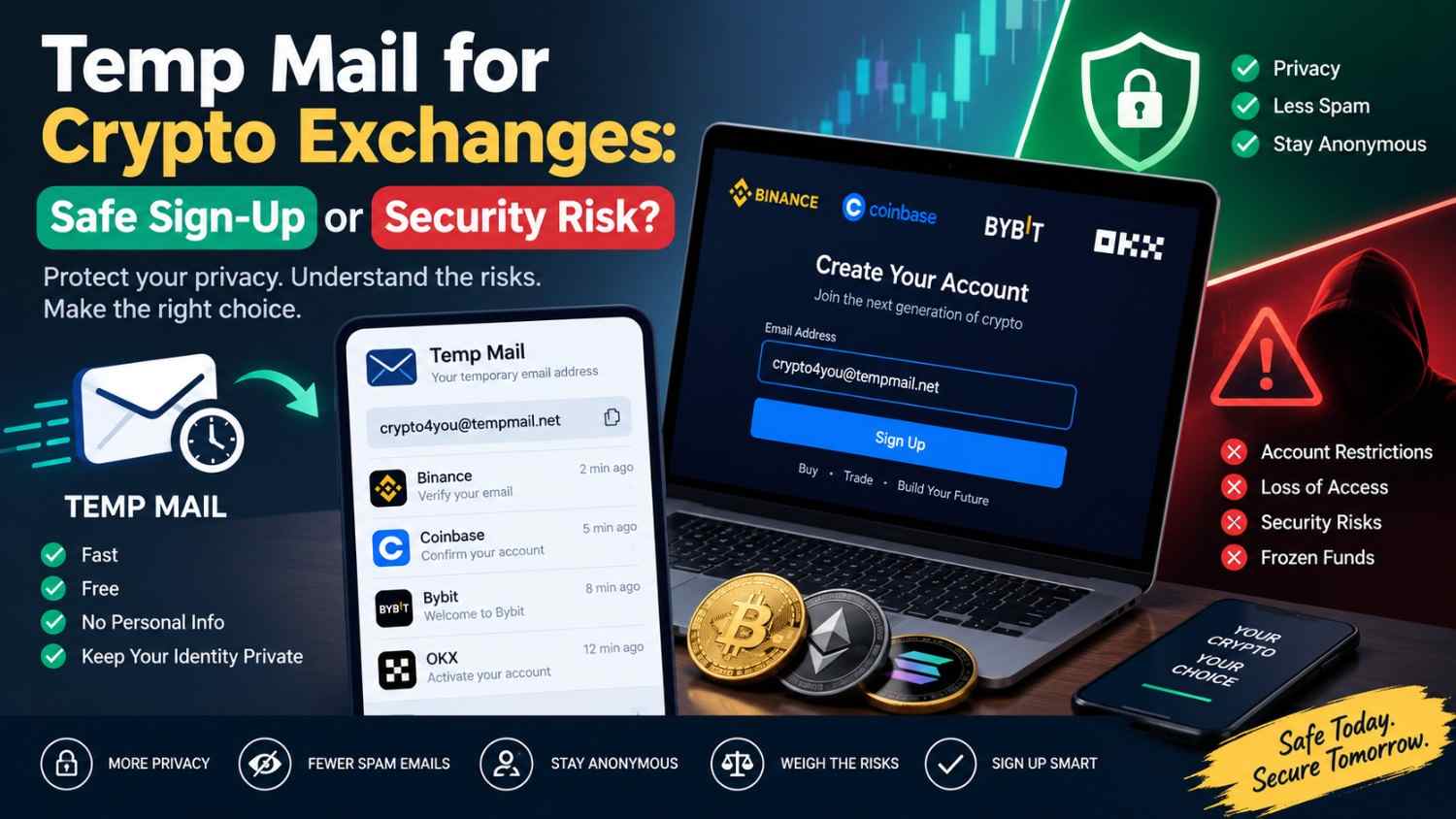
Temp Mail for Crypto Exchanges: Safe Sign-Up or Security Risk?
Temp Mail for Crypto Exchanges: Safe Sign-Up or Security Risk?
Quick Answer: Temp mail crypto exchanges sign-up is a calculated risk. A disposable email handles the initial verification step but creates a critical vulnerability. Most exchanges require email-based two-step verification and account recovery. Losing access to the registered email on a platform holding real funds can permanently lock users out. Understanding where disposable email helps and where it hurts is essential before using it on any crypto platform.
Crypto exchanges hold real money. Unlike a social media account or a streaming trial, a locked crypto account without email recovery can mean permanent loss of funds. Temp mail on crypto platforms sits at the intersection of privacy and financial security. Anyone weighing this trade-off can generate a temp mail crypto exchange address in seconds to see how the sign-up flow works before deciding.
Chainalysis's 2026 Crypto Crime Report recorded roughly $17 billion lost to crypto scams and fraud in 2025, with impersonation and phishing-driven account compromises rising sharply, underscoring why the email address used at signup is one of the highest-risk data points in the entire crypto ecosystem.
Important Points
- Temp mail crypto exchanges use is viable for registration-only verification but creates a serious security gap for any account that will hold funds or assets.
- Most major exchanges require KYC verification regardless of the email address used, meaning email privacy provides limited identity protection at regulated platforms.
- Disposable email crypto use is most appropriate for testnet accounts and exchange API testing. It also works for evaluating platform interfaces without depositing real assets.
- A hybrid approach works best. Create the account with a disposable email. Then update it to a permanent address before depositing cryptocurrency or completing KYC.
What Is Temp Mail and Why Crypto Users Consider It
A temporary email is a session-based disposable inbox that generates instantly. It receives verification messages in real time and permanently deletes all content when the session ends. No registration or personal data is required. Crypto users consider disposable email for two specific reasons. For the full picture beyond crypto use cases, see the complete guide on what is temp mail.
First, exchanges have historically been breach targets. An email address connected to a crypto exchange account can trigger targeted phishing campaigns, SIM-swapping attempts, and social engineering attacks against other accounts using the same address.
Second, some users want to evaluate an exchange's interface, fee structure, or available trading pairs before committing personal contact details to the platform's marketing and communication systems. For a closer look at the mechanics behind this, see how does temp mail work.
Where Temp Mail Crypto Exchanges Actually Work
Disposable email for crypto is genuinely appropriate in specific, limited scenarios.
Exchange interface evaluation
Before depositing funds, many traders want to explore an exchange's UI, order types, fee schedules, and security settings. A disposable email creates a test account for this purpose without connecting a real email to the platform's notification and marketing infrastructure.
Testnet and sandbox environments
Blockchain developers and traders testing strategies on exchange testnets or sandbox environments benefit from disposable email accounts that generate no real financial exposure and leave no permanent data trail.
API integration testing
Development teams building crypto trading bots, portfolio trackers, or exchange integrations need clean test accounts. Disposable email for these accounts keeps test activity separated from real trading identities. Teams automating this at scale can also look at temp mail API for developers for programmatic inbox generation.
Evaluating decentralised exchange front-ends
Some DEX platforms and aggregators require email registration for access to advanced features. A temporary email for exploring these platforms carries no financial risk because no centralised custodian holds funds. Not all disposable inbox tools work the same way; see 10 minute mail vs temp mail for how the options compare.
Where Temp Mail Creates Serious Crypto Exchange Security Risk
This is the section that matters most for anyone considering this approach with real funds.
Two-factor authentication
Most exchanges send 2FA codes via email for login confirmation, withdrawal approvals, and security setting changes. If the registered email is a Tempo Mails address, it may expire. Once expired, these codes cannot be delivered. Logging in from a new device, withdrawal requests, and any security-triggered re-verification all fail silently. Anyone testing this limitation firsthand can try a temp mail crypto exchange signup and watch how quickly the address stops receiving codes after the session ends.
Account recovery
Forget a password on a crypto account registered with an expired disposable address and the recovery email goes nowhere. On regulated exchanges holding custody of real assets, this can mean permanent account lockout with no recourse.
Withdrawal confirmation emails
Most centralised exchanges send a confirmation email for every withdrawal request. The email contains a link to authorise the transaction.
An expired Tempo Mails address means the withdrawal confirmation cannot be completed, effectively freezing withdrawal capability.
KYC communication
Regulated exchanges operating in the US, EU, UK, and other major jurisdictions require KYC identity verification. Communication during the KYC review process, including requests for additional documentation or approval confirmations, is delivered via the registered email. A disposable address that has expired interrupts this process at a critical stage. Some of these requests include file attachments, so it is worth knowing whether a temporary email can receive attachments before relying on one for KYC-related steps.
Temp Mail vs Permanent Email for Crypto Exchange Accounts
Feature | Disposable Email (Tempo Mails) | Permanent Email |
Initial registration | Works | Works |
Email 2FA | Fails after session ends | Reliable |
Account recovery | Impossible after session | Available |
Withdrawal confirmation | Fails after session ends | Reliable |
KYC communication | Interrupted | Uninterrupted |
Marketing protection | Complete | Limited |
Phishing risk reduction | High | Moderate |
Suitable for funded accounts | No | Yes |
Suitable for test accounts | Yes | Not necessary |
The Hybrid Approach: Best of Both
The most practical approach for privacy-conscious crypto users is not choosing between disposable email and permanent email but sequencing them. Create the exchange account with a Tempo Mails address. If you are also weighing other privacy options, temp mail vs email alias vs masked email breaks down how these approaches differ.
Complete the initial email verification during the active session. Before depositing any cryptocurrency or completing KYC verification, update the registered email in the exchange account settings to a dedicated permanent email created specifically for crypto communications.
This approach achieves two goals simultaneously. The original registration data submitted to the exchange during signup contains the expired Tempo Mails address, not the permanent email.
Going forward, the account communicates through the permanent email that can receive 2FA codes, withdrawal confirmations, and recovery messages reliably.
The dedicated permanent email used for this purpose should itself be protected with strong 2FA and kept separate from email addresses used for everyday signups, social media, and marketing communications. The first, disposable part of this sequence takes seconds using a disposable email crypto tool.
How to Complete Crypto Exchange Verification With Tempo Mails
- Step 1. Open a free disposable email generator for crypto exchange signups. An address is generated immediately. Keep this tab open.
- Step 2. Open the exchange signup page in a separate tab. Enter the Tempo Mails address in the email field.
- Step 3. Complete any initial form fields and submit. The exchange sends a verification email.
- Step 4. Return to Tempo Mails. The crypto account verification email arrives within 10 to 20 seconds.
- Step 5. Click the verification link or copy the code. The account is activated.
- Step 6. Immediately navigate to the exchange's account settings and update the registered email to a permanent, dedicated address. Confirm the update using the permanent inbox.
- Step 7. Close Tempo Mails. The session ends. The temporary address expires, and all messages are permanently deleted.
Do not deposit cryptocurrency until the email update in Step 6 is fully confirmed.
What Exchanges Actually Know Even With Disposable Email
Using a disposable email for crypto signup does not provide anonymity on regulated exchanges. It provides email privacy, which is a narrower protection.
Centralised exchanges collect IP addresses, device fingerprints, and browser metadata during registration regardless of the email type used. KYC-required platforms collect government-issued identity documents.
The email address used at signup is one data point among many, and typically the least revealing for a platform that requires full identity verification. Some users pair a temporary email with other privacy tools; see disposable email vs virtual phone number for how these compare.
For decentralised protocols and platforms that genuinely operate without identity collection, a disposable email provides more meaningful privacy.
For Binance, Coinbase, Kraken, and other regulated centralised exchanges, the email protects the inbox from marketing and phishing, not the identity from the platform.
Binance reported that its AI-powered security systems blocked nearly $2 billion in potential fraud losses in the first quarter of 2026 alone, intercepting roughly 23 million scam and phishing attempts, underscoring how central email-based social engineering remains to attacks on exchange accounts.
Conclusion
Temp mail crypto exchanges have a narrow legitimate use: test accounts, interface evaluation, and API development environments where no real funds are involved. For any account that will hold cryptocurrency, complete KYC, or require 2FA through email, a permanent address is not optional. Ready to test the registration-only use case? Generate a temp mail crypto exchange address now and see the hybrid approach in action.
The hybrid approach, creating with Tempo Mails and immediately updating to a permanent dedicated email, delivers the registration privacy benefit without creating the recovery and security gaps that disposable email cannot solve on financial platforms.
About the Author
Daniel Reyes is a cybersecurity and digital-privacy writer specializing in cryptocurrency exchange security, account authentication, and disposable email infrastructure. He has covered exchange security practices and KYC compliance workflows for over six years. All content reflects current exchange behaviour and is reviewed regularly. Last Updated: August 2026
(FAQs)
Can a crypto exchange detect that a disposable email was used at signup?
Most exchanges perform basic domain validation during registration. Tempo Mails' domain rotation means many signups complete without detection. However, detection is not the primary concern for funded accounts; the security risk from losing email access is far more significant. Some platforms are stricter than others about this; see why some websites block temp mail domains for more detail.
Will depositing cryptocurrency into an account with a disposable email cause problems?
Yes, potentially. Withdrawal confirmations, security alerts, and 2FA codes for the funded account all go to the registered email. If that address expires, core account functions may fail when email delivery is required.
Does using Tempo Mails protect identity on KYC exchanges?
No. KYC-required exchanges collect government-issued identification regardless of the email address used. Tempo Mails protects the inbox from marketing and phishing; it does not prevent identity disclosure to exchanges that legally require it.
Is disposable email allowed under exchange terms of service?
Most exchanges require a valid email address capable of receiving messages. Tempo Mails satisfies this at the technical level during the active session. Review specific exchange terms for any restrictions on temporary email; terms vary by platform. For the broader legal picture beyond exchange terms, see is using a temporary email illegal.
What is the safest email approach for a long-term crypto trading account?
A dedicated permanent email used exclusively for crypto communications, protected with strong authentication and kept entirely separate from everyday email addresses. This provides marketing isolation without the recovery vulnerability that disposable email creates for funded accounts.
Can I use the same Tempo Mails address across multiple exchange signups?
Only within the same active session. Once the session ends, the address expires. A fresh Tempo Mails session generates a new unique address for each subsequent exchange registration.
Does Tempo Mails work for decentralised exchange email registration?
Yes. DEX platforms and DeFi front-ends that collect email addresses for notifications or advanced feature access are well-suited for disposable email because no custodial funds are involved and the registration is typically low-stakes.
How quickly does the exchange verification email arrive in Tempo Mails?
Typically 10 to 20 seconds after form submission. The Tempo Mails inbox refreshes automatically with no manual page reload required.