How to Block Junk Emails: Choose a Spam Email Blocker
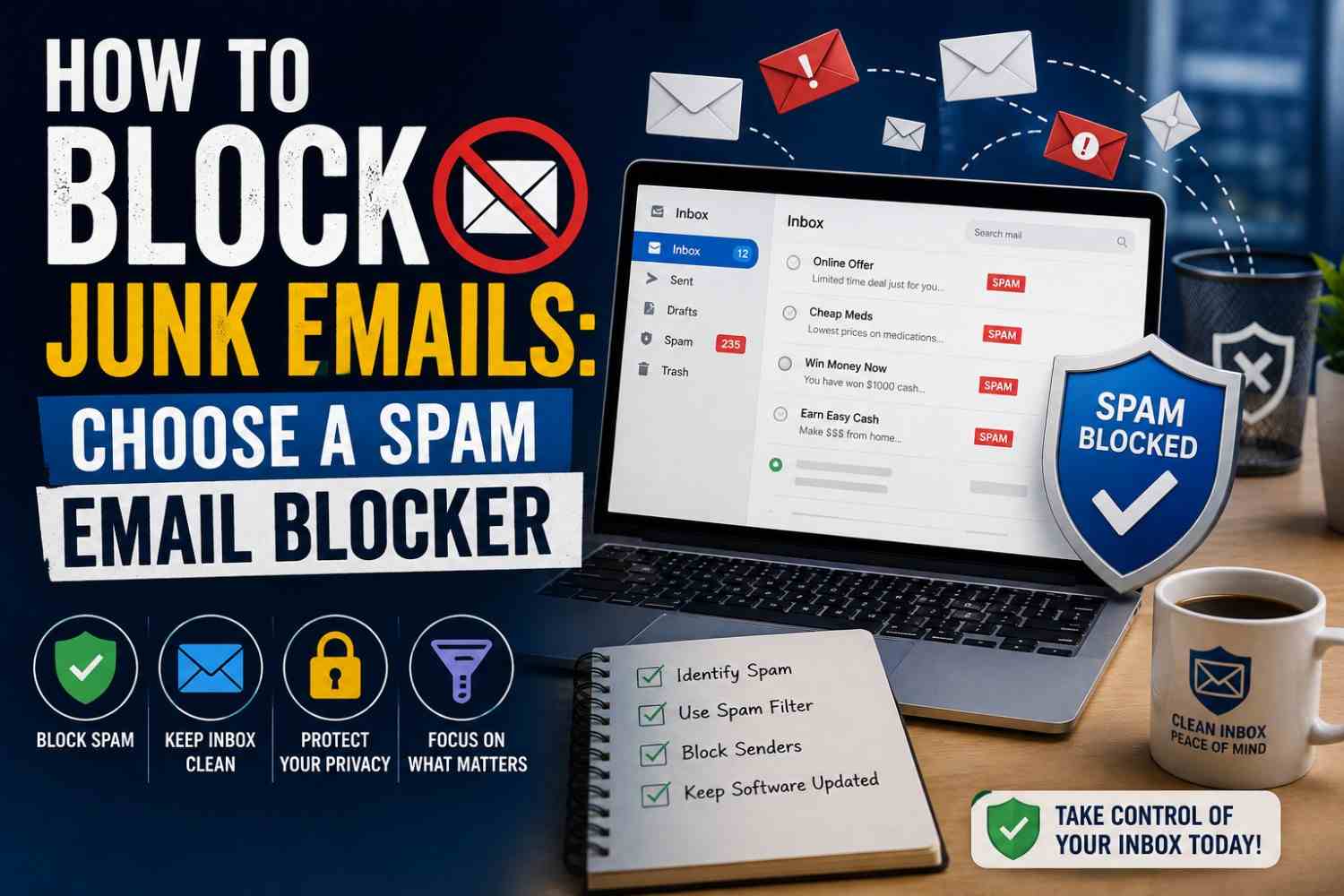
How to Block Junk Emails: Choose a Spam Email Blocker
Quick Answer: The spam email blocker you use will depend on your level of threat and technical comfort. It also depends on whether you need personal or business-grade protection. Successful inbox security is a mix of server-side filtering, provider settings, and disposable email. Each layer filters a different sort of junk before it gets to your Inbox.
The volume of spam worldwide is almost half of all email messages. It is not just a nuisance; it's loaded with phishing attempts, malware, and even identity theft with each unwanted message.
According to Validity's 2026 State of Email Report, 49% of all email sent worldwide is deemed spam or junk, resulting in a total annual loss of lost productivity, security incidents, and data recovery costs to businesses and individuals of $20.5 billion.
Main Points
- Email spam filters work at multiple levels: server-side, provider-level, third-party software, and disposable email, each addressing a different category of junk mail.
- Blocking junk emails through provider settings is the first free step, but it only manages spam that has already reached your account's ecosystem.
- Email Spam protection using disposable addresses can be the only solution that will stop junk email from getting into your real email account in the first place, upstream of delivery.
- Third-party inbox security tools add machine learning, attachment scanning, and multi-account management that built-in provider filters cannot match.
Ways to Block Junk Emails
There is no single method that eliminates all spam. Understanding each available layer helps build an approach that actually works.
Mail server-level filtering
Mail servers analyse headers, sender IP addresses, and domain reputation before messages reach any inbox. This filters obvious spam before it ever arrives, but sophisticated senders adapt quickly and bypass basic server rules.
Allowlists and blocklists
The user can whitelist the sender if he wants to receive emails from him/her and blacklists spam emails so that they get automatically rejected. Manual list management may struggle with the volume and variety of spam senders.
Content-based filtering
Bayesian filters analyse message content, subject lines, body text, and link patterns. They score each message for spam probability. The filters also learn from user behaviour and improve as messages receive correct or incorrect classifications.
Sender authentication protocols
SPF, DKIM, and DMARC help ensure that emails that arrive have actually been sent from the sender's domain. SPF, DKIM, and DMARC are the main protection tools against spoofed email addresses used in phishing attacks.
Behavioural analysis
There are advanced systems designed to detect spam using sending patterns, such as sending a large volume of emails from a single email address, sending emails at unusual times, or engagement metrics that indicate automated sending rather than genuine communication.
Filter training
Marking messages as spam or not spam trains provider filters. Over time, consistent feedback helps filters recognise similar content and improve inbox accuracy.
Temporary email addresses
The only approach that prevents junk from ever being associated with a real inbox. A disposable address used for any signup, including newsletter sign-ups, absorbs all subsequent marketing, phishing attempts, and data broker contact permanently because the address no longer exists once the session ends.
Email aliases
Aliases forward messages from a secondary address to the primary inbox, providing separation without loss of deliverability. Useful for ongoing relationships where some contact is wanted but the real address should remain hidden.
How to Block Spam in Popular Email Services
Each major provider offers built-in tools for managing junk mail. Here is how to use them effectively.
Gmail
Gmail spam filter is on by default. Click on Settings and then See All Settings to enhance it. Open Filters and Blocked Addresses. Use sender domain, subject keywords, or phrases to create filters.
To block a specific sender, open the message and click on the three-dot menu. Choose Block. Gmail also reads the spam reports. It can be beneficial to report consistently in order to enhance the accuracy of filters over time.
Outlook
Outlook automatically moves suspected junk to the Junk Email folder. Open Settings, then Mail, and select Junk Email. Select Standard or Strict Filtering depending on the degree of filtering you want. Set up a Safe Senders list. Will help prevent false positives in important messages.
Yahoo Mail
Yahoo filters junk automatically but allows custom filter creation. Select Settings, More Settings and then Filters. Set rules to move particular emails to the Spam folder, or even delete them straight away, according to the sender, subject, or content of the email. Block individual senders through the More Options menu within any message.
ProtonMail
ProtonMail applies end-to-end encryption and built-in spam detection. Create custom filters through Settings, then All Settings, then Filters. Block specific senders directly from any message through the sender information panel.
ProtonMail's spam detection is particularly strong for phishing attempts targeting encrypted communication users.
Top Spam Email Blocker Programs
If you require protection that goes beyond the capabilities of the providers' built-in tools, then third-party spam email blocker solutions offer more capabilities.
SpamAssassin
Open-source, server-level filtering using Bayesian analysis, heuristic rules, and DNS-based blocklists. Highly customisable but requires technical knowledge to configure. Best for organisations managing their own mail servers. Free.
MailWasher
View and control emails on the server before they reach your Inbox. Enables multiple accounts, such as POP3, IMAP and webmail. The free version handles basic filtering. The Pro version adds more advanced rules and blacklist access. Pro starts at $39.95 per year.
SpamSieve
It's a Mac tool that will work with Apple Mail, Outlook, and other Mac email clients. It performs filtering with the aid of Bayesian learning that improves the filter over time. There is a one-time fee of $30.
CleanTalk
Cloud-based anti-spam solution, compatible with WordPress, Joomla, and custom API connections. Prevents spam from happening at source by filtering it in real time and without false positives. Starts at $12 per year per site.
SpamTitan
This business-grade email security solution uses AI, machine learning, and heuristics. Detects attachments and URLs and prevents ransomware. Detailed reporting facilitates organisations requiring managed protection. Pricing starts at $15 per month.
Barracuda Email Security Gateway
This business-oriented service includes multi-layer filtering and data loss prevention. It can be integrated into Microsoft 365 and Google Workspace. The solution is suitable for organizations having their own IT staff. Pricing starts at $39.99 per month for small businesses.
Proofpoint Essentials
Advanced threat detection with attachment sandboxing, URL protection, and email encryption. Scales from small businesses to enterprise environments. Pricing based on organisation size; contact for a quote.
Temporary Email as an Inbox Security Tool
Every approach discussed so far manages spam that has already entered the email ecosystem in some form. Temporary email is fundamentally different; it prevents the real inbox from entering the spam ecosystem at all.
How it works as an inbox security tool
Email lists are created using a double opt-in method where the message is sent to the entered email address and the confirmation link in the message should be clicked. Addresses that expire before or after confirmation never complete this process and never enter active marketing lists.
Tempomail generates a disposable inbox the moment the site opens. Any signup using that address newsletter, free trial, content download, forum registration, promotional discount completes its verification step through the temporary inbox.
When the session ends, the address expires. Every marketing sequence, data broker contact, and phishing attempt directed at that address goes undelivered permanently.
Why this matters for email spam protection
Spam filters manage what arrives. A disposable address prevents arrival. The distinction matters because even the best spam email blocker cannot catch every unwanted message, and every message that reaches the spam folder still represents a successful data collection from the user's real email address. Tempomail removes the address from the data collection chain before it begins.
Six Practical Benefits Of Tempomail As A Spam Email Blocker
- Spam protection: Disposable addresses absorb all promotional and marketing contact. Nothing reaches the real inbox, not now, not in six months.
- Anonymity: No personal information is linked to the temporary address. The website receives a working verification address. The user's real identity stays out of the platform's data systems entirely.
- Instant setup: No registration, no download, no configuration. The address appears when the page loads, and you can access your temporary mailbox and inbox instantly on any device.
- Free access: All core functionality of this free disposable email address service address generation, inbox access, message delivery, and automatic deletion is available at no cost.
- Automatic expiry: The address and all its messages are deleted permanently at session end. No manual cleanup. No residual data on any server.
- Universal compatibility: Any website that accepts standard email format and validates through a confirmation email works with Tempomail. The tool is not limited to specific platforms, regions, or email types.
Pew Research Center's Digital Privacy Survey of 2026 Americans revealed that 84% said they should have more control over the personal information that companies gather about them, and among all personal data points they have given up when using the Internet, email addresses were the most common and the most regretted.
Conclusion
No single spam email blocker eliminates all junk. The most effective approach layers multiple tools: provider-level filters for existing accounts, third-party software where business-grade protection is needed, and Tempomail for any new signup where ongoing contact is not intentional.
Block junk emails at the server and inbox level for what already exists. Use a disposable inbox for everything new. The combination reduces both the volume of incoming spam and the surface area of real email data exposed to marketing systems, data brokers, and phishing campaigns simultaneously.
About the Author
The Tempomail Editorial Team researches inbox security strategies, spam-blocking tools, and email privacy solutions for individual and business environments. Content is reviewed regularly to reflect current platform behaviour and threat landscape changes. tempomail.com.
(FAQs)
Which spam email blocker method works fastest?
Temporary email works fastest because it prevents junk from being associated with the real inbox at all, requiring no configuration, no filter training, and no ongoing management. For existing accounts, provider-level blocking combined with filter training delivers measurable improvement within days.
Can I use multiple spam blocking methods at the same time?
Yes. Layering approaches is the most effective strategy. Provider filters handle existing accounts. Third-party software adds advanced scanning for business environments. Tempomail handles new signups where ongoing contact is not wanted.
Will marking emails as spam actually help reduce junk mail?
Within your own inbox, yes. Consistent spam marking trains your provider's filter to recognise similar content and intercept it in future. It does not remove the real email address from any external marketing list or data broker database.
Is temporary email better than unsubscribing from newsletters?
For most users, yes. Unsubscribing works with compliant senders but can confirm address activity to non-compliant ones. A temporary address that expires requires no unsubscribe decision; the address ceases to exist before the question arises.
Does Tempomail work as a spam email blocker for business accounts?
Tempomail is most effective for individual privacy. For business environments requiring managed inbox security, dedicated tools like SpamTitan, Barracuda, or Proofpoint Essentials provide the multi-user management, reporting, and compliance features that business accounts require.
What happens to spam sent to a Tempomail address after it expires?
Sending servers receive a non-delivery response. The message is not delivered anywhere. The real inbox is never involved. Every piece of spam or marketing content directed at the expired Tempomail address goes permanently undelivered.
Are free spam blocker tools effective enough for personal use?
For most personal users, yes. Gmail, Outlook, and Yahoo Mail's built-in filters handle the majority of obvious spam effectively when trained through consistent marking. Adding Tempomail for new signups addresses the upstream problem that built-in filters cannot solve.
How long does it take for provider spam filters to improve after training?
The majority of providers experience measurable improvement within 1-2 weeks of regular training. It helps the learning process go faster, and the filter gets more accurate throughout the account by marking 20-30 messages as spam or not spam every week.