Temp Mail for Job Portal Signups: When It Helps and When It Hurts
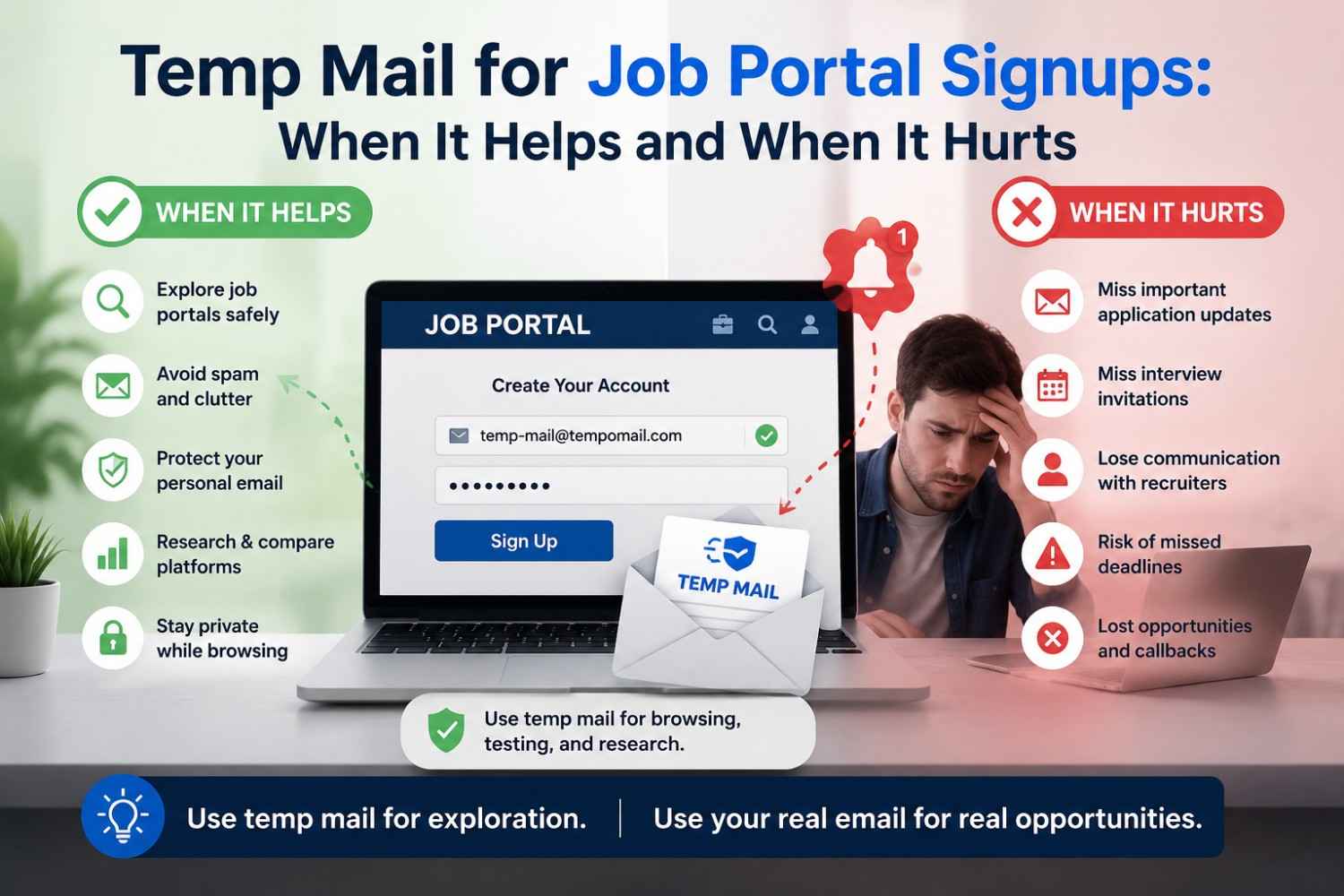
Quick Answer: Temp mail for job portals can handle initial account creation and reduce recruiter spam from platforms you explore briefly. However, most serious job portals require a permanent email for application updates, interview invitations, and employer communication. It helps for browsing and testing — it hurts when you miss the call-back.
Job portals are aggressive email senders by design. Every application, saved search, and recruiter match can trigger an email. Most platforms continue sending messages after signup.
Key Takeaways
- Temp mail for job portals works during account creation on most career sites. Recruitment platforms rely on email for important updates after signup.
- Job application registration on major platforms can generate recruiter outreach. A disposable inbox can filter these messages before a real address is shared.
- A permanent email is essential for job portals used for applications, interview requests, or communication with hiring managers.
- A temporary email for recruitment helps users explore unfamiliar platforms. It also supports portal testing and job-market research before using a real career identity.
What Is Temp Mail and Why Do Job Seekers Consider It?
A temporary email creates a disposable inbox without personal information. It receives verification links and platform notifications in real time. The service deletes everything when the session ends. Readers new to the concept can start with this overview of what temp mail is and how it works, which also covers the technical process behind temporary inboxes in more depth.
A job seeker has to use a temp email for job portals, as career portals can convert an email address into a long-lasting recruitment marketing channel.
Job alerts, sponsored content, and recruiter messages are sent out upon sign-up via LinkedIn, Indeed, Glassdoor, and other regional job boards.
Users can have access to job listings, compare platforms, and try search tools before sending out a real career email. A disposable address provides a clean entry point. This makes a temporary email for recruitment one of the simplest ways to browse multiple career sites without committing a permanent address upfront.
Why Job Portal Email Volume Is a Genuine Problem
1. Career Platforms Send More Emails Than Almost Any Other Category
Career and recruitment platforms are widely considered among the most frequent email senders of any registered-account category, often outpacing e-commerce and SaaS platforms in weekly send volume. Job alerts, recruiter messages, salary reports, and sponsored listings all target the registered address continuously.
2. Recruiter Data Sharing Is Industry Standard
It is common practice, and disclosed in many platforms' own privacy policies, for job portals to share registered user data, including email addresses, with recruiting partners, background check services, and advertising networks. A real email submitted to a job portal often travels considerably further than the original platform.
3. Unsubscribing From Job Portal Emails Is Ineffective
Most job portals send multiple email streams from different internal teams: job alerts, recruiter messages, platform updates, and promotional content. Unsubscribing from one stream does not stop the others. A disposable address sidesteps this entirely by preventing the real email from entering the system. The same logic applies broadly to inbox management: this guide on stopping newsletter spam with a temporary email covers the wider pattern beyond job portals specifically.
Where Temp Mail Helps on Job Portals
Exploring A New Platform Before Registering Fully
Evaluate job availability, search quality, and regional coverage without committing your career email. The same evaluate-first approach applies to adjacent work platforms too, including using temp mail for Fiverr and Upwork signups when testing freelance marketplaces alongside traditional job portals.
Testing Portal Interfaces For Developer Or QA Work
Teams building recruitment integrations or testing application flow need isolated accounts with no real identity attached. Developers running repeated or automated tests may prefer a temp mail API built for developers instead of manually generating addresses one at a time.
Accessing Gated Salary Data Or Market Reports
Many job platforms gate compensation benchmarks and industry reports behind an email registration form. The same approach works for downloading gated reports and ebooks with a temporary email on non-recruitment sites as well.
Signing Up For A Platform You Are Unsure About
A disposable address lets you evaluate recruiter quality and job relevance before deciding whether the platform is worth using seriously.
Reducing Initial Marketing Contact
If you want to evaluate a platform for a week before committing, a temp address absorbs the onboarding email sequence until you make that decision.
Where Temp Mail Hurts on Job Portals
Missing Interview Invitations
Recruiters contact candidates via the registered platform email. If the inbox has expired, those messages go undelivered permanently.
Losing Application Confirmation Records
Job application registration confirmation emails serve as records of submission dates and reference numbers. A closed temp inbox makes these permanently inaccessible.
Account Recovery Becomes Impossible
If you are locked out of a job portal account while applications are active, password recovery via the registered email is the only option. An expired inbox makes recovery impossible.
Recruiter Responses Go Unseen
Recruiters who respond to an application through the platform's messaging system often also send an email notification. A disposable inbox means those notifications never arrive.
Career Profile Data Is Lost
CVs, cover letters, and application history stored on a platform account become inaccessible if the account cannot be recovered due to an expired inbox.
Platform Compatibility: Which Job Portals Accept Disposable Email?
Not every platform treats disposable addresses the same way. Some career sites screen for known temp mail domains at signup, which is part of a broader pattern covered in why some websites block temp mail domains. Stricter platforms sometimes fall back on phone verification instead of email checks, a trade-off explored in this comparison of disposable email versus virtual phone numbers.
Platform | Domain Check | Additional Verification | Suitable For |
Indeed | Basic | None | Browsing, testing |
Glassdoor | Basic | None | Salary research, reviews |
Strict | Phone may be required | Limited compatibility | |
Reed.co.uk | Light | None | UK job browsing |
Totaljobs | Basic | None | Platform evaluation |
Workday portals | Moderate | Employer-linked | Not recommended |
Government job portals | Blocked | Identity required | Not suitable |
How to Use Tempomail on a Job Portal — The Right Way
Before you start: Only use a disposable address on job portals where you are browsing or evaluating, never where you plan to apply.
Open Tempomail And Copy The Address
Go to the free temp mail generator for job portals. A fresh inbox generates immediately. Copy the address. Keep this tab open until registration is complete.
Register On The Job Portal Using The Tempomail Address
Navigate to the career site. Select the email signup option. Paste your Tempomail address. Submit the registration form. Most portals require only an email and password at this stage.
Retrieve The Verification Email
Return to Tempomail. The account confirmation email arrives within 30 to 60 seconds. Click the verification link to activate the account.
Browse The Platform With Your Goals In Mind
Evaluate job availability in your sector, search quality, recruiter activity, and whether the platform serves your market. Note specific employers or roles worth pursuing through a permanent account.
If The Platform Proves Valuable, Update The Email Before Applying
Go to account settings and update the registered email to your real career address before submitting any application. Do this while the Tempomail session is still open; the platform will send a confirmation to the new address.
Close Tempomail Only After Updating
Once the email update is confirmed, close the Tempomail tab. All messages are deleted permanently. The platform's marketing sequence will now reach your real address, but you have chosen to make that trade for a platform worth using.
Benefits of Using Temp Mail Strategically on Career Platforms
Inbox Protection During Platform Evaluation
Career site signups trigger immediate onboarding sequences. A disposable address absorbs those emails during the evaluation window without polluting the real inbox. Running new signups through a disposable inbox for career sites keeps this kind of onboarding noise away from your main email entirely.
Separating Exploration From Active Job Searching
Using a disposable address for initial platform research keeps the primary career inbox reserved for active applications and genuine recruiter contact, not onboarding campaigns from platforms you may never use seriously.
Reducing Exposure To Recruiter Data Sharing
A real email submitted to a job portal often ends up in multiple recruiter and HR systems. A temporary address limits that exposure to platforms where you have made a deliberate choice to engage. Using a temporary email service at the browsing stage is a simple way to control that exposure before deciding a platform is worth it.
Protecting Your Primary Email From Low-Quality Platforms
Not every job portal is legitimate or well-maintained. A temporary email for recruitment allows you to assess a platform's quality before your real career identity is attached to it.
When You Must Use a Real Email on Job Portals
Use a permanent email from the very beginning when:
- You intend to apply for any position through the platform
- The portal is linked to an employer's Applicant Tracking System (ATS)
- The platform is a government or public sector employment service
- You need to upload and store a CV for recruiter discovery.
- Professional networks such as LinkedIn require an identity-based profile.
- Long-term application tracking also requires access to your history.
A simple rule: if there is any chance a recruiter or employer will need to reach you through the platform, use a real email. Missing a job opportunity because of an expired inbox is a concrete professional cost.
Alternatives for Managing Career Platform Email Volume
A Dedicated Job Search Email Address
A separate Gmail or Outlook address can handle job portal registrations. This keeps the primary career inbox clean while preserving platform access.
Job alerts, recruiter messages, and application confirmations can all reach the secondary address. This approach suits active job seekers who need long-term access.
Email Alias Services
Services like SimpleLogin generate a permanent forwarding alias that satisfies job application registration requirements while masking the real address. For a full breakdown of how these options differ, see temp mail versus email alias and masked email services.
Aliases can be disabled individually if a specific platform's email volume becomes unwanted, without affecting other platforms using different aliases.
Platform-Specific Email Alert Settings
Most major job portals allow users to adjust email frequency in account settings. Reducing job alerts to weekly rather than daily cuts volume significantly without requiring a disposable inbox.
FAQs
1. Does temp mail work on Indeed?
Yes, in most cases. Indeed applies basic domain validation. Temp mail addresses pass in the majority of first attempts, and verification emails arrive quickly.
2. Will I miss recruiter messages if I use a disposable email on a job portal?
Yes. Recruiter responses and interview invitations go to the registered email. If that inbox has expired, those messages are permanently lost.
3. Can I use a temp address on LinkedIn?
LinkedIn applies stricter domain screening than most job portals and may require phone verification. Compatibility is limited, and using a disposable address on a professional identity platform is not recommended for any serious career use. A closer look at using temp mail for LinkedIn specifically covers exactly where it fails and why.
4. Is there a risk to my professional reputation from using temp mail on job platforms?
No reputational risk arises from the email type itself. The practical risk is operational: missing communications from employers or recruiters due to an expired inbox. For readers wondering about the legitimacy question directly, whether using a temporary email breaks any rules addresses that separately from the practical risk covered here.
5. How do I switch from a temp address to a real email on a job portal?
Go to account settings while the Tempomail session is still open. Update the registered email to a permanent address. Then confirm the change through the verification email sent to the new address.
6. Does TempMail affect how recruiters find my profile?
No. Recruiter search and profile visibility are based on profile content, not email domain type. The email address itself is not visible to recruiters on most platforms.
7. Can I use temp mail to access gated salary data on Glassdoor?
Yes. Glassdoor's salary data gate applies basic domain validation. Tempomail passes in most attempts and works well for this specific research use case.
8. What is the safest approach to job portal email management?
A dedicated secondary email address used exclusively for career site signups. It keeps the primary inbox clean, maintains full recruiter access, and supports account recovery across every platform where you are active.
Conclusion
Temp mail for job portals occupies a narrow but genuinely useful role in the job search process. For platform evaluation, salary research, and interface testing, a disposable inbox keeps the real career email out of a recruitment marketing system until a deliberate choice is made to engage.
The limit is clear and consequential: any platform where applications are submitted, where recruiters might respond, or where interview invitations might arrive requires a permanent email from the moment of registration. A missed interview call-back because of an expired inbox is not a recoverable situation.
The smartest approach is a combination of using Tempomail to evaluate, then switch to a dedicated job search email before committing. That gives platform privacy during the research phase and reliable access during the phase that matters. Bookmarking a reliable temp mail for job portals tool makes this two-step approach easy to repeat every time you explore a new career platform.
Author Expertise
Written by Daniel Reyes, Career Tools & Email Privacy Writer at Tempomail, who researches disposable email compatibility across career platforms, recruitment tools, and professional networking sites. Reviewed by the Tempomail editorial team. Content reflects current platform verification behaviour and recruitment industry practices. Last Reviewed: August, 2026.