Temp Mail for LinkedIn: Create a Test or Secondary Account Safely
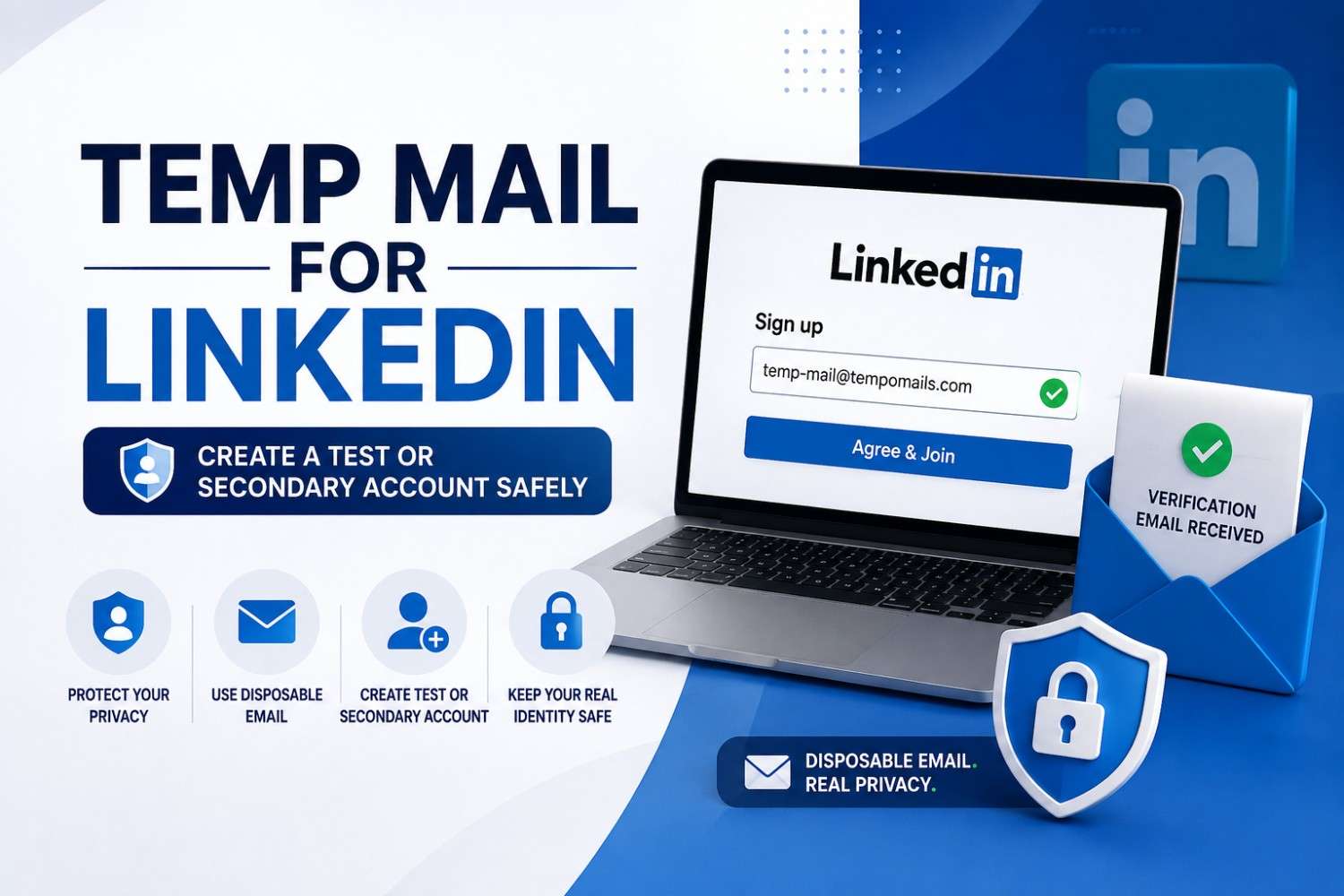
Temp Mail for LinkedIn: Create a Test or Secondary Account Safely
Quick Answer: Temporary email addresses for LinkedIn allow you to create a test or secondary account without linking your actual inbox to the platform's data and recruitment systems. Tempo Mails generates a working address instantly that receives the LinkedIn email verification message, completes account creation, and deletes everything automatically, keeping your professional identity separate from the new account.
One platform that's at the heart of online professional identity is LinkedIn. If your email, job title, and employer are all registered to the same account, then data brokers and advertising networks have one of the most detailed personal profiles anywhere on the Internet. If you're new to the idea, it helps to first understand what a temporary email actually is and how it works before applying it to a platform like LinkedIn.
Key Takeaways
- A temporary email keeps a LinkedIn test or secondary account separate from your real professional identity and inbox.
- Most Tempo Mails addresses pass LinkedIn's domain checks on the first attempt, thanks to regular domain rotation.
- For a primary professional profile, switch to a permanent, recoverable email address right after verification so account recovery is never at risk.
- Using LinkedIn's disposable-email policy the wrong way won't get an account banned, but it can cost you account recovery if the temp inbox expires too soon.
Why Do People Use Temporary Email for LinkedIn?
People choose a disposable email for LinkedIn for practical, privacy-driven reasons, not just convenience.
1. To Avoid Spam
LinkedIn sends a high volume of notifications, connection requests, job alerts, InMail promotions, weekly digest emails, and product updates. Providing a real email means all of this lands in your primary inbox indefinitely. A temporary address absorbs every notification without a single message reaching the real inbox.
2. Privacy Protection
Not everyone wants their personal email connected to a professional networking platform. A temporary email keeps the real address out of LinkedIn's data systems, advertising partnerships, and third-party vendor agreements, protecting inbox privacy from the first moment of signup. If you've also considered an alias service, here's how temp mail stacks up against an email alias or a masked email.
3. Testing LinkedIn Features
Marketers, developers, and recruiters often need LinkedIn test accounts. They may evaluate the interface, test API integrations, or run CRM experiments. A disposable email simplifies account creation without attaching a real identity to the test profile. Developers running larger test batches can also automate disposable email testing through an API instead of generating addresses manually.
4. Multiple Accounts for Different Purposes
Some professionals maintain separate LinkedIn accounts for freelance work, agency operations, regional campaigns, or a secondary brand identity. A temporary email for each account creation keeps them fully independent from the primary professional profile and from each other. Some professionals combine this with a virtual number too — it's worth comparing a disposable email against a virtual phone number to see which fits a given signup better.
5. Research and Competitive Intelligence
Market researchers, recruiters, and business development professionals sometimes create accounts to observe competitor activity, analyse platform behaviour, or conduct industry research without connecting that activity to a traceable professional identity.
Does LinkedIn Accept Temporary Email Addresses?
LinkedIn's signup form performs two checks on any submitted address. Initially, it verifies that the domain name has a valid mail server. Secondly, it checks the domain with a disposable email provider blocklist. This is the same mechanism many platforms use to block temp mail domains, and it's worth understanding before relying on any disposable address.
The first check is met with Tempo Mails, as their domains have valid MX records, and their mail servers are active. The second check depends on whether a specific domain has accumulated blocklist presence. Tempo Mails' domain rotation strategy keeps fresh domains ahead of LinkedIn's cataloguing cycle.
In practice, most Tempo Mails addresses work on the first attempt. If LinkedIn rejects a domain, generating a fresh address from a new session typically resolves the issue immediately.
A second rejection indicates that LinkedIn is using a broad validation tool on that day; in this case, a permanent secondary email is the right alternative.
Key Benefits of Using Temp Mail for LinkedIn
Using a disposable email for LinkedIn signup delivers five direct advantages.
- Professional identity protection. Your real email connects your LinkedIn profile to your broader digital identity. A disposable address separates the two, keeping your professional network activity isolated from your primary contact details.
- No recruiter spam. LinkedIn sells access to its member data. Recruiters, sales professionals, and data brokers all target registered email addresses. A temporary inbox absorbs this exposure before it reaches your real address.
- Test account flexibility. Developers testing LinkedIn integrations, social media managers evaluating features, and professionals exploring a secondary brand account all benefit from a clean signup that leaves no permanent data trail.
- Zero setup required. Tempo Mails generates an address the moment the site loads. No account, no payment, no download. The LinkedIn email verification step completes in under two minutes. For a lighter, single-use option, see how 10 Minute Mail compares to a full temp mail service.
- Domain rotation compatibility. LinkedIn performs real-time domain checks during signup. Tempo Mails rotates its available domains regularly, maintaining compatibility with LinkedIn's validation system across the majority of signup attempts.
How to Use Tempo Mails for LinkedIn Signup — Step by Step
Step 1 — Open Tempo Mails first
Go to Tempo Mails' temporary email generator. An address is generated immediately. Keep this tab open throughout the process.
Step 2 — Open LinkedIn's signup page
Navigate to linkedin.com/signup in a separate tab. Begin the account creation process.
Step 3 — Paste the Tempo Mails address into the email field
Enter your name and paste the Tempo Mails address where LinkedIn requests an email. Submit the form.
Step 4 — Switch back to Tempo Mails
The LinkedIn email verification message arrives within ten to twenty seconds. The inbox refreshes automatically — for the technical details behind this, see how temp mail actually works behind the scenes.
Step 5 — Click the verification link
Open the message and click the confirmation link. LinkedIn activates the account.
Step 6 — Decide on email update
For test or short-term accounts, close Tempo Mails. For the secondary LinkedIn account you intend to maintain, update the registered email in LinkedIn settings to a permanent address before the Tempo Mails session expires.
This preserves recovery access while keeping your real address out of the original registration data.
Step 7 — Close Tempo Mails
The session ends. The address is deactivated. All messages are permanently deleted.
When Temp Mail for LinkedIn Works Best
- Testing LinkedIn integrations. Developers building LinkedIn API integrations, testing OAuth flows, or evaluating LinkedIn's features for client projects need clean accounts that do not expose real professional identities.
- Creating a secondary LinkedIn account. Professionals maintaining a separate profile for freelance work, a side business, or a different professional brand use a disposable email for LinkedIn account creation to keep the secondary account fully independent.
- Evaluating the platform before committing. Users exploring LinkedIn for the first time who are not ready to connect their real email to the platform's data systems benefit from a temporary signup that can be converted to a permanent account if the platform proves useful.
- Avoiding recruiter and sales outreach. LinkedIn's email address is a primary targeting point for InMail campaigns, recruiter outreach, and third-party sales tools. A temporary email removes the real address from this targeting system at the point of signup.
Data broker research consistently shows that a registered email address, combined with job title and employer data, forms one of the most valuable personal data combinations on the market, since it ties a real identity directly to a verified professional and financial profile that recruiters and advertisers pay a premium to target.
When Not to Use Temp Mail for LinkedIn
A temporary email creates limitations that matter for specific LinkedIn use cases.
- Primary professional profiles. Your main LinkedIn account supports your career, professional reputation, and networking over the years. This account requires a permanent, recoverable email address for security alerts, connection requests, and account recovery.
- Accounts requiring employer verification. LinkedIn Recruiter, LinkedIn Premium, and LinkedIn Learning accounts linked to employer verification require a permanent, employer-associated email address that confirms professional credentials.
- Any account where recovery matters. After new device logins or suspicious activity, you may need to re-verify your email address on LinkedIn, or after LinkedIn review periods. If the Tempo Mails address has expired, that re-verification email cannot be delivered, and account access may be lost.
Most LinkedIn users are unaware that their registered email address can be accessible to LinkedIn's advertising partners and third-party data vendors under the platform's standard data-sharing agreements, since this detail sits deep in the privacy policy rather than in the signup flow itself.
Conclusion
Temp Mail for LinkedIn is the right tool for testing, secondary accounts, and any signup where keeping a real professional email out of LinkedIn's data systems matters. For long-term primary accounts, the smart approach is to create with a disposable email first, then update to a permanent address immediately after verification, protecting the real inbox at signup while maintaining full recovery access going forward.
About the Author
Written by Daniel Reyes, a digital privacy researcher on the Tempo Mails Editorial Team with over eight years testing disposable email compatibility across major professional and social platforms, evaluating domain acceptance, verification behaviour, and privacy outcomes. Content is reviewed regularly to reflect current platform behaviour. Last Updated: August 2026
FAQs
Will LinkedIn restrict an account created with a disposable email?
LinkedIn restricts accounts for policy violations and suspicious behaviour patterns, not for the type of email address used at registration. Accounts created with Tempo Mails function normally on LinkedIn's platform.
Can I upgrade a secondary LinkedIn account to a permanent email later?
Yes. Go to Settings and Privacy, select Email Address under Account preferences, and add a new permanent email. Complete the update while the Tempo Mails session is still active to receive LinkedIn's confirmation message.
Does LinkedIn's real-time domain check always block disposable addresses?
Not always. LinkedIn blocks specific known domains, not all disposable services. Tempo Mails' domain rotation means fresh domains regularly pass LinkedIn's validation check on the first attempt.
How long does the LinkedIn verification email take to arrive in Tempo Mails?
Typically, ten to twenty seconds after the signup form submission. The Tempo Mails inbox refreshes automatically; no manual page reload is needed to see the incoming message.
Can professionals use temp mail for a freelance LinkedIn profile?
Yes. A separate LinkedIn profile for freelance work or a side business benefits from a disposable address that keeps the secondary profile's creation data independent from the primary professional account. The same logic applies beyond LinkedIn — the same approach works for signing up on Snapchat or other platforms where you want a similar separation.
What happens if LinkedIn requires re-verification after the Tempo Mails session ends?
The re-verification email goes undelivered. If the account is important, update to a permanent email address in LinkedIn settings immediately after initial verification completes, before closing the Tempo Mails tab.
Is creating a secondary LinkedIn account with temp mail against LinkedIn's terms?
LinkedIn's terms require accurate profile information. The email address type is not specifically addressed. Review LinkedIn's current User Agreement for the most up-to-date guidance on secondary account policies. For the broader legal picture, see whether using a temporary email is legal in the first place.
Does Tempo Mails work for LinkedIn signup on the LinkedIn mobile app?
Yes. Open Tempo Mails in a mobile browser and the LinkedIn app simultaneously. Copy the generated address from Tempo Mails and paste it into LinkedIn's registration field in the app. The inbox receives the verification message in both environments.
Related Source:
Temp Mail for Snapchat: Sign Up Without Sharing Your Real Inbox
Temp Mail for Reddit: Sign Up Anonymously Without Your Real Email