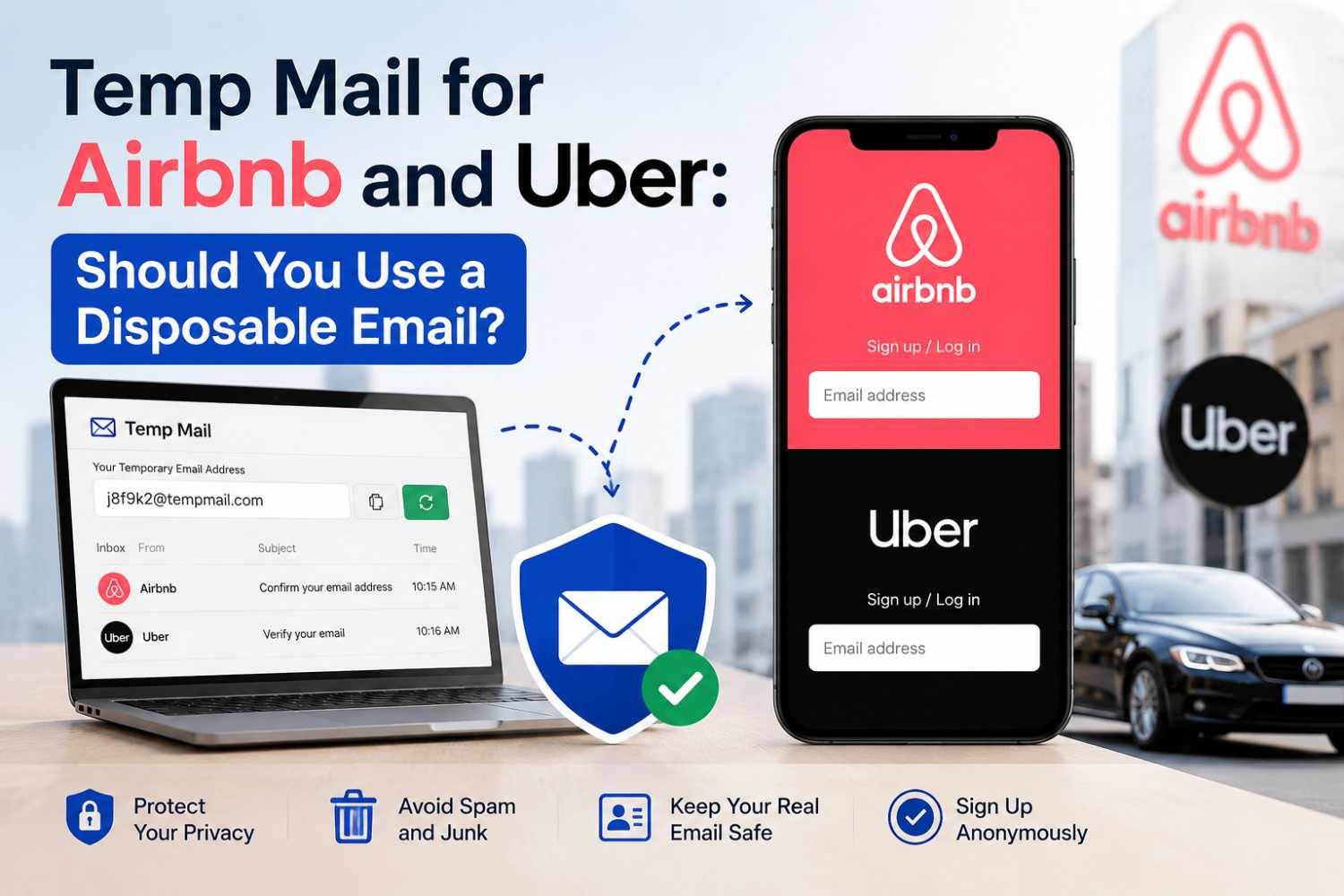
Temp Mail for Airbnb and Uber: Should You Use a Disposable Email?
Quick Answer: Temp mail for Airbnb and Uber can complete the initial email verification step, but both platforms require identity verification, phone confirmation, and payment details before full functionality is available. Tempo Mails handles the signup email cleanly and instantly — but for any account you plan to actually book or ride with, a permanent email is essential for safety alerts, receipts, and account recovery.
Two of the most personal online platforms are Airbnb and Uber. Airbnb is what they call “home stays.” Uber tracks physical journeys in real time. Both platforms collect significant amounts of personal data and use the registered email address as a central communication and safety channel.
Travel and ride-hailing apps are frequently cited in consumer surveys as among the categories users trust least with personal contact data, largely because a single account touches home addresses, payment details, and real-time location.
Newly created travel and mobility accounts also tend to generate a heavier-than-average flow of promotional emails in the weeks after signup, which is part of why some users prefer to keep that traffic away from a primary inbox.
Key Takeaways
- Temp mail for Airbnb and Uber works for the initial email verification step, but both platforms still require phone confirmation, government ID, or both before full account access.
- Airbnb applies lighter domain screening, so temp mail addresses usually pass on the first attempt; Uber's stricter filtering may require a few retries.
- Neither platform accepts a disposable inbox for real bookings or rides — safety alerts, receipts, and dispute communications all require a recoverable email.
- Temp mail is best suited for browsing, developer testing, or one-off account creation, not for accounts tied to an actual trip or stay.
- For ongoing use, a dedicated travel email address or an alias service protects privacy without losing account recovery.
What Is Temp Mail and How Does It Work?
A temporary email service is an email address that doesn't gather personal details and instead produces a disposable inbox. It receives real emails and verification links in real time. The service deletes all content when the session ends.
Tempo Mails generates an inbox the moment the site loads. No sign-up, no password, and no personal data. The address works exactly like any email for receiving messages. When the browser tab closes, the session ends, and every message is permanently deleted.
For a deeper look at what temp mail is and how the verification process works behind the scenes, see our full breakdown.
Why Users Consider Disposable Email for Travel Apps
1. Reducing Promotional Email Volume
Travel app privacy concerns are often triggered by the sheer volume of marketing that follows signup. Uber sends ride promotions, Airbnb sends destination inspiration, and both send regular platform updates. A disposable email service absorbs all of it before it reaches the real inbox.
2. Evaluating the Platform Before Committing
A user researching accommodation or ride options may want to browse the platform interface, compare pricing structures, or review features before deciding to register fully. A temp address allows that exploration without immediate inbox commitment.
3. Testing App Integrations or Developer Workflows
Developers building tools that interact with Uber or Airbnb data, or QA teams testing booking flows, need isolated test accounts. A disposable email keeps each test clean with no shared identity data between runs. Teams building against these platforms can also use a temp mail API for automated testing to generate addresses programmatically.
4. One-Off Trips Where an Ongoing Account Is Not Needed
Occasional travellers may need only one Uber ride or Airbnb booking. They may not want a permanent account relationship. A temp email handles verification. The booking then completes, and the inbox expires afterwards.
How Airbnb and Uber Each Handle Temporary Email Addresses
Airbnb
Airbnb performs basic domain validation during Airbnb account verification but does not maintain an aggressive blocklist for disposable email providers. Tempo Mails addresses pass Airbnb's initial check in most attempts. The verification email typically arrives within 30 seconds.
But Airbnb has also implemented government ID verification before a guest can make their first booking, as well as complete ID verification for hosts before they list a property. These steps use real personal documents, not email. A disposable address only reaches the account creation stage before real identity information is required.
Uber
Uber applies stricter domain screening during Uber email registration than Airbnb does. Known disposable domains are more likely to be rejected outright. Tempo Mails' domain rotation improves compatibility, but multiple attempts may be needed before a domain passes.
Uber also requires phone number verification as a mandatory second step before any ride can be requested. This step uses a real phone number, not email. For a closer look at how the two verification methods differ, see this comparison of disposable email versus virtual phone numbers. The email is used for receipts, safety alerts, and account management, all of which require a recoverable address for any account used for actual travel.
Platform Comparison: Temp Mail Compatibility and Requirements
The table below compares how each platform handles disposable email and what real information is required beyond the initial signup step.
Feature | Airbnb | Uber |
Temp mail domain check | Basic — most pass | Stricter — may need retries |
Verification email speed | ~30 seconds | 30 to 60 seconds |
Phone verification required | Optional at signup | Mandatory before first ride |
Government ID required | Yes — before first booking | Required for driver accounts |
Safety alerts via email | Yes — trip confirmations | Yes — ride receipts and alerts |
Account recovery via email | Yes | Yes |
Temp mail suitability | Browsing only | Testing only |
The Real Limits of Using Temp Mail on Safety-Driven Platforms
Airbnb and Uber are not social platforms or design tools. They involve physical safety: entering someone's home, getting into a stranger's car. Both platforms use email as a core safety communication channel, not just a marketing one.
- Airbnb sends host contact details, check-in instructions, and dispute communications to the registered address.
- Uber sends ride receipts, driver safety reports, and account security alerts, all critical for dispute resolution.
- If either platform detects unusual activity and emails the registered address, a closed temp inbox means no response is possible.
- Password recovery and account reactivation both depend on email access; losing this on a travel platform is a practical safety issue, not just an inconvenience.
How to Sign Up on Airbnb or Uber Using Tempo Mails
Generate a disposable address on Tempo Mails
Visit tempomails.com. Your inbox appears automatically. Copy the address displayed. Keep the tab open throughout the process.
Go to Airbnb or Uber and select email signup
On Airbnb, you will click Sign Up, selecting Continue with Email. Log in to the Uber app or website, tap Create Account, and choose to sign up with email instead of a phone number. Paste your Tempo Mails address. Using temp mail for Airbnb and Uber follows the same initial steps on both platforms.
Retrieve the verification email
Switch to Tempo Mails. The Airbnb account verification or Uber email registration confirmation arrives within 30 to 60 seconds. Click the link inside to activate the account.
Complete the remaining verification steps
Both platforms will prompt for additional information beyond email. To book a ride with Uber, a phone number is required. Government ID is required before booking at Airbnb. These steps use real personal information regardless of which email type was used.
Update to a permanent email before any real transaction
Change the registered email in account settings to a permanent address before making any booking or requesting any ride. This ensures all safety communications, receipts, and account recovery options remain accessible.
When Temp Mail Makes Sense and When It Does Not
Situations where temp mail is appropriate:
- Browsing Airbnb listings or Uber pricing structures before deciding to register fully
- Developer or QA testing of booking or ride request flows in a controlled environment.
- Exploring the interface before committing a real email to either platform's marketing system
Situations where a permanent email is required:
- Any actual Airbnb booking where host contact details and check-in information must be received
- Any Uber ride where a receipt and driver safety information need to be documented
- Accounts that need to raise a dispute, request a refund, or contact support via email
This same signup pattern comes up across other platforms too — see how it plays out for creating a LinkedIn account with temp mail and signing up for dating apps like Tinder.
Travel App Privacy: What These Platforms Actually Collect
Travel app privacy involves more than email addresses. Airbnb collects IP addresses, browsing behaviour, device identifiers, and booking patterns. Uber tracks GPS location, trip history, and device data during active sessions.
Using a disposable email address removes one data point: the email, but does not limit either platform's broader data collection.
Tempo Mails does not log IP addresses or retain any session data after the tab closes. For users wanting broader anonymity when evaluating travel platforms, combining Tempo Mails with a VPN provides more complete protection during the signup session itself.
Better Alternatives for Ongoing Travel Platform Privacy
A dedicated travel account email address
A secondary Gmail or Outlook address used exclusively for travel apps passes both platforms' domain checks reliably, supports account recovery, and keeps the primary inbox clean. The most practical solution for regular travellers.
Email alias services
Services like SimpleLogin or Apple's Hide My Email satisfy both Airbnb account verification and Uber email registration requirements while masking the real address.
Unlike disposable inboxes, aliases are permanent and support account recovery, essential for platforms where safety communications depend on email access. See our full temp mail versus email alias comparison for more detail.
Proton Mail
A Proton Mail address is encrypted, permanent, and passes platform verification reliably. It offers meaningful privacy without the recovery limitations that make disposable inboxes unsuitable for active travel accounts.
Platform Policies on Disposable Email Addresses
Neither Airbnb nor Uber explicitly prohibits disposable email addresses in their terms. Using temp mail for Airbnb and Uber for platform exploration falls into a contractual grey area.
Creating multiple accounts to exploit promotional credits or bypass bans violates both platforms' terms. Manipulating review systems also violates those terms. The issue involves account duplication, not email type. Review each platform's current terms before proceeding.
Conclusion
Temp mail is a reasonable tool for exploring Airbnb and Uber before committing a real email to either platform's marketing system. For platform research, developer testing, or one-off interface evaluation, the disposable signup approach works cleanly.
For any account used for actual bookings or rides, a permanent email is not optional; it is a safety requirement. Host contact details, ride receipts, and dispute communications all depend on email access. Losing that access mid-trip or mid-dispute is not a privacy win; it is a practical problem.
The recommended approach: use a temp mail service at signup, update to a permanent email before the first booking, and consider an alias service for ongoing travel platform privacy that does not sacrifice account recovery.
About the Author
Written by Sarah Whitfield, a digital privacy consultant with over eight years of experience covering travel-tech platforms, account verification systems, and online identity protection. Content is reviewed regularly to reflect current platform verification behaviour. Last Updated: August 2026
(FAQs)
1. Which platform is more likely to accept a Tempo Mails address: Airbnb or Uber?
Airbnb. It applies lighter domain screening and accepts Tempo Mails addresses more consistently on the first attempt. Uber's stricter domain validation may require two or three attempts.
2. Can I complete an Airbnb booking using a disposable email account?
Not fully. Airbnb requires government ID verification before confirming a guest booking. The email step is only the first of several identity requirements. A permanent email is needed for all booking-related communications.
3. Does Uber require phone verification even if I use email to register?
Yes. Uber enforces phone verification for all rides, regardless of the email used to create the account. Temp mail handles the email step only.
4. What safety risks come with using a temp email for a travel app account?
The main risk involves losing important communications when the temp inbox expires. These may include safety alerts, host contacts, driver reports, security notices, or dispute responses.
5. Can I request a refund from Airbnb or Uber if my temp email has expired?
Refund processes typically involve email communication with support teams. If the registered inbox has expired, receiving and responding to those communications becomes impossible without first updating to a permanent email.
6. Is using temp mail for travel apps legal?
Yes. Using a disposable email for platform signup is legal in all major jurisdictions. There is no specific language in Uber's or Airbnb's terms to bar it for one legitimate account for personal use. For a deeper breakdown, see the legal side of using temp mail.
7. How does Tempo Mails protect privacy during the signup session?
Tempo Mails does not log IP addresses or retain any message data after the session ends. When the browser tab is closed, there is no trace of the device from the sign-up session itself.
8. What is the most privacy-friendly way to use Airbnb and Uber long-term?
Use an email alias service such as SimpleLogin for registration. The alias masks the real address, passes platform verification reliably, and supports full account recovery, giving both privacy and the safe communication access these platforms require.