GDPR and Disposable Email: What Every User Should Know
GDPR and Disposable Email: What Every User Should Know
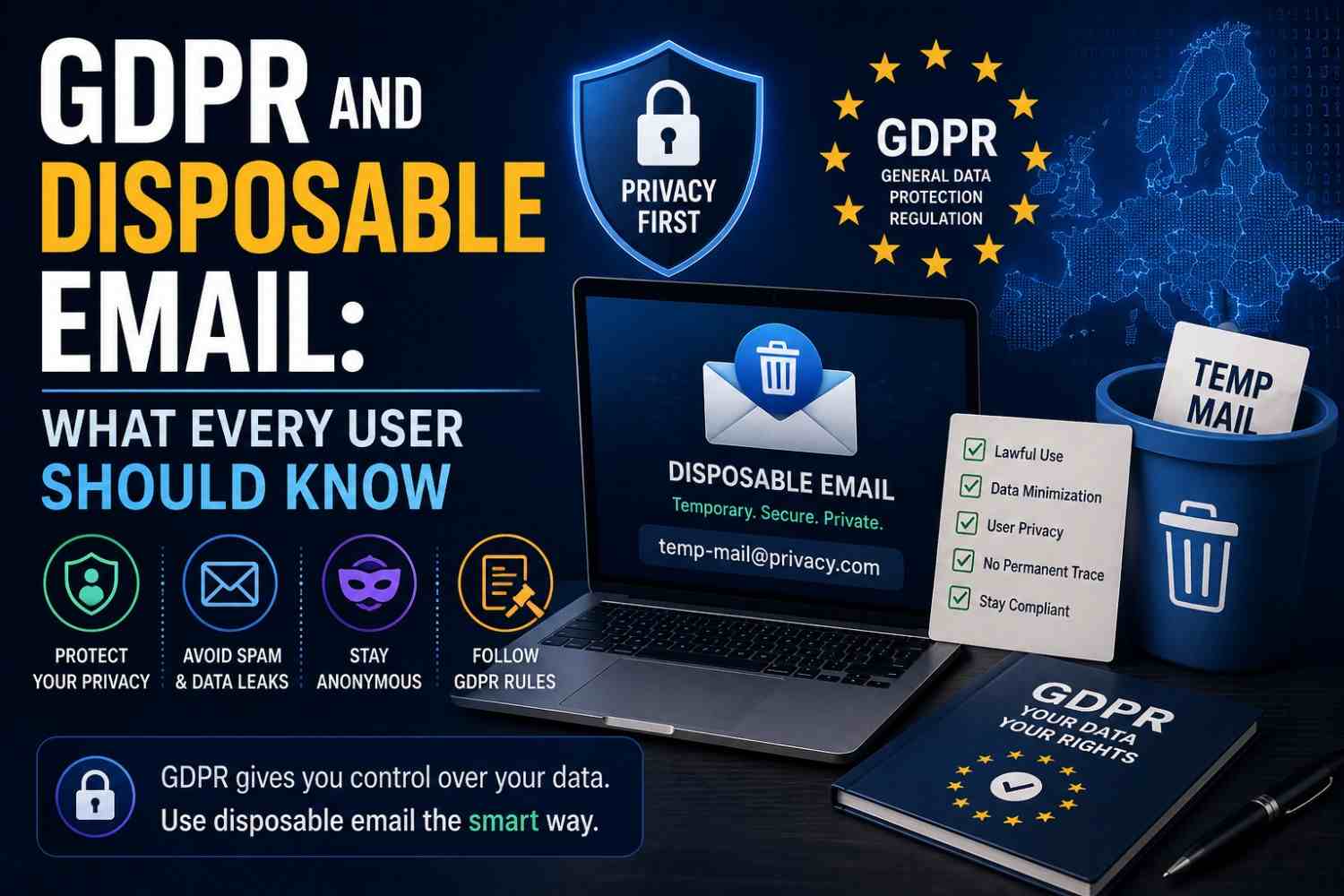
Quick Answer: Using a disposable email under GDPR is fully supported by EU law. GDPR places obligations on organisations collecting data, not on individuals choosing how much to share. Using a temporary email to limit personal data disclosure is a direct exercise of the data minimisation rights GDPR was built to protect. The practice is not barred or limited by EU rules.
GDPR is often misunderstood as placing restrictions on users. It does the opposite. It places restrictions on organisations, and gives individuals the right to protect their own data.
Regulators and privacy researchers have noted a steady rise in individual adoption of privacy tools, including disposable email, across EU member states, with data minimisation frequently cited as the legal basis supporting their use.
Important Points
- Disposable email use under GDPR is legally consistent with Article 5's data minimisation principle. EU residents have a legal basis for limiting personal data submitted to online services.
- EU privacy compliance obligations fall on data controllers, not on individuals choosing which email type to provide during registration.
- Tempomail uses a zero-collection architecture. It aligns with GDPR's privacy-by-design standard. The service collects no personal data after the session ends. You can generate a free disposable email address in seconds to see this in practice.
- Email privacy rights under GDPR include erasure and purpose limitation. Disposable email supports both through session-based deletion.
What GDPR Actually Says About Email Addresses
GDPR classifies personal email addresses as personal data when they identify an individual. A name-based business email is clearly personal data. A randomly generated Tempomail address containing no identifying information occupies a significantly weaker position in this classification.
More importantly, GDPR's obligations run toward the data controller, the organisation collecting and processing the email, not toward the individual providing it.
No GDPR provision requires individuals to submit permanent email addresses to websites. The regulation requires websites to handle whatever address they receive lawfully.
Three core GDPR principles directly support disposable email use.
- Data minimisation (Article 5): Data collected must be limited to what is necessary for the stated purpose. A website needing email for verification does not need a permanent, marketable address. A disposable address satisfies the stated purpose without the excess.
- Purpose limitation (Article 5): Data collected for verification cannot be repurposed for marketing without separate consent. A disposable address that expires before any secondary use prevents purpose creep in practice.
- Storage limitation (Article 5): Data should not be retained longer than necessary. A Tempomail address self-deletes at session end, automatically aligning with this principle by design.
Does GDPR Prohibit Using Disposable Email?
No. GDPR contains no provision restricting individuals from using temporary addresses. The European Data Protection Board has not issued any guidance identifying disposable email use as a regulated or restricted activity.
Some platforms cite GDPR in justifying their blocklists for disposable email domains. This justification has no regulatory basis. GDPR does not require platforms to verify the permanence of submitted email addresses.
Blocking disposable email is a commercial decision, protecting free trial revenue and marketing list quality, not a GDPR compliance requirement. That said, using a disposable email service remains entirely lawful for the user regardless of a platform's own policy.
EU Privacy Compliance: What GDPR Requires of Platforms
Under data protection rules, platforms collecting email addresses during registration must:
- Have a lawful basis for collection
- Disclose how the data will be used
- Not use the data beyond the stated purpose without separate consent
- Honour the right to erasure upon request
- Protect the data from unauthorised access
None of these requirements extends to individuals choosing which email address to provide. A user who submits a Tempomail address is not in breach of any data protection rule. The platform's GDPR obligations apply to whatever address it receives.
Email Privacy Rights Under GDPR
Right to Erasure (Article 17)
GDPR gives EU residents the right to request deletion of personal data held by organisations.
When users submit a real email address, they must make a formal request to enforce this right. Platforms may take weeks to process these requests. For a broader look at how disposable addresses reduce this burden, see our temporary email privacy guide.
A Tempomail address achieves erasure automatically. When the session ends, the address and all messages are deleted from Tempomail's servers by architectural design. No erasure request is needed because no persistent data was ever stored.
Right to Data Portability (Article 20)
Under GDPR, there is a right to “portability” of personal data. A Tempomail address generates no personal data profile; users cannot port any data because Tempomail collects nothing.
Right to Object to Processing (Article 21)
If they are an EU resident, they may object to the processing of their data for direct marketing. A disposable email address that expires before any marketing processing begins makes this objection unnecessary; the processing never starts.
How Tempomail Aligns With GDPR Standards
Tempomail operates on a privacy-by-design model, the standard GDPR recommends for technical compliance at the service level. Registration does not collect personal data. Message content never enters a permanent database. Creating a temporary email address takes only a few seconds and requires no sign-up.
The service also does not log an IP address or device identifier to a user record. When the session ends, all session state is cleared architecturally, not deleted from storage, but never written to storage in the first place.
This means that even a regulatory request to Tempomail would produce no personal data, because none was ever collected. The zero-collection model is the strongest possible alignment with GDPR's privacy-by-design principle.
When Disposable Email Intersects With Platform Terms
GDPR compliance and platform terms of service are separate questions. Some platforms prohibit disposable email in their terms; this is a contractual matter, not a data protection rules issue. Violating a platform's terms by using a disposable address carries contractual consequences only: typically account termination. Knowing which situations call for a disposable address and which don't is worth understanding on its own; our temporary email safety guide breaks down when it helps and when it doesn't.
No GDPR provision, no EU directive, and no national data protection law in any EU member state creates legal liability for an individual who provides a temporary email address to a website that prefers a permanent one.
To date, no EU member state has enacted legislation restricting the use of disposable email addresses by individuals for personal privacy purposes, and no supervisory authority has issued guidance identifying such use as contrary to EU data protection rules.
Put GDPR-Compliant Privacy Into Practice
Every registration form that asks for an email address is a small data-minimisation decision. Handing over a permanent inbox invites marketing follow-ups, data-breach exposure, and profiles you never agreed to build. A disposable address lets you complete the signup, receive the one verification message you need, and walk away clean, exactly the outcome GDPR's own principles were designed to protect. Generate your free temporary email address now and see how much simpler privacy-first signups can be.
Conclusion
In short, disposable email use under GDPR is fully consistent with EU law and actively supported by the data minimisation, purpose limitation, and storage limitation principles at the core of the regulation. Tempomail's zero-collection architecture aligns with GDPR's privacy-by-design standard.
EU users exercising their email privacy rights through disposable email are not circumventing the law; they are using it as intended.
Author Expertise
This article is written by Elena Marsh, a data privacy consultant with over eight years advising SMEs on GDPR compliance, who covers EU privacy compliance, GDPR application to email privacy tools, and data protection rights for everyday users. Content is reviewed against current regulatory guidance and updated regularly. Editorial disclosure: Tempomail is a temporary email service; this article discusses how its architecture relates to GDPR, and readers should independently verify legal guidance for their specific situation. (tempomails.com)
FAQs
Does GDPR require individuals to provide permanent email addresses?
No. GDPR places obligations on data controllers rather than individuals. No provision requires users to submit permanent or verifiable addresses to private websites.
Can a platform claim GDPR requires them to block disposable email?
No. GDPR does not require platforms to verify address permanence. Blocking disposable email is a commercial decision, not a regulatory compliance requirement.
Is Tempomail itself GDPR compliant?
Yes. Tempomail collects no personal data. It saves none of the content when the session is closed. Its architecture is privacy by design and complies with GDPR technical standards.
Does the right to erasure apply differently with disposable email?
A Tempomail address achieves automatic erasure at session end; no formal request needed. For the platform that received the address, normal GDPR erasure rights apply upon request.
Are EU users legally protected when using disposable email?
Yes. No EU law restricts individual use of disposable email addresses. The EDPB has not identified the practice as contrary to any EU data protection rule.
Does using Tempomail prevent platforms from building a data profile?
It prevents email-based profile building and contact. Platform-side session tracking and cookie-based profiling operate independently of the email address type used at signup.
Can platforms share a Tempomail address with third parties under GDPR?
They can attempt to, but the address expires before any third-party contact attempt is possible. GDPR requires platforms to disclose data-sharing purposes; a disposable address bypasses the practical impact of that sharing even when it occurs.
Does GDPR's purpose limitation principle protect against marketing after signup?
It requires platforms to have separate consent for marketing. A Tempomail address that expires prevents marketing contact regardless of consent status; the practical protection is complete even where regulatory enforcement is imperfect.