Temp Mail for Freelancers: Protect Your Inbox on Upwork and Fiverr
Quick Answer: Temp mail for freelancers protects the primary work inbox from platform marketing, client-unrelated notifications, and tool evaluation spam. Freelancers use disposable email for signups on productivity tools, competitor research platforms, and service trials without exposing their professional email address to systems that share data with advertisers or send ongoing promotional campaigns.
Introduction
Freelancers operate like small businesses and constantly evaluate tools, often starting with a quick look at what temp mail is before adopting it into their signup routine. They sign up for platforms to access client work and compare pricing and features. Each registration with a primary work email creates another entry point for marketing contact, data broker collection, and potential breach exposure.
Temp mail for freelancers addresses this by keeping the professional inbox reserved for client communication and income-generating activity, while a free disposable email service handles every other registration automatically.
Upwork's 2026 Freelancer Economy Report found that independent professionals use 17 digital tools and platforms monthly on average. The report also found that 73% experience inbox disruption from promotional and platform marketing emails.
Main Points
- Temp mail for freelancers keeps the professional work email out of tool evaluation platforms, trial signups, and competitor research registrations that generate ongoing marketing contact.
- Freelancer email privacy depends on limiting how many commercial platforms hold the real work address, since each one is an independent breach risk and marketing exposure point.
- Temporary email for work applies to low-stakes platform evaluations where no ongoing communication with the service is needed after the initial signup or access step.
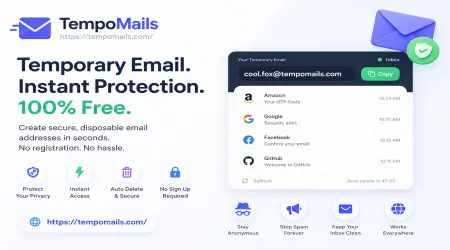
- Tempomails provides instant disposable email generation with no cost, no registration, and automatic session-end deletion that leaves no persistent data anywhere.
Why Freelancers Need Inbox Protection
The Professional Inbox Problem
A freelancer's primary email is the centre of their business. Client proposals arrive there. Project briefs land there. Invoice confirmations, contract communications, and payment notifications all route through it.
When that inbox fills with SaaS trial follow-ups, competitor platform newsletters, and discount expiry alerts from tools evaluated months ago, client communications get buried.
Unlike salaried employees who can rely on employer IT to manage inbox filtering, freelancers manage their own communication infrastructure.
Inbox hygiene directly affects responsiveness to clients and the professional impression every reply timing creates.
The Data Exposure Risk
Every platform holding a freelancer's real work email is a potential breach source. A breached freelance email connected to a productivity tool or competitor service exposes a professional identity that clients search and evaluate. Following a temporary email data breach protection approach limits how far a single breach can reach into a freelancer's professional identity.
Phishing emails crafted to look like legitimate client or platform communications become more dangerous when attackers know which platforms the freelancer uses.
Where Temp Mail for Freelancers Adds Direct Value
Tool and Software Evaluation
Freelancers regularly evaluate project management tools, invoicing software, design platforms, writing assistants, and client communication tools before committing to one. Most evaluations require email registration that immediately triggers a sales sequence.
Disposable email for signups on tool evaluations lets freelancers access the trial, assess the product thoroughly, and make a subscription decision without receiving a sales campaign in the primary inbox throughout the evaluation period. This mirrors how QA teams handle disposable emails for app testing, applied here to the freelancer's own tool-evaluation cycle.
Competitor Research and Market Analysis
Understanding competitor pricing, service offerings, and client communication requires competitor platform registrations. Submitting a real work email creates significant privacy exposure. It also identifies the freelancer as a competitive observer.
A temporary email for work used in competitor research completes the registration without connecting the freelancer's professional identity to the competitor's CRM or marketing database.
Job Board and Marketplace Exploration
Freelancers use disposable email to evaluate new platforms before creating a professional profile. Setting up an Upwork or Fiverr test account can help assess the buyer interface, fee structure, and service categories. A real professional email is unnecessary until the freelancer decides to create a genuine profile.
Newsletter and Industry Content Access
Many freelance-relevant newsletters, content platforms, and industry publications gate their most valuable content behind email registration.
Temp mail for freelancers retrieves the content access link or first issue during the session, allowing evaluation before deciding whether the content is worth subscribing with a real address. The same approach works well when the goal is simply to stop newsletter spam using a temporary email altogether.
When Real Email Is Required for Freelancers
Primary Marketplace Accounts
Upwork, Fiverr, Toptal, and similar freelance marketplaces require a permanent email. The address supports client communication, dispute resolution, payment notifications, and identity verification.
These accounts represent direct income channels where email access is a business-critical function. A disposable address used here creates unacceptable operational risk.
Client-Facing Platform Access
Platforms where clients invite freelancers to collaborate, access shared documents, or communicate on project deliverables require a permanent email. The client's invitation, access permissions, and project communications all route through the registered address.
Payment and Invoicing Tools
PayPal, Stripe, Wave, and similar payment platforms freelancers use for invoicing and receiving payments require a permanent email for transaction confirmations, dispute communications, and tax documentation delivery. This is why using a disposable email for PayPal carries risk freelancers should understand before trying it.
Long-Term Service Subscriptions
Any platform where the freelancer subscribes to a paid plan requires a permanent email for billing confirmations, renewal alerts, and subscription management communications.
Freelancer Email Privacy Strategy
The Two-Tier Approach
The most effective freelancer email privacy strategy uses two distinct address types rather than one. The primary work email handles all client communication, income-generating platforms, payment services, and any subscription where billing or account recovery matters. This address appears in client proposals, LinkedIn profiles, and professional directories.
Tempomails handles everything else: tool evaluations, competitor research, content access registrations, platform exploration, and any signup where ongoing communication from the service adds no value to the freelance business.
This separation keeps the primary inbox signal-to-noise ratio high, protects professional reputation from breach exposure through low-value platforms, and eliminates the subscription management overhead that accumulates from tool evaluation campaigns.
Using Tempomails in a Freelance Workflow
Daily Workflow Integration
The practical workflow is straightforward. Before evaluating any new tool or registering on any non-client platform, open a disposable inbox generator. A temporary inbox generates immediately without any input. Copy the address. Complete the platform registration. Return to Tempomail to retrieve the verification email. Activate the account. Evaluate the tool or access the content.
If the tool is worth adopting, update the registered email to the real work address. Complete this step before closing the Tempomails tab. If the tool does not meet the requirement, close the tab and move on. Everything deletes automatically.
Mobile Workflow
For freelancers working primarily on mobile devices, Tempomails is accessible through any mobile browser via its free temporary email tool. Android users can also use the Tempomails Android app available on the Google Play Store for native mobile access to disposable inbox generation.
Pew Research Center's 2026 Professional Digital Privacy Survey found that self-employed professionals experience 42% higher rates of professional-identity-targeted phishing than salaried employees, with the primary exposure vector identified as the professional email address appearing in commercial platform databases through tool trial and evaluation signups.
Conclusion
Temp mail for freelancers converts every low-value platform registration into a zero-exposure interaction that leaves no permanent data trail connected to the professional work identity. Tempomails provides the disposable inbox generation freelancers need to evaluate tools freely, research competitors confidently, and access content without accumulating marketing campaigns in the inbox where client relationships are built and maintained.
About the Author
Covering freelancer email privacy strategies, temporary email for work use cases, and disposable email for signups across freelance marketplaces, productivity tools, and professional service platforms.
(FAQs)
Should freelancers use temp mail for Upwork or Fiverr accounts?
No. Primary marketplace accounts require a permanent email for client communication, payment notifications, and account recovery. Temp mail for freelancers applies to platform evaluations and research, not income-generating marketplace profiles.
Does temporary email for work protect freelancer data from breaches?
Yes. A Tempomails address submitted to a tool evaluation platform expires before any breach can use it as an active contact point. The professional work email never enters the database.
Can I use Tempomails on my phone while working with freelance clients?
Yes. Tempomails works in any mobile browser. The Android app is also available on the Google Play Store for native access on Android devices.
Does disposable email for signups affect the freelancer's ability to evaluate tools properly?
No. Trial accounts created with disposable addresses function identically to those created with real emails during the evaluation period.
What happens if I decide to keep a tool after evaluating it with Tempomails?
Update the registered email in the tool's account settings to the real work address before closing the Tempomails tab. The account retains full functionality with the permanent email going forward.
Does freelancer email privacy improve by using Tempomails for newsletter signups?
Yes. Disposable email for signups on industry newsletters retrieves the content access without adding the work email to the publication's marketing database or subscriber list.
Is there any cost for freelancers to use Tempomails?
No. Tempomails is completely free with no registration required and no premium tier needed for any core functionality.
Can Tempomails be used for competitor research on Upwork or Fiverr buyer accounts?
Yes. Exploring the buyer perspective on freelance marketplaces using a disposable email keeps the freelancer's professional identity separate from the research activity.