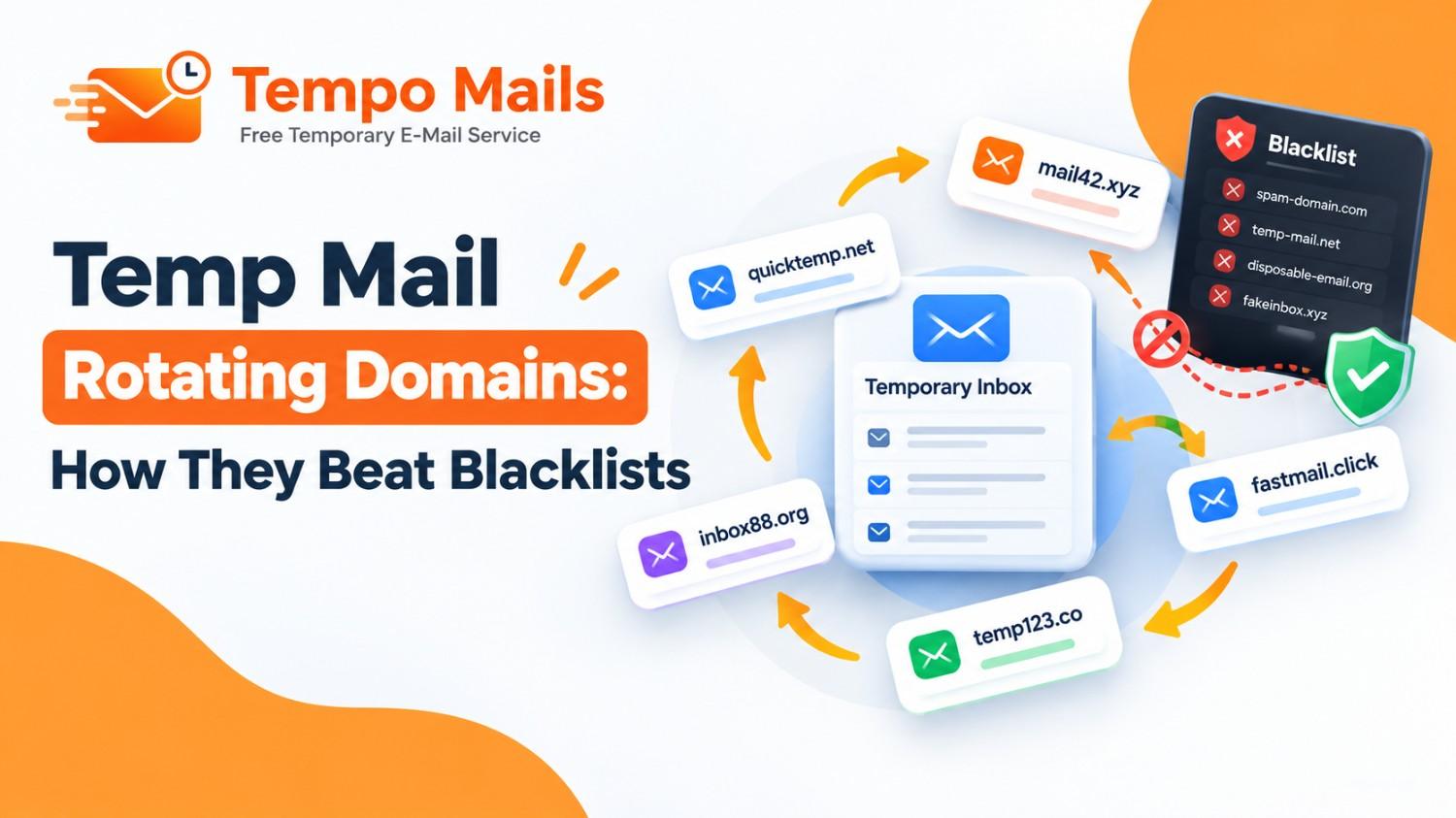
Temp Mail Rotating Domains: How They Beat Blacklists
Quick Answer: Rotating domain temp mail beats blacklists by continuously cycling through fresh domains that have not yet been identified and blocked by platform screening tools. When one disposable email domain gets flagged, the rotation system moves to a new one automatically. Tempo Mails uses this approach to maintain high compatibility across platforms that actively filter known temporary email providers.
Introduction
Every disposable email domain eventually gets blacklisted. Platforms that want to block temporary inboxes maintain lists of known disposable email providers and reject any address using those domains. Understanding how temp mail works in the first place makes it clear why rotation is necessary.
Rotating domain temp mail solves this problem by staying one step ahead. Fresh domains that have not yet appeared on any blocklist pass validation checks that older, flagged domains fail. That gap between discovery and blocking is where rotation works.
Key Points
- Rotating domain temp mail stays ahead of blocklists by cycling through fresh, unrecognised domains continuously.
- Temporary email blacklists target specific known domains, not the concept of disposable email itself.
- Dynamic temp mail domains give users a working address even on platforms with aggressive filtering.
- Disposable email domains lose effectiveness over time without rotation, making it a critical feature for reliable inbox delivery.
Why Platforms Build Temporary Email Blacklists
Platforms block disposable email addresses for a specific set of reasons: preventing multiple free trial signups from one user, reducing fake account creation, and maintaining contact with users for marketing and retention purposes. These are the same underlying reasons covered in why platforms block temp mail domains.
Industry monitoring by major email validation providers consistently shows thousands of disposable email domains circulating across shared blocklists at any given time, with new domains being added on a continuous, ongoing basis.
Email hygiene research has repeatedly found that a meaningful share of addresses submitted through consumer web forms come from known temporary email domains, which is part of why platforms continue investing in detection infrastructure.
The scale of this filtering system is why static temporary email domains, those that never change, eventually stop working on many platforms. Major validation service providers regularly update and share temporary email blacklist databases. This is also why comparing temp mail against alternatives like email aliases and masked email matters when choosing a privacy tool.
How Temporary Email Blacklists Actually Work
Understanding the mechanics of blacklisting explains why domain rotation defeats it.
Domain reputation tracking
Email validation services monitor domains that repeatedly support disposable inbox activity. A domain that receives thousands of verification emails from different platforms in a short period develops a pattern that flags it as a temporary email provider.
Shared blocklist databases
Major email validation providers, including ZeroBounce, NeverBounce, and Mailgun Validate, maintain shared databases of known temporary email domains. When a platform integrates one of these services, it inherits the full blocklist. A domain blocked on one platform quickly becomes blocked across many.
MX record pattern analysis
Disposable email services often use mail server configurations that differ from those of standard email providers. Validation tools that analyse MX record patterns can identify disposable infrastructure even when the domain itself is not yet on a named list. An MX record is the DNS entry that tells other mail servers where to deliver a domain's email.
Syntax and format fingerprinting
Some validation tools look for patterns in randomly generated addresses, such as specific character distributions or address length ranges, that correlate with automated address generation rather than human-chosen usernames.
Each of these detection methods targets temporary email domains based on observable behaviour rather than a permanent characteristic of the address format itself.
Rotation directly undermines all four by ensuring fresh domains exhibit none of the accumulated behavioural signals that trigger blocking.
How Rotating Domain Temp Mail Defeats Each Detection Method
Against reputation tracking
A new domain has no reputation history. It has received no previous disposable email activity that validation services can observe. It appears identical to a legitimate new email provider. Rotating domain temp mail exploits this invisibility window before reputation data accumulates.
Against shared blocklists
Blocklist databases update on cycles, typically daily or weekly. A domain that enters rotation today will not appear in the next update until services detect and process its usage patterns. The gap between a domain entering active rotation and appearing on a shared blocklist creates a reliable window of full compatibility.
Against MX record pattern analysis
Sophisticated rotation systems vary mail server configurations across their dynamic temp mail domains, making MX record fingerprinting less reliable as a detection signal.
Against address pattern fingerprinting
Rotation can also vary the address generation algorithm, producing usernames that match different patterns across different domains, reducing the statistical signal that fingerprinting tools rely on.
What This Means for Tempo Mails Users
Tempo Mails’ domain rotation means that even on platforms with aggressive temporary email blacklist systems, a fresh address from a new session is likely to pass where an older, flagged domain would fail.
If a Tempo Mails address is rejected during a sign-up attempt, the practical fix is straightforward: close the tab, open a new rotating domain temp mail session, and copy the new address generated in that session.
The new session draws from a different point in the rotation pool, typically producing a domain with clean reputation status. Most users complete successful registrations within one or two attempts even on platforms with strict filtering.
The rotation system handles the technical work of staying ahead of blocklists. Users only ever need to generate a fresh address.
Platforms Where Domain Rotation Makes the Difference
Some platforms use aggressive disposable email filters. Without rotation, static disposable email domains fail on these consistently. Rotation helps maintain compatibility because the fresh domain has no prior blocking history.
High-filtering platforms where rotation matters most include LinkedIn, which applies strict domain screening during professional account creation; Outlook, which uses Microsoft's own validation infrastructure and blocks many known providers; and major SaaS platforms that integrate third-party email validation APIs using shared blocklist databases. Developers building around temp mail for developers can expect the same filtering behaviour when testing signups programmatically against a dynamic temp mail domains pool.
Lower-filtering platforms, including most e-commerce sites, content platforms, and regional services, accept temporary email domains regardless of rotation because their validation is limited to format and mail server checks. On platforms like these, questions such as whether using temporary email is illegal or how it compares to a virtual phone number matter more than domain freshness.
The Lifecycle of a Disposable Email Domain
Understanding the lifecycle explains why rotation is a permanent requirement rather than a temporary fix. A new domain enters the rotation pool with no blocklist presence. During initial deployment, it passes validation checks on virtually every platform.
Over weeks or months of use, validation services identify the domain through usage pattern analysis. It appears on one or two blocklist databases, then spreads through shared database updates.
Acceptance rates on high-filtering platforms decline. The domain is retired from the active rotation pool. A new domain enters, and the cycle repeats. Dynamic temp mail domains are the mechanism that keeps this lifecycle running continuously.
Without new domain supply, a disposable email service degrades into a static provider with a fixed set of increasingly blocked domains.
Conclusion
Rotating domain temp mail is not a workaround; it is the fundamental architecture that makes reliable disposable email possible in 2026. Temporary email blacklists are effective against static providers but structurally limited against rotation systems that continuously introduce fresh domains. A constantly refreshed disposable email domains pool is what keeps that structural advantage intact.
Tempo Mails’ rotation approach keeps disposable email domains functional across platforms that would otherwise reject them, requiring nothing from users beyond generating a new address when needed.
Start Generating Rotating Temp Mail Addresses Now
Static disposable email addresses fail more often the longer they stay in use, and every rejected sign-up costs you time. Generate a fresh rotating temp mail address and get a domain with clean reputation status on the first try. Prefer working from your phone? Grab the Tempo Mails Android app and carry a rotating pool of fresh addresses with you.
Author Expertise
Written by Marcus Webb, an email deliverability and anti-abuse researcher who has spent over six years studying domain reputation systems, blocklist infrastructure, and disposable email detection methods used by validation vendors. Marcus tracks how blocklist databases, MX record analysis, and address-pattern fingerprinting evolve to counter high-volume signup abuse. This article reflects current infrastructure behaviour and is updated as the domain ecosystem evolves. Visit dynamic temp mail domain pool to access the full rotation pool.
FAQs
1. Why does a Tempo Mails address get rejected on some platforms?
The specific domain assigned to that session may already appear on the platform's temporary email blacklist. Generating a fresh address from a new session typically resolves this immediately.
2. How often does Tempo Mails rotate its domains?
The rotation operates continuously, with new domains entering the pool as older ones accumulate blocklist presence. Users always receive addresses from the current active pool.
3. Can platforms block rotating domain temp mail permanently?
No. Blocking rotation systems requires identifying new domains before they are used, which is not feasible at the speed professional rotation pools operate.
4. Does domain rotation affect how fast verification emails arrive?
No. Delivery speed depends on the sending platform's mail server. Fresh disposable email domains receive messages at the same speed as established ones. The same holds for messages that include attachments.
5. Are dynamic temp mail domains less private than static ones?
No. Privacy depends on the service's data practices, not the domain age. Tempo Mails retains no session data regardless of which domain is assigned.
6. Why do some disposable email services stop working over time?
They use static domains without rotation. As those domains accumulate blocklist presence, acceptance rates decline across filtering platforms until the domains become largely unusable. Comparing a dedicated rotation service against something like 10 minute mail makes the difference easy to see.
7. Can a platform block all possible temp mail domains?
Theoretically yes, but practically no. The volume of available domains and the speed of rotation make comprehensive blocking impossible to maintain in real time.
8. What should I do if two Tempo Mails attempts are rejected in a row?
Try a third fresh session. Rejections cluster when a rotation pool happens to assign recently flagged domains. A third attempt almost always draws from a clean pool segment.