Temp Mail vs VPN: Which Tool Protects Your Privacy Better?
By Claire Donovan, Privacy & Security Writer at Tempo Mails — reviewed for accuracy
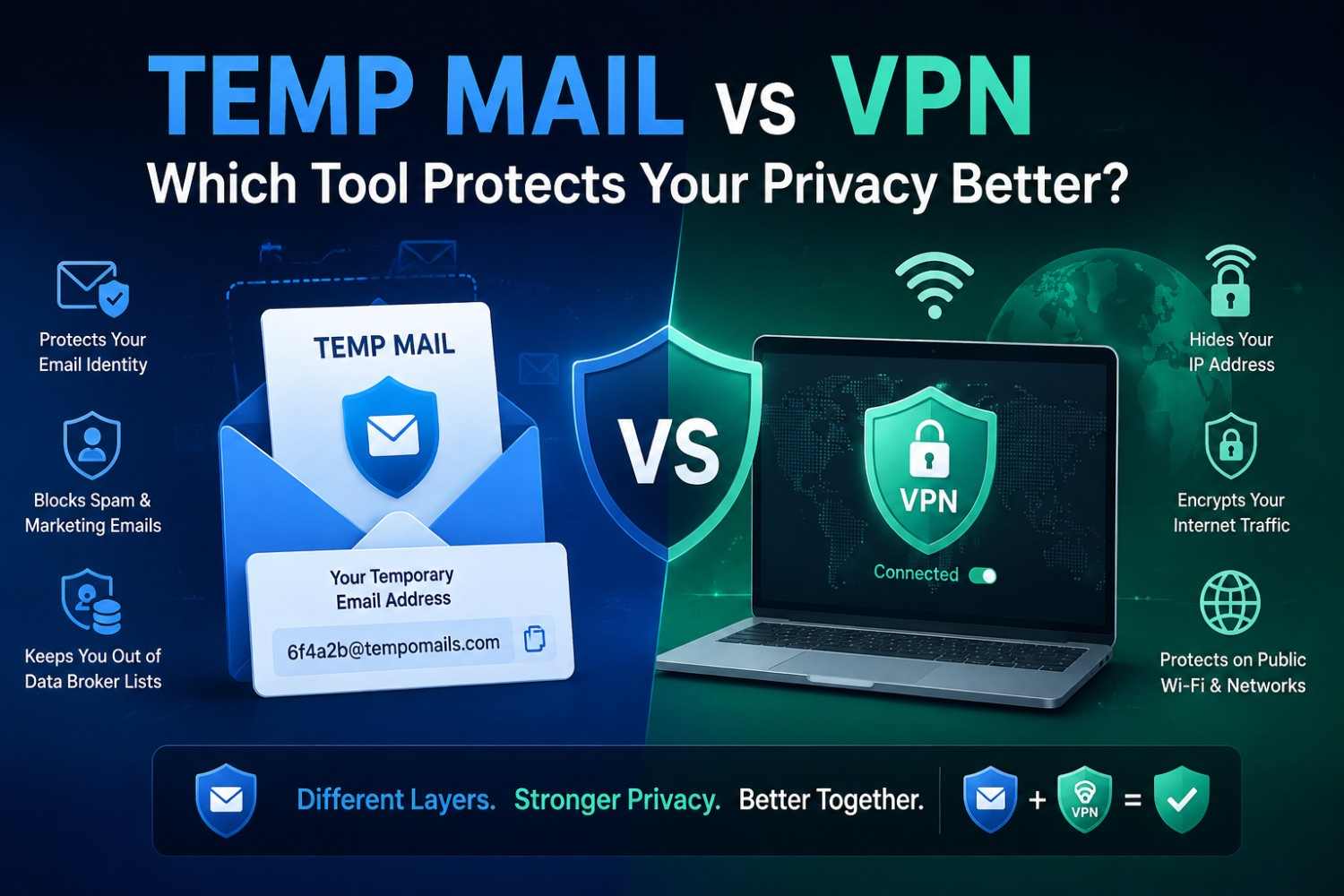
Quick Answer: Temp mail vs VPN is not a competition. They serve as barriers to various dangers. A VPN obscures your IP address and secures your network communications. Temp mail keeps your real email out of platform databases. One does not replace the other. The privacy gap neither can fill is where the other tool belongs.
The use of privacy tools is only effective when paired with the right threat. VPN protection of your inbox is similar to locking the front door and leaving the window open.
Many VPN users mistakenly believe their tool also stops platforms from collecting their email address, which means their inbox stays just as exposed to data collection as before. You can try the free temporary email generator yourself to see how quickly a disposable address is created.
Main Points
- Temp mail vs VPN is a comparison of two tools addressing completely separate privacy layers. If you're new to the concept, see this complete guide to what temp mail is before diving into the comparison.
- A VPN protects network-level IP address visibility; it does not affect what email address is submitted to a platform.
- Temp mail protects inbox identity and email data exposure; it does not affect how the device appears on the network.
- Combined, they help close two of the most commonly exploited privacy gaps for everyday internet users.
What a VPN Actually Protects
A VPN routes internet traffic through an encrypted tunnel to a remote server. It replaces the device's real IP address with the server's IP. Websites visited during the session see the VPN server's IP instead.
This can protect geographic location from websites and advertisers. It can also limit ISP-level traffic monitoring. A VPN secures data on public Wi-Fi and enables access to region-restricted content.
A VPN does not protect email addresses submitted during signups. It does not prevent platform-side data collection after login. It also cannot block email tracking pixels or stop data brokers from building profiles.
What Temp Mail Actually Protects
Tempo Mails' disposable email address generator completes platform verification and then expires automatically at session end. The real email address is never submitted to the platform's database.
This prevents marketing contact after signup, removes the address from breach exposure pools, eliminates email-linked cross-platform identity tracking, and stops data brokers from compiling the address into a commercial profile. For a deeper technical breakdown, see how temp mail actually works.
Temp mail does not mask the IP address, does not encrypt network traffic, does not prevent session-level behavioural tracking on the platform, and does not affect how the browser fingerprint appears to websites. For signups that ask for a phone number instead of an email, see how temp mail compares to virtual phone numbers.
Temp Mail vs VPN: Direct Comparison
Feature | Temp Mail | VPN |
Hides IP address | No | Yes |
Encrypts network traffic | No | Yes |
Protects email from data brokers | Yes | No |
Prevents marketing emails | Yes | No |
Stops email breach exposure | Yes | No |
Blocks cross-platform email linking | Yes | No |
Secures public Wi-Fi use | No | Yes |
Prevents ISP monitoring | No | Yes |
Works on any device | Yes | Yes |
Cost | Free | Usually paid |
Online Privacy Comparison: Which Threat Is More Common?
For most everyday users, email-based tracking causes more immediate and visible harm. Spam campaigns, targeted phishing, data broker profiles, and marketing saturation are direct consequences of real email addresses in platform databases. These effects appear daily.
IP-based tracking through VPN use produces less visible effects, primarily more accurate cross-site ad targeting and ISP visibility into browsing habits. Both matter, but inbox exposure tends to produce faster and more tangible consequences for most non-technical users.
Anonymous Internet Usage: How Close Can Each Tool Get You?
Neither tool achieves true anonymous internet usage alone. A VPN user can remain identifiable after submitting a real email address. Changing the IP does not protect the account once login connects the identity to the session.
A Tempo Mails user without a VPN remains identifiable by IP address. The disposable email protects the inbox but leaves the network layer exposed. Together, they remove two major identity vectors.
Adding a fingerprint-blocking privacy browser removes a third. Together, these steps are part of a wider strategy to protect your digital footprint. The combination of all three provides a practical level of anonymous internet usage for everyday interactions without requiring technical expertise.
Privacy Protection Tools: The Right Stack
The concept of a single privacy protection tool that handles everything is a marketing claim, not a technical reality. Each tool in a privacy stack addresses a specific threat layer.
Temp mail handles the email identity layer, the most commercially exploited and breach-exposed personal data point for most users. Deploy it for every low-stakes signup where ongoing email access is not needed. Tempo Mails' free disposable email addresses service makes this easy to do on any device.
A VPN handles the network layer: IP address visibility, ISP monitoring, and data security on untrusted networks. Deploy it for all browsing sessions where location and traffic privacy matter.
A fingerprint-blocking browser handles the device identity layer, preventing cross-session tracking that persists despite IP changes and cleared cookies.
These three together provide practical coverage across the three main tracking vectors that affect everyday internet users.
When Temp Mail Is the Better Choice
Use Tempo Mails when the primary risk is email-based data collection: newsletter signups, free trial activations, content downloads, forum registrations, AI platform evaluations, and any signup where marketing emails are not wanted. No cost. No configuration. Address generates in seconds and expires automatically. It also works as a free Android app for generating addresses on the go, and it helps to know why certain websites block temp mail domains before relying on it for every signup.
When a VPN Is the Better Choice
Use a VPN when the main risk involves network-level exposure. This includes public Wi-Fi and ISP monitoring concerns. It also helps with geographic restrictions and IP-based privacy risks.
When Both Are Needed
For example, when creating a new account on an untrusted network such as coffee shop Wi-Fi, use both tools simultaneously.Tempo Mails protects the email identity layer. The VPN protects the network layer. Neither duplicates the other's function. This combination is especially useful when using temp mail while travelling on hotel or airport Wi-Fi.
Users who combine a VPN with a disposable email service typically report a noticeable drop in spam and phishing attempts compared to relying on a VPN alone, which highlights the gap that network protection by itself leaves open.
Conclusion
Temp mail vs VPN resolves simply: use both for different reasons. Temp mail protects the email identity layer that VPNs cannot reach. A VPN protects the network layer that temp mail cannot touch. Head to the temporary email service to generate a disposable address in seconds.
Together they help close two of the most commonly exploited privacy gaps for everyday internet users, at a combined cost that is either free or minimal.
(FAQs)
Does a VPN stop companies from collecting my email address?
No. A VPN masks the IP address but does not affect what data is voluntarily submitted during platform registration. The email address is collected regardless of VPN use.
Does temp mail protect browsing history?
No. Tempo Mails addresses the email identity layer only. Browsing history protection requires network and device-level measures. A VPN and privacy-focused browser can provide these layers. For a broader look at the risks involved, see this breakdown of temporary email safety.
Can I use Tempo Mails and a VPN at the same time?
Yes. They work in parallel layers and don't intertwine. Using both simultaneously protects both the email identity and network layers.
Which is more important for everyday privacy: temp mail or VPN?
Temp mail addresses more immediately visible harm for most users. Email-based spam and phishing can affect daily life directly. Data broker exposure also creates ongoing risks. For many people, these threats matter more than IP-based tracking. It's also worth understanding whether using temporary email is legal in your region before relying on it regularly.
Does a free VPN provide the same network protection as a paid one?
Not reliably. Many free VPN services log user data and sell it to third parties, creating a new data collection risk that partially offsets the network protection they provide.
Does Tempo Mails work while connected to a VPN?
Yes. Tempo Mails functions identically regardless of the network connection type, including VPN-encrypted connections. The temporary address generates and receives messages normally.
Will using both tools together achieve complete anonymity?
No tool combination achieves complete anonymity. Together they remove two major tracking vectors. A fingerprint-blocking browser addresses a third. Residual platform-side session tracking remains regardless of external tools used.
Is combining temp mail and a VPN worth the effort?
Tempo Mails requires no effort; the address generates in seconds. A VPN requires a one-time setup. The combined protection delivers significantly stronger privacy than either tool alone for minimal additional work.