Tempo Mails vs Guerrilla Mail: A Modern Alternative to a Classic Tool
Quick Answer: Guerrilla Mail has been a reliable disposable email tool since 2006, but its public inbox model and dated interface have limitations modern users notice quickly. Tempomail offers a faster, cleaner Guerrilla Mail alternative with instant address generation, session-based privacy, and no publicly accessible inboxes — making it the stronger choice for users who prioritise both speed and actual privacy.
Guerrilla Mail pioneered the disposable inbox in 2006. The temporary email market has changed considerably since then. Differences between older and newer services now matter more than many users realise.
This category of tool is broadly known as a disposable email address, a concept that predates most of today's providers and still shapes how modern services like Tempomail are designed.
Main Points
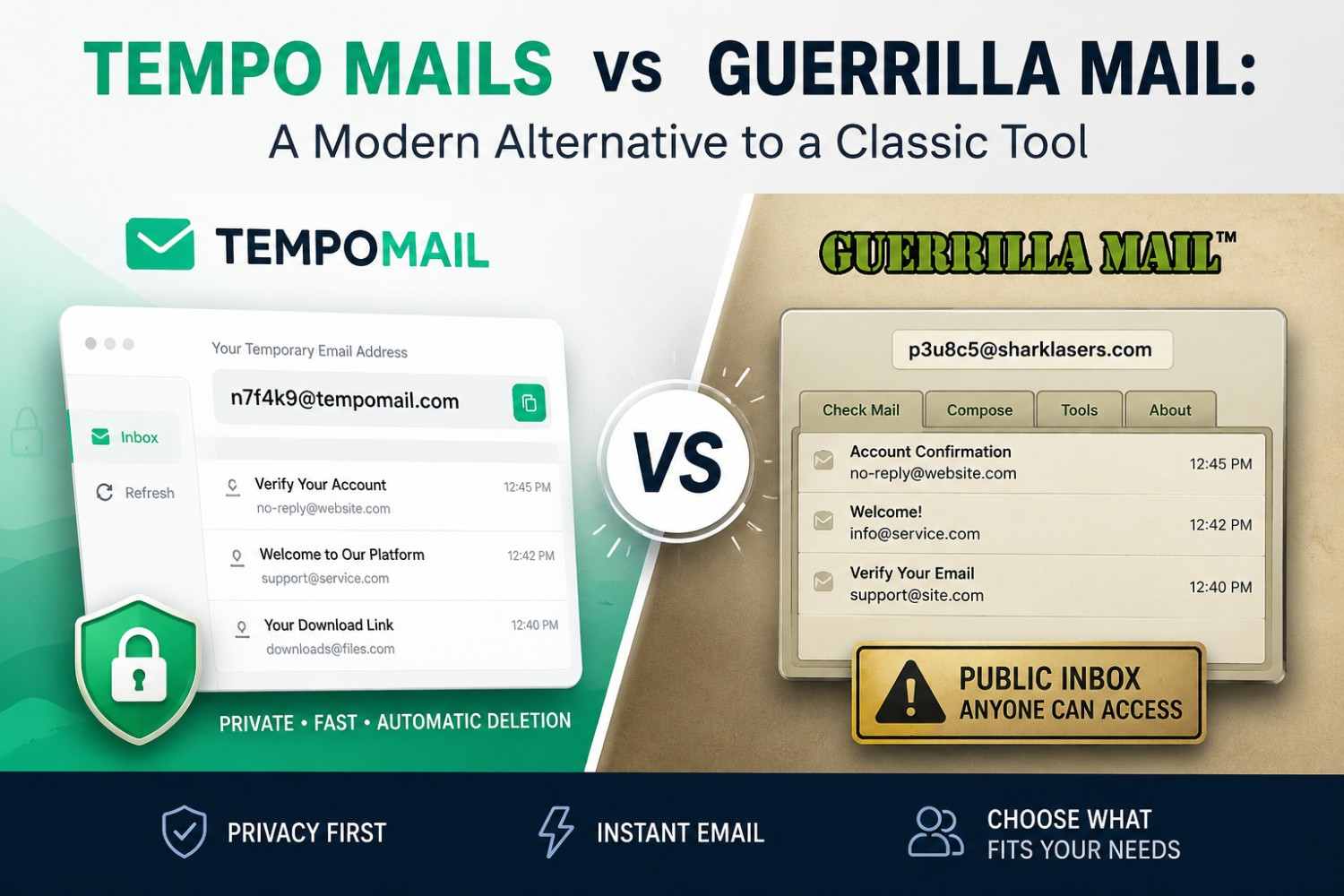
Guerrilla Mail inboxes are publicly accessible to anyone who knows the address. Tempomail sessions are private by design and delete automatically.
Tempomail generates a working address in under three seconds with no setup; Guerrilla Mail requires no setup either, but its public model creates privacy exposure most users do not realise exists.
Both services work as anonymous email platforms for basic verification tasks, but differ significantly in privacy architecture and interface quality.
For developer testing requiring persistent, shareable inboxes, Guerrilla Mail has a specific advantage. For personal privacy, Tempomail is the more appropriate disposable email service and a best Guerrilla Mail alternative for everyday, privacy-first use.
What Is Guerrilla Mail and Who Still Uses It?
Guerrilla Mail is one of the oldest temporary email services available. It generates a disposable address instantly and provides a working inbox. Users can receive messages without registration. The service is free. Before comparing the two tools in detail, it helps to understand what a temp mail is and how the category works as a whole.
Its defining feature is also its main privacy limitation. Guerrilla Mail inboxes remain public. Anyone who knows the email address can open the inbox and read its messages.
Guerrilla Mail provides no session ownership or private access control. Anyone who knows the address can monitor the inbox.
This model was designed for an era when the primary use case was simple spam avoidance during one-off signups. For that narrow purpose, it still works.
For users who care about whether their verification emails, download links, and confirmation codes are visible to anyone else, the public inbox model is a meaningful limitation.
Developer teams and QA professionals who specifically need shareable inboxes where multiple team members can access the same test inbox are the group for whom Guerrilla Mail's public model is genuinely useful rather than a privacy risk.
What Is Tempomail and How Does It Differ?
Tempomail is a session-based disposable email service. An address generates the moment the page loads, the inbox is private to that browser session, and all messages are permanently deleted when the tab closes — the full mechanics are covered in our explainer on how temp mail works.
Only the user can access a Tempomail inbox. After the session ends, the service retains no session record. Tempomail also collects no personal data. The session-end deletion that makes recovery impossible is the same feature that makes the inbox genuinely private during the session.
As a Guerrilla Mail alternative, Tempomail addresses the core privacy limitation of the older service while maintaining the same instant, no-registration experience. The tradeoff is that inbox sharing and recovery after session closure are not supported by design.
Feature Comparison
| Feature | Tempomail | Guerrilla Mail |
| Address generation speed | Under 3 seconds | Under 3 seconds |
| Registration required | No | No |
| Inbox privacy | Private session only | Public; anyone can access |
| Session-end deletion | Yes, automatic | No, inbox persists |
| Inbox sharing | No | Yes |
| Outgoing email | No | Yes |
| Custom address | No | Yes |
| Mobile interface | Responsive | Basic |
| Domain rotation | Yes | Limited |
| Attachment support | Standard | Standard |
| Cost | Free | Free |
| Best for | Personal privacy | Developer testing |
Attachment handling is often a deciding factor too — see whether a temporary email can receive attachments before relying on either service for file-based signups or downloads.
Where Tempomail Outperforms Guerrilla Mail
Private inbox access
The most significant difference is inbox privacy. A Guerrilla Mail address can be opened by any person who visits the site and types the address. For personal verification emails, download links, and account confirmation codes, this creates real exposure. Tempomail's session model ensures that only the person who opened the session can see what arrives.
Cleaner interface
Guerrilla Mail's interface reflects its age. The layout is functional but cluttered compared to modern disposable email services. Tempomail loads with an address already displayed and a clean inbox; no navigation required, no options to configure before using it.
Automatic deletion
Guerrilla Mail inboxes persist after use. Messages remain accessible indefinitely unless manually deleted. Tempomail's session-end deletion means no residual data remains after the session closes. For users who want a clean, traceless session, automatic deletion is the more appropriate behaviour.
Domain rotation
Tempomail maintains a rotating pool of domains, which improves compatibility with platforms that screen for known disposable email providers. Guerrilla Mail uses a fixed set of well-known domains that are more frequently blocked on platforms that filter temporary email providers. For a closer look at this issue, see why some websites block temp mail domains.
Where Guerrilla Mail Has the Edge
Outgoing email
Guerrilla Mail allows users to send emails from a disposable address, not just receive them. Tempomail is receive-only. For use cases requiring anonymous outgoing communication, Guerrilla Mail is one of the few free temporary email providers that supports this.
Custom address selection
Guerrilla Mail allows users to choose a specific username within its domains. Tempomail generates a random address. For situations where a predictable, memorable address is useful, particularly in developer testing, this is a genuine advantage.
Persistent shareable inboxes
Teams testing application email flows sometimes need multiple people to access the same inbox simultaneously. Guerrilla Mail's public model supports this directly. Tempomail does not offer shared inbox access. Developers building automated signup or QA flows may also want to look at temp mail for developers and API access as a more scalable option.
How to Use Tempomail as Your Guerrilla Mail Alternative
Step 1: Open Tempomail
Go to www.tempomail.com. An address appears automatically on the page. No input required. Copy the address displayed.
Step 2: Use the address for your signup or verification
Open the platform or service requiring an email address. Paste your Tempomail address into the email field. Submit the form.
Step 3: Return to Tempomail for the incoming email
Switch back to the Tempomail tab. The verification or confirmation email usually arrives within 30 to 60 seconds. The inbox refreshes automatically, so manual reloading is unnecessary.
Step 4: Complete the verification step
Click the confirmation link or copy the verification code from the Tempomail inbox. Then return to the platform and complete registration or access.
Step 5: Save anything you need before closing
If the email contains a download link, access code, or important content, save it before closing Tempomail. Closing the tab permanently deletes the inbox and its messages. Because closed sessions can't be reopened, it helps to understand your options for temp mail account recovery beforehand.
Step 6: Close the tab when done
Close the Tempomail tab. The session ends. All messages are deleted permanently. The platform's follow-up emails have no active inbox to reach.
Privacy Architecture: Why the Difference Matters
Both services offer anonymous email platforms, but their privacy models differ significantly. These differences matter for practical use cases.
Guerrilla Mail keeps inboxes accessible for longer and makes them public. Anyone who knows the address can access sensitive links, codes, or other messages before the user clears the inbox.
Many users choose obvious or predictable Guerrilla Mail addresses. Others may guess these addresses and access the inbox. Because both tools sit in a legal grey area on some platforms, it's worth understanding whether using a temporary email is illegal before relying on either service.
Tempomail's random address generation and session-based private access mean that the inbox cannot be guessed, accessed by third parties, or retrieved after the session ends.
For users who are using disposable email because they care about privacy, Tempomail's model provides actual privacy rather than just inbox isolation.
Which Service Fits Which Use Case
Choosing the right temporary email alternative often comes down to whether privacy or persistence matters more for the task at hand. If you're also weighing phone-based verification, our comparison of disposable email vs a virtual phone number breaks down the tradeoffs.
Use Tempomail when:
You want a private inbox that no one else can access, you are registering on consumer platforms and want no residual data, you need fast mobile-compatible access, or your primary goal is preventing the real inbox from receiving marketing contact.
Use Guerrilla Mail when:
Your team needs shared access to a test inbox, you need to send an outgoing email from a disposable address, you want a custom predictable address for a specific developer testing workflow, or you need the inbox to persist beyond a single browser session.
Both services work as disposable email services for basic verification. The choice depends on whether privacy or persistence is the higher priority for the specific task.
Alternatives Worth Knowing
10 Minute Mail — session-based with a fixed 10-minute timer. Good for rapid single-use verification. No persistence after the timer. Read our full 10 Minute Mail vs Temp Mail comparison for a closer look.
Mailinator — public inbox model similar to Guerrilla Mail. Well-known in developer testing communities. Heavily blocked by consumer platforms due to its public profile.
YOPmail — inboxes persist for eight days and are publicly accessible. Useful for longer-term test scenarios where persistence across sessions is needed.
SimpleLogin — permanent forwarding alias rather than a disposable inbox. Better for long-term privacy than any temporary inbox service. For a deeper breakdown of how these approaches compare, see our guide on temp mail vs email alias vs masked email.
(FAQs)
1. Can anyone read my Tempomail inbox like they can with Guerrilla Mail?
No. Tempomail keeps inboxes private within the browser session that creates them. Guerrilla Mail keeps inboxes public. Anyone who knows the address can open and read the messages.
2. Does Tempomail let me send emails as Guerrilla Mail does?
No. Tempomail is a receive-only service. Guerrilla Mail supports outgoing email from a disposable address, which is one of its specific remaining advantages for certain use cases.
3. Which service is harder for platforms to detect and block?
Tempomail's domain rotation gives it an advantage over Guerrilla Mail's fixed, well-known domains, which are frequently blocked on consumer platforms that filter disposable email services.
4. Can I choose my own address on Tempomail?
No. Tempomail generates a random address automatically. Guerrilla Mail allows custom username selection within its available domains.
5. What happens to my Guerrilla Mail inbox after I stop using it?
The inbox persists and remains publicly accessible until manually cleared. Messages sent to that address continue to arrive and are readable by anyone who knows the address.
6. Is Tempomail free like Guerrilla Mail?
Yes. Both services are completely free. No registration, payment, or subscription is required for basic temporary inbox use.
7. Which service works better on mobile?
Tempomail has a more responsive mobile interface. Guerrilla Mail's interface functions on mobile but was not designed with mobile-first use in mind.
8. Can I use both services for different purposes?
Yes. Tempomail suits privacy-sensitive personal signups. Guerrilla Mail can suit developer testing when shared inbox access matters. This approach matches each service to its practical strengths.
Conclusion
Guerrilla Mail became a recognised temporary email provider through its early launch, free access, and reliable service. For developer testing scenarios where shared inbox access and outgoing email matter, it retains specific advantages no newer service has fully replaced.
For personal privacy use, protecting a real inbox from marketing, completing platform verifications without permanent data exposure, and ensuring no residual information remains after a session, Tempomail is the more appropriate Guerrilla Mail alternative.
The session-based private inbox model is simply better aligned with what most individual users actually need from a disposable email service in 2026.
Author Expertise
The Tempomail editorial team writes and reviews this content and regularly tests disposable email services, temporary inbox platforms, and anonymous email tools. The team evaluates use cases from personal privacy to developer testing. Content is updated to reflect current service behaviour and feature availability.
This comparison is based on hands-on testing of both services' signup flows, inbox behaviour, and mobile interfaces conducted in 2026, with the team drawing on several years of combined experience in email privacy and anti-spam tooling.
Related Source:
Temp Mail vs Email Alias vs Masked Email: What's the Difference
Disposable Email vs Virtual Phone Number: Which Verification Method Is Better?